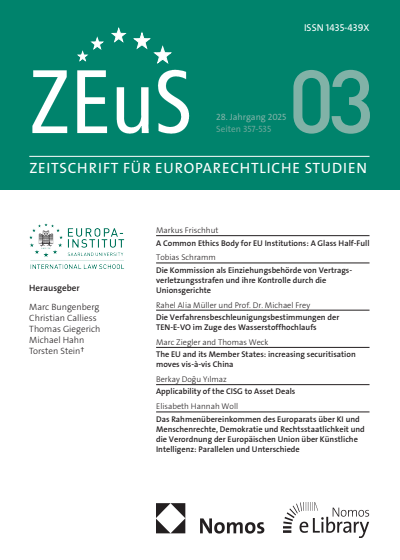
The Zeitschrift für Europarechtliche Studien (ZEuS) is published by the Europa-Institut, law department, of Saarland University since 1998. The concept of ZEuS is a wide one: the journal addresses current aspects and fundamental problems connected with European Integration, European law and International law. Consisting of articles especially in German and English which commentate on current developments in the law, ZEuS offers an ideal forum for contributors of both academic and professional backgrounds. Moreover, ZEuS makes a conscious effort to provide young academics and students with the opportunity to have their work published. Finally, all speeches held at the Europa-Institut are published in ZEuS. Website: www.zeus.nomos.de
While Torsten Stein’s great merits for the Deutsche Vereinigung für Internatioales Recht (DVIR), for which he served as Secretary-General (1993–2006) and President (2006–2016) as well as his merits for the International Law Association, for...
Also from a European perspective, 24 February 2022 marked a turning point. In view of global challenges, it will be essential for the European Union in the future to achieve better control of essential policy areas through a stronger separation of...
The Achmea decision of the European Court of Justice (ECJ) triggered case law and developments which caused a profound impact on the system of investment protection within the European Union. Ostensibly, it deals with issues of jurisdiction but at...
The French Cour de cassation recently had the opportunity to rule on whether the Unidroit Principles can be chosen as the “law” applicable to a contract before state courts. In its judgment of November 16, 2022, the Cour de cassation reaffirmed...
The American Inflation Reduction Act has caused a stir in the economic world. This expression of a new American industrial policy is attracting investment, which is why fears of de-industrialisation are spreading on the European side. This article...
In the evolving context of European Union public law, mutual trust has risen as a pivotal structural principle, anchoring the horizontal relationship among EU Member States, particularly in areas falling outside the scope of application of EU law....
On the UN as well as the European level, the concepts of peace and security have been broadened. Negative peace has been extended to positive peace and security from inter-State security against military and hybrid attacks to inter- and intra-State...
The Russian Federation's war of aggression against Ukraine marks a dramatic turning point for the European security order; it strikes at the core of Europe's ability to act as a global political actor, its strategic autonomy, and its identity as a...
This article examines the question whether judicial persecution of the Russian aggression against Ukraine is feasible and which tribunal might be competent. In this context, a distinction has to be drawn between individual criminal responsibility...
Is the right of self-defence (Art. 51 UN Charter), in equivalence to the prohibition of the use of force (Art. 2 No. 4 UN Charter), limited to forcible measures of counter-defence or can it also justify non-forcible measures (e.g. suspension of...
Force majeure is a recognized excuse from performance of contractual obligations in national legal systems and in the UN Convention on Contracts for the International Sale of Goods (CISG), as well as a regular component of international...