The purpose of The Journal of European Integration History is to encourage the analysis and understanding of different aspects of European integration, especially since 1945, in as wide a perspective as possible. The Journal publishes the conclusions of research on diplomatic, military, economic, technological, social and cultural aspects of integration. Numbers devoted to single themes as well as to diverse subjects are published in English, French or German. Each number includes reviews of important, relevant publications. Website: www.zgei.nomos.de
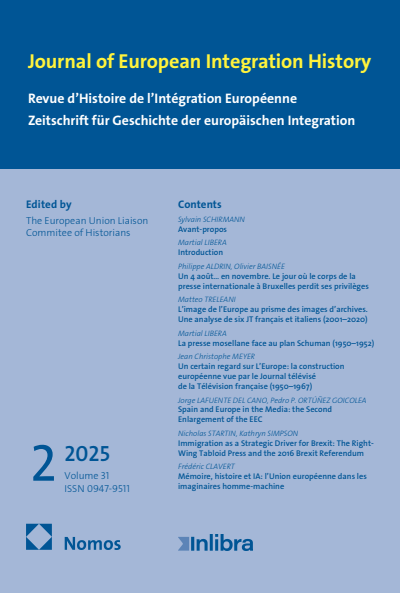
This article analyses an event – the end, in 1999, of a relational system between the European Commission and the international press corps in Brussels – from a configurational perspective. Until then, this system was articulated around three...
Through the lens of the reuse of archival footage, the ANR CROBORA project maps the visual representation of Europe in French and Italian media from 2001 to 2020. The collection of reprises was carried out in the evening newscasts of six national...
This article analyses how the Schuman Plan, with its European scope, was received by the regional press in the Moselle department, where the impact of the coal and steel pool was particularly high and whose proponent, Robert Schuman, was one of the...
Dealing with the evolution of television news programs about Europe in France from 1950 to 1967, our article unavoidably focuses on the TV coverage of the first significant milestones of European construction. But it does not ignore more modest,...
In the years of the transition to democracy, Europe and the EEC, as synonyms for democracy, were a common image in the Spanish media. The long process of Spain’s accession, however, also led to the appearance of some less friendly images,...
This paper analyses the Right-Wing British Tabloid Press’s (RWBTP) influence on the outcome of the 2016 UK referendum on EU membership. Focusing on The Sun, The Daily Mail, and The Daily Express, it examines their ‘agenda setting’ role both...
This article examines the visions of the historical past embedded in generative artificial intelligence systems, using the European Union as a case study. It considers user queries and generated artifacts as primary sources revealing historical...