, to see if you have full access to this publication.
Monograph No access
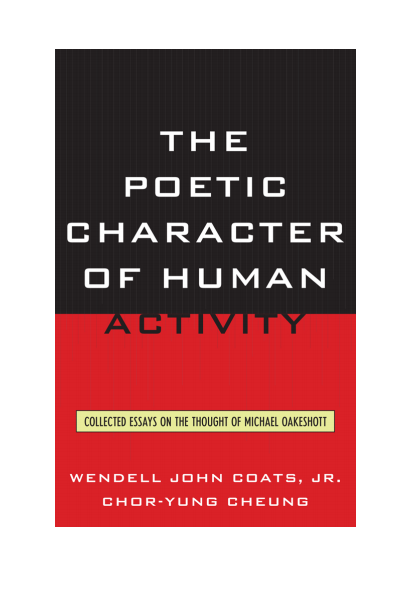
The Poetic Character of Human Activity
Collected Essays on the Thought of Michael Oakeshott
Authors:
|
Publisher:
2012
Summary
The Poetic Character of Human Activity is a collection of essays by two Oakeshott scholars, most of which explores the meaning of Oakeshott’s pregnant phrase, “the poetic character of human activity” by comparing and contrasting this idea with similar and opposing ones, in particular those of the Taoist thinker, Zhuangzi (Chuang Tzu), and his Western interpreter, A.C. Graham. Oakeshott’s deep appreciation of the poetic and non-instrumental character of human activity led him to develop an interest in the works of Zhuangzi and Confucius. Comparison of shared themes between Oakeshott and these two Chinese thinkers facilitates appreciation of his elegant analytic style and his resort to use of metaphors and story-telling when conveying some of his most profound insights. The collection also contains essays contrasting Oakeshott’s idea of the “creative” in human experience with views of, among others, Plato, Leo Strauss and Eric Voegelin.
Oakeshott used the phrase “the poetic character of human activity” (arguably the animating center of his entire thought), to refer to the “creative” character of human experiential reality, that is, to the fact that the form (the how) and content (the what) of all human experience and activity arise simultaneously and fluidly, and can be separated only at the expense of theoretical coherence and practical skill. The various essays in this collection explore the meaning of this claim, and its ramifications for the proper role of critical intellect in especially philosophy, morality, learning, and governance. There is also some brief contrast of Oakeshott with John Rawls, Alasdair MacIntyre, Charles Taylor, and Quentin Skinner.
Search publication
Bibliographic data
Edition
1/2012
Copyright Year
2012
ISBN-Print
978-0-7391-7161-5
ISBN-Online
978-0-7391-7162-2
Publisher
Lexington, Lanham
Language
English
Pages
140
Product Type
Monograph
Table of contents
ChapterPages
Contents No access
Acknowledgements No access
Introduction No access
Chapter One: Michael Oakeshott and the Poetic Character of Human Activity No access Pages 1 - 10
Chapter Two: Practical Implications of Oakeshott’s Poetic Conception of Human Experience No access Pages 11 - 18
Chapter Three: Skepticism, Poetic Imagination, and the Art of Non-Instrumentality: Oakeshott and Zhuangzi No access Pages 19 - 40
Chapter Four: Some Correspondences between Michael Oakeshott’s Critique of Rationalism and A.C. Graham’s Account of “Spontaneity” vs. “Reason” No access Pages 41 - 56
Chapter Five: Learning and Conversation: Oakeshott and Confucius No access Pages 57 - 78
Chapter Six: Michael Oakeshott and Contemporary Political Philosophy: An Interpretation No access Pages 79 - 98
Chapter Seven: “Theory and Practice” in Oakeshott, Strauss, and Vöegelin No access Pages 99 - 108
Chapter Eight: Three Views of Hobbes’ Leviathan—Strauss, Oakeshott, Vöegelin No access Pages 109 - 116
Chapter Nine: The Cave, The Tower of Babel, and Civil Conversation: Metaphors and the Philosophical and Political Thought of Oakeshott No access Pages 117 - 138