, to see if you have full access to this publication.
Monograph No access
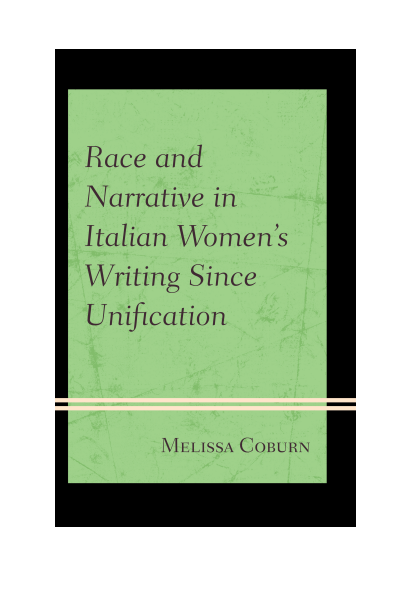
Race and Narrative in Italian Women's Writing since Unification
Authors:
Publisher:
2013
Summary
Race as Narrative in Italian Women's Writing Since Unification explores racist ideas and critiques of racism in four long narratives by female authors Grazia Deledda, Matilde Serao, Natalia Ginzburg, and Gabriella Ghermandi, who wrote in Italy after national unification. Starting from the premise that race is a political and socio-historical construction, Melissa Coburn makes the argument that race is also a narrative construction. This is true in that many narratives have contributed to the historical construction of the idea of race; it is also true in that the concept of race metaphorically reflects certain formal qualities of narration. Coburn demonstrates that at least four sets of qualities are common among narratives and central to the development of race discourse: intertextuality; the processes of characterization, plot, and tropes; the tension between the projections of individual, group, and universal identities; and the processes of identification and otherness. These four sets of qualities become organizing principles of the four sequential chapters, paralleling a sequential focus on the four different narrative authors. The juxtaposition of these close, contextualized readings demonstrates salient continuities and discontinuities within race discourse over the period examined, revealing subtleties in the historical record overlooked by previous studies.
Keywords
Search publication
Bibliographic data
Edition
1/2013
Copyright Year
2013
ISBN-Print
978-1-61147-599-9
ISBN-Online
978-1-61147-600-2
Publisher
Lexington, Lanham
Language
English
Pages
127
Product Type
Monograph
Table of contents
ChapterPages
Contents No access
Acknowledgments No access
Introduction—Race as Narration No access
Chapter One: Grazia Deledda’s Narrative Negotiations with the Racialization of Sardinian Character No access Pages 1 - 36
Chapter Two: The Tropics of Race in the Land of Cockayne No access Pages 37 - 66
Chapter Three: The Irreducible Individual and the Ethics of Writing in Natalia Ginzburg’s Lessico famigliare No access Pages 67 - 88
Chapter Four: “We Are Stories of Stories in History” No access Pages 89 - 104
Conclusion—The Persistent Past No access Pages 105 - 112