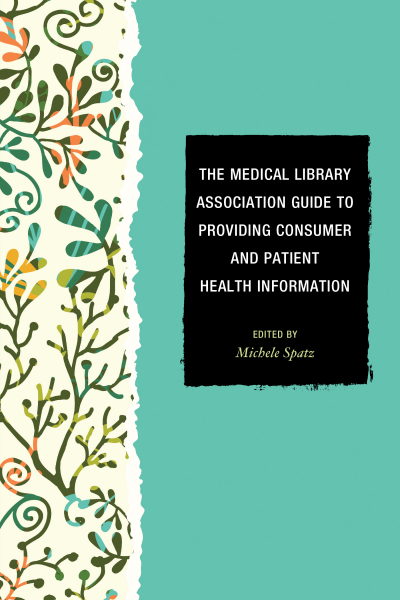
The Medical Library Association Guide to Providing Consumer and Patient Health Information
- Authors:
- Publisher:
- 2014
Summary
Comprised of fifteen chapters written by experienced consumer health librarians, The Medical Library Association Guide to Providing Consumer and Patient Health Information is designed for library and information science graduate students as well as librarians new to health and medical librarianship, regardless of library setting. It is comprehensive in scope, covering all aspects of consumer and patient health and medical information from their humble, grassroots beginnings to the ever-evolving applications of new technology and social media. In between, the mundane aspects of health and medical librarianship, such as needs assessment, costs, budgeting and funding, and staffing are discussed. Adding richness to this discussion are the coverage of more sensitive topics such as patient-friendly technology, ethical issues in providing consumer and patient health information, meeting the needs of diverse populations, and responding to individuals from various cultural backgrounds. No comprehensive picture of consumer and patient health librarianship would be complete without addressing the critical importance of marketing and strategic partnerships; such discussions round out this invaluable guide.
Patients today must be knowledgeable enough to participate in their health and well-being. Shorter hospital stays, changing reimbursement patterns and the gradual shift towards focusing on proactively maintaining health and managing disease require patients to be informed and actively engaged. Education, information and understanding are important components of actively-engaged patients. Correspondingly, in today’s e-world, there is a glut of information resources available through the Internet – from YouTube videos to Googling to blogs and Twitter feeds. What is lacking in these information-rich times is the relevance of meaning and context for those who ask, “Does this health and medical information apply to me and my unique clinical picture?” or “How do I use this information?” As knowledge navigators, information technology wizards and content experts, librarians offer focused responses to individuals’ specific and highly personal health and medical information queries. In a new healthcare world order of optimizing health and minimizing hospitalizations, such a service is invaluable.
Sadly, there still exists in our highly networked and technological age an information gap for those who struggle in obtaining meaningful health or medical information. These individuals may be foreign-born, non-English speaking, poor, rural, aged or semi-literate. Whatever their status, librarians must have the wherewith-all to find germane resources and also help create responsive mechanisms to bridge that health information gap for vulnerable citizens. The Medical Library Association Guide to Providing Consumer and Patient Health Information will guide you on the road to providing that response.
Search publication
Bibliographic data
- Edition
- 1/2014
- Copyright Year
- 2014
- ISBN-Print
- 978-1-4422-3070-5
- ISBN-Online
- 978-1-4422-2571-8
- Publisher
- Rowman & Littlefield, Lanham
- Language
- English
- Pages
- 224
- Product Type
- Monograph
Table of contents
- Contents No access
- Figures and Tables No access
- Preface No access
- Acknowledgments No access
- Chapter 1. History of Consumer and Patient Health Librarianship No access Pages 1 - 10
- Chapter 2. Where to Start? Needs Assessment No access Pages 11 - 26
- Chapter 3. Strategic Planning for Success No access Pages 27 - 36
- Chapter 4. Bricks and Mortar: Costs, Budgeting, and Funding No access Pages 37 - 56
- Chapter 5. Consumer- and Patient-Friendly Technology: Today and Tomorrow No access Pages 57 - 76
- Chapter 6. Prized Assets: Staff No access Pages 77 - 96
- Chapter 7. Health Reference Service No access Pages 97 - 120
- Chapter 8. Ethical Issues in Providing Consumer and Patient Health Information No access Pages 121 - 128
- Chapter 9. Social Media for Health Consumers and Patients No access Pages 129 - 150
- Chapter 10. Meeting the Needs of Diverse Groups: Children, Teens, LGBT, and Patients with Low Literacy No access Pages 151 - 172
- Chapter 11. Cultural Sensitivity and Health Information Resources and Services No access Pages 173 - 184
- Chapter 12. Marketing Health Library Services to Patients and Consumers No access Pages 185 - 198
- Chapter 13. Strategic Partnerships No access Pages 199 - 210
- Index No access Pages 211 - 216
- About the Editor No access Pages 217 - 218
- About the Contributors No access Pages 219 - 224