, to see if you have full access to this publication.
Monograph No access
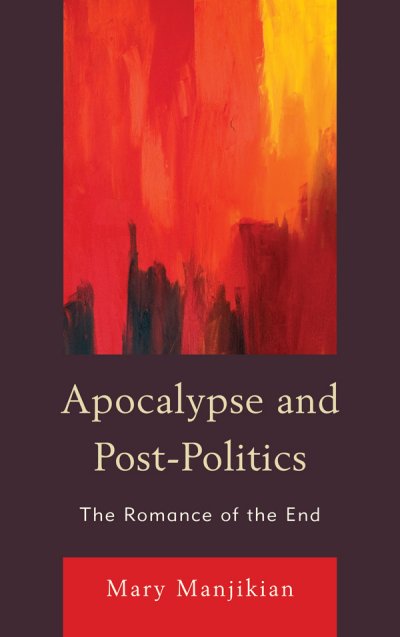
Apocalypse and Post-Politics
The Romance of the End
Authors:
Publisher:
2012
Summary
Mary Manjikian’s Apocalypse and Post-Politics: The Romance of the End advances the thesis that only those who feel the most safe and whose lives are least precarious can engage in the sort of storytelling which envisions erasing civilization. Apocalypse-themed novels of contemporary America and historic Britain, then, are affirmed as a creative luxury of development. Manjikian examines a number of such novels using the lens of an international relations theorist, identifying faults in the logic of the American exceptionalists who would argue that America is uniquely endowed with resources and a place in the world, both of which make continued growth and expansion simultaneously desirable and inevitable. In contrast, Manjikian shows, apocalyptic narratives explore America as merely one nation among many, whose trajectory is neither unique nor destined for success. Apocalypse and Post-Politics ultimately argues that the apocalyptic narrative provides both a counterpoint and a corrective to the narrative of exceptionalism.
Apocalyptic concepts provide a way for contemporary Americans to view the international system from below: from the perspective of those who are powerless rather than those who are powerful. This sort of theorizing is also useful for intelligence analysts who question how it all will end, and whether America’s decline can be predicted or prevented.
Search publication
Bibliographic data
Edition
1/2012
Copyright Year
2012
ISBN-Print
978-0-7391-6622-2
ISBN-Online
978-0-7391-6624-6
Publisher
Lexington, Lanham
Language
English
Pages
338
Product Type
Monograph
Table of contents
ChapterPages
CONTENTS No access
INTRODUCTION No access Pages 1 - 38
CHAPTER 1. APOCALYPSE AND NATIONAL SECURITY No access
CHAPTER 2. CATASTROPHE NOVELS AND PREDICTION No access
CHAPTER 3. UTOPIAN NOVELS AND FORECASTING No access
CHAPTER 4. THE ROMANCE OF THE WORLD’S END No access
CHAPTER 5. APOCALYPSE AND EPISTEMOLOGY No access
CHAPTER 6. EXCEPTIONALITY AND APOCALYPSE No access