, to see if you have full access to this publication.
Monograph No access
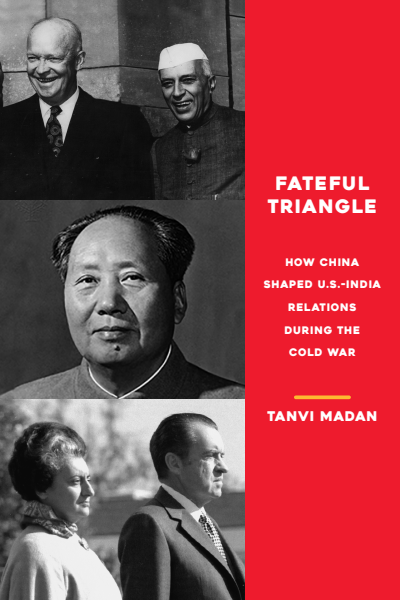
Fateful Triangle
How China Shaped U.S.-India Relations During the Cold War
Authors:
Publisher:
2020
Summary
Taking a long view of the three-party relationship, and its future prospects
In this Asian century, scholars, officials and journalists are increasingly focused on the fate of the rivalry between China and India. They see the U.S. relationships with the two Asian giants as now intertwined, after having followed separate paths during the Cold War.
In Fateful Triangle, Tanvi Madan argues that China's influence on the U.S.-India relationship is neither a recent nor a momentary phenomenon. Drawing on documents from India and the United States, she shows that American and Indian perceptions of and policy toward China significantly shaped U.S.-India relations in three crucial decades, from 1949 to 1979. Fateful Triangle updates our understanding of the diplomatic history of U.S.-India relations, highlighting China's central role in it, reassesses the origins and practice of Indian foreign policy and nonalignment, and provides historical context for the interactions between the three countries.
Madan's assessment of this formative period in the triangular relationship is of more than historic interest. A key question today is whether the United States and India can, or should develop ever-closer ties as a way of countering China's desire to be the dominant power in the broader Asian region. Fateful Triangle argues that history shows such a partnership is neither inevitable nor impossible. A desire to offset China brought the two countries closer together in the past, and could do so again. A look to history, however, also shows that shared perceptions of an external threat from China are necessary, but insufficient, to bring India and the United States into a close and sustained alignment: that requires agreement on the nature and urgency of the threat, as well as how to approach the threat strategically, economically, and ideologically.
With its long view, Fateful Triangle offers insights for both present and future policymakers as they tackle a fateful, and evolving, triangle that has regional and global implications.
Keywords
Search publication
Bibliographic data
Copyright Year
2020
ISBN-Print
978-0-8157-3771-1
ISBN-Online
978-0-8157-3772-8
Publisher
Rowman & Littlefield, Lanham
Language
English
Pages
backcover1
Product Type
Monograph
Table of contents
ChapterPages
Table of Contents No access
Acknowledgments No access
Introduction No access Pages 1 - 12
The Orientation in the Orient (1949-1952) No access
Why So Wary? (1953-1956) No access
The Pandit and the President (1956-1958) No access