, to see if you have full access to this publication.
Monograph No access
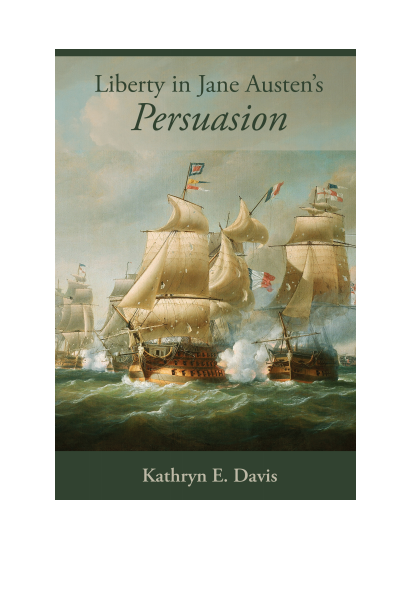
Liberty in Jane Austen's Persuasion
Authors:
Publisher:
2016
Summary
Liberty in Jane Austen’s Persuasion is a meditation on Persuasion as a text in which Jane Austen, writing in the Age of Revolution, enters the conversation of her epoch. Poets, philosophers, theologians and political thinkers of the long eighteenth century, including William Cowper, George Gordon Byron, Samuel Johnson, Hugh Blair, Thomas Sherlock, Edmund Burke, and Charles Pasley, endeavored definitively to determine what it means for a human being to be free. Persuasion is Austen’s elegant, artful and complex addition to this conversation. In this study, Kathryn Davis proposes that Austen's last complete novel offers an apologia for human liberty primarily understood as self-governance. Austen’s characters struggle to attain liberty, not from an oppressive political regime or stifling social conventions, but for a type of excellence that is available to each human being. The novel's presentation of moral virtue has wider cultural significance as a force that shapes both the “little social commonwealth[s]” inhabited by characters of Austen’s own making and, possibly, the identity of the nation whose sovereign read Persuasion.
Keywords
Search publication
Bibliographic data
Edition
1/2016
Copyright Year
2016
ISBN-Print
978-1-61146-227-2
ISBN-Online
978-1-61146-228-9
Publisher
University Press Copublishing, Lanham
Language
English
Pages
181
Product Type
Monograph
Table of contents
ChapterPages
Contents No access
Acknowledgments No access
Abbreviations No access
Introduction No access Pages 1 - 34
Chapter One: Reading Jane Austen’s Readings on Liberty No access Pages 35 - 66
Chapter Two: “Though alive, not at liberty” No access Pages 67 - 88
Chapter Three: The Ultimate Dichotomy No access Pages 89 - 114
Chapter Four: Toward the Free Movement of the Soul No access Pages 115 - 142
Chapter Five: The Limits of Human Liberty No access Pages 143 - 160