The European Criminal Law Review (EuCLR) is a journal dedicated to the development of European Criminal Law and the cooperation in criminal matters within the European Union. In these areas the Lisbon Treaty has supposedly brought about the most important changes and also the greatest challenges for the future. It is the journal’s ambition to provide a primary forum for comprehensive discussion and critical analysis of all questions arising in relation to European Criminal Law. It will include articles and relevant material on topics such as - the harmonisation of national criminal law in consideration of European legal instruments, - the implementation of the principle of mutual recognition in the area of cooperation in criminal matters and the development towards the creation of a European Public Prosecutor, - the emergence of a balanced European Criminal Policy based on fundamental rights, freedom and democracy with particular reference to the Charter of Fundamental Rights of the European Union and the European Convention on Human Rights.
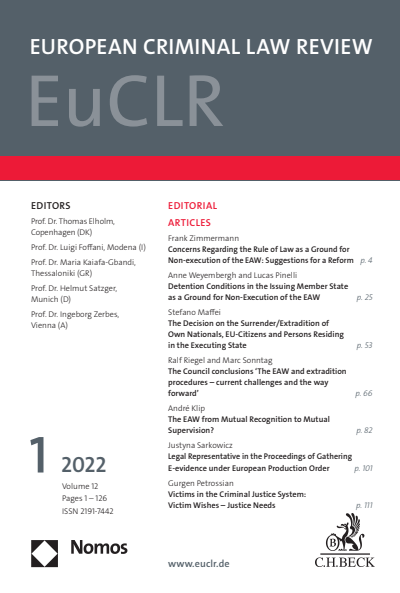
The judicial reforms in Poland, which are harshly and continuously criticised as undermining the independence of Polish courts, have brought the principle of mutual recognition and the European arrest warrant (EAW) to its limits. These unprecedented...
In its Aranyosi and Căldăraru judgment, the Court of Justice of the EU (CJEU) recognized explicitly for the first time the possibility for executing judicial authorities to deny the execution of European Arrest Warrants (EAWs) when there is a...
The present report was drafted for the IV Working Group that was engaged on the very current topic of the decision on the surrender/extradition to third (non-EU) States of own nationals, EU citizens and persons residing in the execution State. This...
On 1 December 2020, the Council of the European Union has adopted conclusions on ‘the European arrest warrant and extradition procedures - current challenges and the way forward’. They represent the Council’s response to the ongoing debate on...
Mutual recognition is the rule which guides cooperation in criminal matters within the European Union. Whilst intended to facilitate and make cooperation faster, the Court of Justice has done exactly the opposite in its case law. It has raised the...
The subject of this article is cross-border electronic evidence gathering. First, the process of recognition and execution of the European Production Order will be examined, followed by the process of non-execution of the European Production Order...
The participation system of the victims is a paradigm shift in traditional criminal justice. The victims did not always have the opportunity to actively participate in criminal cases. Human rights movements in late 1980s’ resulted in victims’...