, to see if you have full access to this publication.
Monograph No access
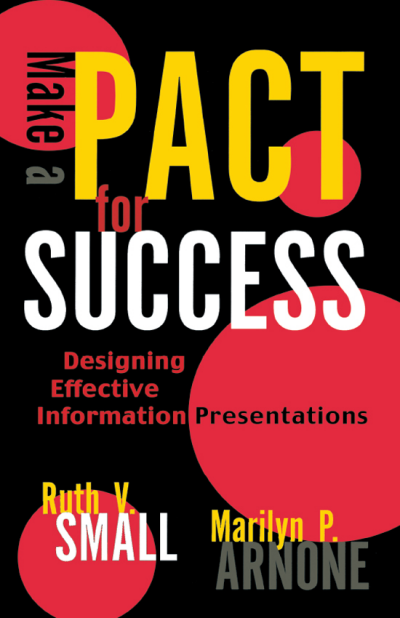
Make a PACT for Success
Designing Effective Information Presentations
Authors:
|
Publisher:
2002
Summary
At one time taking a public speaking course was sufficient to provide the skills necessary for effective presentations. Now, the Information Age makes the use of information technology mandatory, so that presentations are delivered not only through speech, but also using electronic communications, audio and video media, print materials. To succeed in today's world, individuals must understand the characteristics of information, as well as people's information needs, not just how to present information.
Small and Arnone have developed an extraordinarily successful model for professionals and academics—the PACT model (Purpose, Audience, Content, and Technique), which makes it easy to focus on the research, selection, organization, and delivery of information. Whether the assignment is public speaking, technical writing, or web designing, the PACT model can be used to integrate the common principles of information science and communication theory. This book introduces the reader to three crucial models for the successful design, development, delivery, and evaluation of information presentations.
An ideal tool for professionals, a valuable ally for communications instructors, and a necessary resource for college students.
Search publication
Bibliographic data
Edition
1/2002
Copyright Year
2002
ISBN-Print
978-0-8108-4347-9
ISBN-Online
978-1-4616-6950-0
Publisher
Rowman & Littlefield, Lanham
Language
English
Pages
243
Product Type
Monograph
Table of contents
ChapterPages
Table of Contents No access
Preface No access
Acknowledgments No access
Chapter 1: Getting Started No access Pages 1 - 12
Chapter 2: P is for Purpose No access Pages 13 - 30
Chapter 3: A is for Audience No access Pages 31 - 50
Chapter 4: C is for Content: Organization No access Pages 51 - 66
Chapter 5: C is for Content: Selection No access Pages 67 - 96
Chapter 6: C is for Content: Research No access Pages 97 - 112
Chapter 7: T is for Technique: Written Presentations No access Pages 113 - 142
Chapter 8: T is for Technique: Oral Presentations No access Pages 143 - 168
Chapter 9: T is for Technique: Multimedia Presentations No access Pages 169 - 194
Chapter 10: Evaluating your Presentation No access Pages 195 - 216