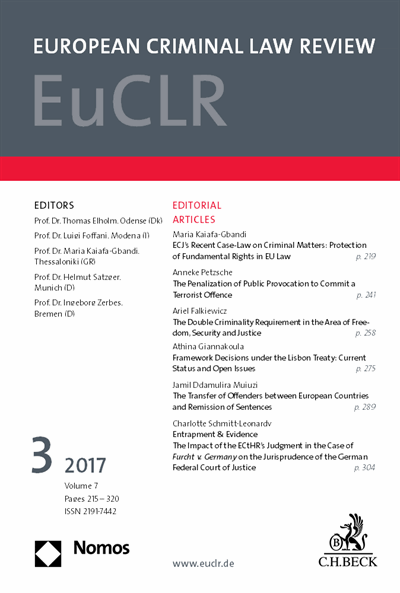
The European Criminal Law Review (EuCLR) is a journal dedicated to the development of European Criminal Law and the cooperation in criminal matters within the European Union. In these areas the Lisbon Treaty has supposedly brought about the most important changes and also the greatest challenges for the future.It is the journal’s ambition to provide a primary forum for comprehensive discussion and critical analysis of all questions arising in relation to European Criminal Law. It will include articles and relevant material on topics such as- the harmonisation of national criminal law in consideration of European legal instruments,- the implementation of the principle of mutual recognition in the area of cooperation in criminal matters and the development towards the creation of a European Public Prosecutor,- the emergence of a balanced European Criminal Policy based on fundamental rights, freedom and democracy with particular reference to the Charter of Fundamental Rights of the European Union and the European Convention on Human Rights.
This paper attempts to highlight the main features of ECJ case-law on safeguarding fundamental rights through an overview of the most nodal recent judgments in criminal cases. The objective is to specify their importance to member states’...
In the last decades, the fight against terrorism has (once again) taken centre stage, not only internationally but also on the European level. On both levels, legal counter-measures have targeted specifically terrorist speech. The national...
Considerable limitations of the double criminality requirement in the third pillar instruments were mainly linked with the constitutional principles nullum crimen, nulla poena sine lege. For this reason, researchers did not pay sufficient attention...
It has almost been eight years since the Lisbon Treaty entered into force on 1 December 2009, reshaping the EU’s competence in the field of criminal law and, among other aspects, abolishing the legal instrument of framework decisions. This...
Article 17 of Council Framework Decision 2008/909/JHA of 27 November 2008 on the application of the principle of mutual recognition to judgments in criminal matters imposing custodial sentences or measures involving deprivation of liberty for the...
The issue of police incitement or entrapment has long been the subject of vivid controversies. The central dilemma is a police investigation that legitimately requires the use of undercover agents, informers and/or other covert practices but is not...