, to see if you have full access to this publication.
Monograph No access
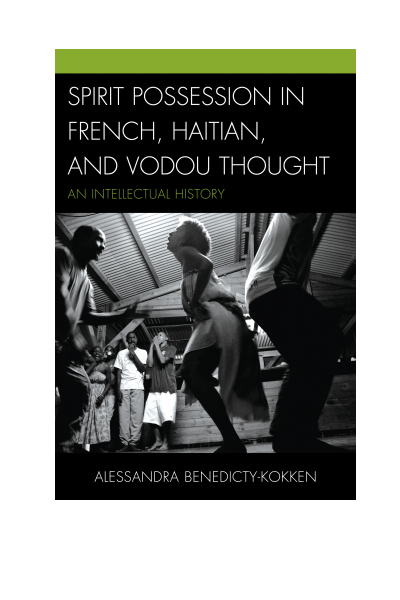
Spirit Possession in French, Haitian, and Vodou Thought
An Intellectual History
Authors:
Publisher:
2014
Summary
This book recuperates the important history that Haitian thought around Vodou possession has had in French critical theory. The author takes the period of the 1930s and ‘40s, as the centerfold of a more complex network of relations that places Haiti as one of the pivots of a more expanded intellectual conversation around “possession,” which links anthropology, literature, psychoanalysis, human rights, and visual arts in France, Haiti, and the United States. Benedicty argues that Haiti as the anthropological other serves as a kick-starter to an entire French-based theoretical apparatus (Breton, Leiris, Bataille, de Certeau, Foucault, and Butler), but once up and running, its role as catalyst is forgotten and the multiple iterations of the anthropological other are cast back into the net of Michel-Rolph Trouillot’s “Savage slot.”
The book offers the reader unfamiliar with Haiti a comprehensive interdisciplinary study of twentieth and early twenty-first century Haitian thought, including a detailed timeline of important moments in the intellectual history that connects Haiti to France and the United States.
The first part of the book is about global dispossessions in the first decades of the twentieth century; the second part points to how the narratives of ‘Haiti’ are intimately linked to a Franco-U.S.-American discursive space, constructed over the course of the twentieth century, a discursive order that has conflated the representation of ‘Haiti’ with an understanding of Vodou primarily as an occult religion, and not as a philosophical system. The third and fourth parts of the book examine how the novels of René Depestre, Jean-Claude Fignolé, and Kettly Mars have revisited the notion of possession since the fall of the Duvalier dictatorships.
Keywords
Search publication
Bibliographic data
Edition
1/2014
Copyright Year
2014
ISBN-Print
978-0-7391-8465-3
ISBN-Online
978-0-7391-8466-0
Publisher
Lexington, Lanham
Language
English
Pages
419
Product Type
Monograph
Table of contents
ChapterPages
Contents No access
Preface No access Pages 1 - 10
Acknowledgments No access Pages 11 - 14
Introduction: Possession, Dispossession, and Self-Possession No access Pages 15 - 2
Chapter One: Hegel and Agamben No access
Chapter Two: States of Exception No access
Chapter Three: The Newest Utopia No access
Chapter Four: Mbembe’s “Unhappiness” and Trouillot’s “Fundamentally New Subjects” No access
Chapter Five: “Unhappiness” as Taboo No access
Chapter Six: Secularizing Possession andFostering Revolution? No access
Chapter Seven: Leiris’s “Lived Theater” No access
Chapter Eight: From Haiti to Brazil, from Herskovits to Métraux No access
Chapter Nine: Verger’s Image in Bataille’sTears of Eros No access
Chapter Ten: Possession, a Threshold to a Biopolitical Order No access
Chapter Eleven: Depestre, the “Autofiction” of the “(Anti)Hero” of “A New World Mediterranean” No access
Chapter Twelve: The West’s Obsession with Defining Art No access
Chapter Thirteen: Between Frankétienne and Glissant No access
Chapter Fourteen: On “Un-Becoming” Racial No access
Chapter Fifteen: Possession as Fluidity: Finding Equilibrium under a Neoliberal Order No access