, to see if you have full access to this publication.
Monograph No access
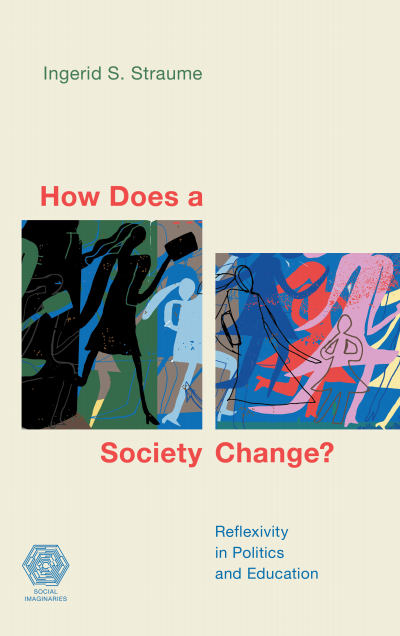
How Does a Society Change?
Reflexivity in Politics and Education
Authors:
Publisher:
2023
Summary
One of the most challenging questions of today concerns how human activities threaten the conditions for our very own existence. With one crisis leading into the next, the need for socio-political change is necessary and desirable, yet so hard to imagine in practice. At the heart of the matter is a deeper crisis of the socio-political imagination.
To understand how a society produces and changes itself, Ingerid S. Straume points to historical and contemporary institutions and the imaginaries they embody, and argues that the key to social creativity is found in the reflexive potential of institutions, especially politics and education. Neoliberal rationality, on its part, has become dominant in many parts of the world, precisely by occulting the socio-political capacity for self-reflection. This occultation takes place in academic theories, policy reforms, technologies, and in individuals’ self-understanding. In response to the planetary eco-crises and the weakening of democratic ideals, a new approach is needed where collectives, not individuals in isolation, become the mode for living well within existing, natural limits.
Inspired by important political thinkers such as Cornelius Castoriadis and Hannah Arendt, How Does a Society Change? develops a theoretical framework to elucidate how politics and education are two interrelated domains wherein a society may openly reflect upon itself. In short, a society that recognizes its capacity to change itself also recognizes the transformative, instituting potential of politics and education.
Keywords
Search publication
Bibliographic data
Edition
1/2023
Copyright Year
2023
ISBN-Print
978-1-78661-152-9
ISBN-Online
978-1-78661-153-6
Publisher
Rowman & Littlefield, Lanham
Language
English
Pages
148
Product Type
Monograph
Table of contents
ChapterPages
Contents No access
Acknowledgements No access
Introduction: Political-Educational Questioning No access Pages 1 - 14
One. The Politics of Education No access Pages 15 - 40
Two. Educational Imaginaries: From Investment to Question No access Pages 41 - 58