, to see if you have full access to this publication.
Monograph No access
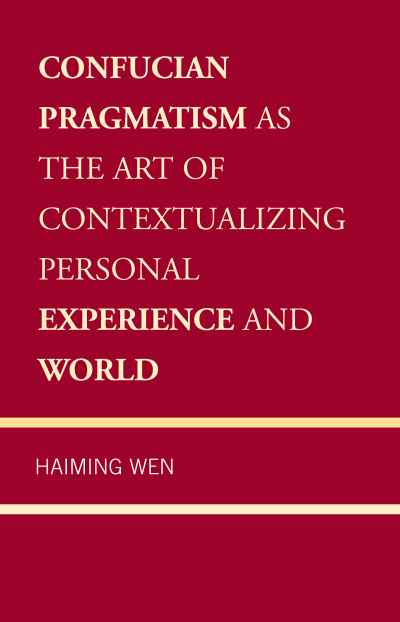
Confucian Pragmatism As the Art of Contextualizing Personal Experience and World
Authors:
Publisher:
2009
Summary
This engaging work of comparative philosophy brings together American pragmatism and Chinese philosophy in a way that generates new interpretations of Chinese philosophy and a fresh perspective on issues in process philosophy. Through an analysis of key terms, Haiming Wen argues that Chinese philosophical terminology is not simply a retrospective language that through a process of stipulation promises us knowledge of an existing world, but is also an open, prospective vocabulary that through productive associations allows philosophers to realize a desired world. Relying on this productive power of Chinese terminology, Wen introduces a new term: 'Confucian pragmatism.' Wen convincingly shows that although there is much that distinguishes American pragmatism from Confucian philosophy, there is enough conceptual overlap to make Confucian pragmatism a viable and exciting field of study.
Search publication
Bibliographic data
Edition
1/2009
Copyright Year
2009
ISBN-Print
978-0-7391-3644-7
ISBN-Online
978-0-7391-3646-1
Publisher
Lexington, Lanham
Language
English
Pages
348
Product Type
Monograph
Table of contents
ChapterPages
Contents No access
Acknowledgements No access
Chapter One The Crisis of Creativity No access Pages 1 - 22
Chapter Two Getting Past the Eclipse of Creativity: Acknowledging the Philosophical Fallacy No access Pages 23 - 60
Chapter Three Intentionality/Meaning (Yi 意) and Confucian Contextual Creativity No access Pages 61 - 94
Chapter Four Feelings (Qing 情) and the Importance of History, Particularity, and Emergence in Context No access Pages 95 - 132
Chapter Five The Contextual Creativity of Key Philosophical Terms No access Pages 133 - 182
Chapter Six Chinese Metaphysical Creativity No access Pages 183 - 230
Chapter Seven Chinese Epistemological Creativity: Thinking-and-Feeling (Mind) and Experience No access Pages 231 - 292
Chapter Eight Confucian Pragmatism as a Post-Modern Comparative Philosophy No access Pages 293 - 326