, to see if you have full access to this publication.
Monograph No access
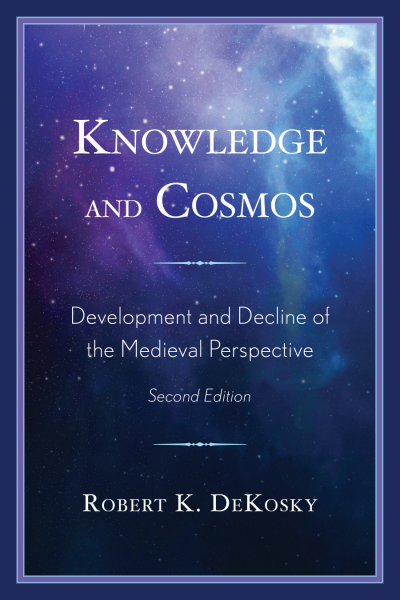
Knowledge and Cosmos
Development and Decline of the Medieval Perspective
Authors:
Publisher:
2023
Summary
In Knowledge and Cosmos: Development and Decline of the Medieval Perspective, 2nd Edition, Robert K. DeKosky focuses on issues in astronomy, cosmology, physics, matter theory, philosophy, and theology vital to the “Copernican Revolution.” This book describes efforts among individuals advocating different world views to fit new ideas compatibly into broad perspectives reflecting four traditional patterns of interpretation: teleological, mechanical, occultist, and mathematico-descriptive. These four modes had guided medieval accounts of heavenly phenomena, material process, and motion.
The teleological explanation, prevalent in Aristotle’s natural philosophy, posited “final causes” (ends or goals toward which objects strove or attempted to become). Ancient classical atomists had emphasized strictly mechanical explanations, invoking direct material contact and collision of moving matter as agents of physical change. Traditions of astrology, magic, and alchemy embraced an occultist pattern of interpretation—citing hidden forces opaque to both sensual detection and rational understanding as explanations of various phenomena. Finally, the mathematico-descriptive approach interpreted natural phenomena according to geometric or arithmetic relationships; unlike the other three, this did not involve causal explanation of a process.
Part I discusses development of the four patterns in the ancient period and their uneasy medieval relationships with each other and with basic Judaeo-Muslim-Christian exigencies of faith. Theory of the heavens follows, including the mathematico-descriptive approach of Ptolemaic astronomy, the teleological and mechanical cosmology of Aristotle, and occultist interpretations of astrologers and magicians. Part I then turns to matter and materiality, discussing differences among the mechanical philosophy of classical atomism, teleological emphases in Aristotle’s material theory, and occultist assumptions of some alchemists. Finally, Part I analyzes conceptions of motion, focusing on Aristotelian interpretations and critical commentaries thereon during the Middle Ages.
Part II relates struggles of leading early-modern figures to adapt new concepts (e.g., Copernicus’ heliocentric astronomy/cosmology, Galileo’s inertial theories of motion, and Kepler’s elliptical planetary orbit) to an allegiance to two or more of the four patterns of interpretation. By this approach, it identifies decreasing dependence on teleological explanation of physical phenomena as crucial to decline of medieval interpretations of those phenomena, followed by rejection of teleology in the natural philosophy of Descartes, and subsequent fruitful confluence of the mechanical, mathematico-descriptive, and occultist patterns in the physics and cosmology of Isaac Newton.
Keywords
Search publication
Bibliographic data
Edition
1/2023
Copyright Year
2023
ISBN-Print
978-0-7618-7400-3
ISBN-Online
978-0-7618-7403-4
Publisher
Hamilton Books, Lanham
Language
English
Pages
508
Product Type
Monograph
Table of contents
ChapterPages
Contents No access
Figures No access
Tables No access
Acknowledgments No access
Preface No access
Abbreviations of Citations in Notes and Bibliography No access
Plato and Aristotle No access
Late Antiquity No access
Islamicate Philosophical Syncretism No access
High Scholasticism and the Universities No access
William of Ockham and the 14th-Century Critique of Human Knowledge No access
Development of Astronomy No access
The Teleological-Mechanical Cosmos of Aristotle and Its Influence on Medieval Natural Philosophy No access
Astrological Causation and the Occultist Interpretation of Heavenly Bodies and Their Influences No access
Classical Atomism No access
Aristotelian Conceptions of Materiality and the Teleological Mode No access
Alchemy No access
Conceptions of Motion No access
Projectile Motion No access
Falling Bodies No access
Emergence of a Kinematic Approach to Motion No access
Copernicus No access
Responses to Copernicus No access
Kepler No access
Galileo and Astronomy No access
Galileo and the Science of Motion No access
The Galilean Approach to Explication of Physical Process No access