, to see if you have full access to this publication.
Book Titles No access

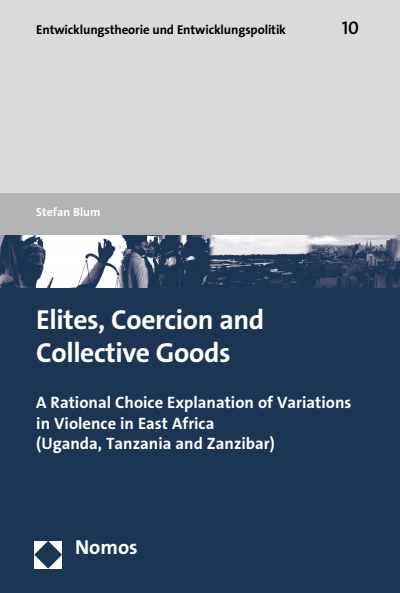
Elites, Coercion and Collective Goods

A Rational Choice Explanation of Variations in Violence in East Africa (Uganda, Tanzania and Zanzibar)
Authors:
Publisher:
 2011

Summary

Kurztext NE:

Dieser Band untersucht die politische Ökonomie von Gewaltkonflikten im post-kolonialen Ostafrika und entwickelt einen gegenüber der bestehenden Literatur abweichenden, Rational Choice-basierten Erklärungsansatz. Im Anschluss werden die zukünftige politische Entwicklung der Region sowie Handlungsoptionen für die internationale Gemeinschaft diskutiert.


Bibliographic data

Copyright year
2011
ISBN-Print
978-3-8329-6014-8
ISBN-Online
978-3-8452-2865-5
Publisher
Nomos, Baden-Baden
Series
Entwicklungstheorie und Entwicklungspolitik
Volume
10
Language
English
Pages
246
Product type
Book Titles

Table of contents

ChapterPages
  1. Titelei/Inhaltsverzeichnis No access Pages 2 - 10
  2. List of Tables and Figures No access Pages 11 - 11
  3. List of Abbreviations and Acronyms No access Pages 12 - 16
  4. Introduction No access Pages 17 - 24
    1. Overview No access Pages 25 - 26
      1. General overview and pre-independence period No access Pages 26 - 30
      2. 1962-1971: Severe conflicts and violence during the first Obote Presidency No access Pages 30 - 33
      3. 1971-1979: Large-scale state repression and general insecurity under Amin No access Pages 33 - 37
      4. 1979-1986: Changing presidents and large-scale civil war No access Pages 37 - 41
      5. 1986-present: Under Museveni, absence of large-scale violence nationally, continuation of violence in northern Uganda No access Pages 41 - 50
      6. Summary No access Pages 50 - 51
      1. General overview and pre-independence period No access Pages 51 - 55
      2. 1961-1967: Consolidation of the state’s political authority and control No access Pages 55 - 56
      3. 1967-1992: Socialist transformation of society, partly through state coercion No access Pages 56 - 59
      4. 1992-present: Largely non-violent conflicts within multi-party system No access Pages 59 - 61
      5. Summary No access Pages 61 - 62
      1. General overview and pre-independence period No access Pages 62 - 67
      2. The 1964 Revolution No access Pages 67 - 67
      3. 1964-1992: State repression in a one-party system No access Pages 67 - 70
      4. 1992-present: Political liberalization and small-scale violence No access Pages 70 - 73
      5. Summary No access Pages 73 - 73
    2. Comparative summary, and selected pairs of observations No access Pages 73 - 76
    1. Lack of democracy No access Pages 77 - 84
    2. Identity conflict and horizontal inequalities No access Pages 84 - 92
    3. Conclusions No access Pages 92 - 94
    1. The Collier/Hoeffler model and theory No access Pages 95 - 97
      1. Applying the model to the post-independence period No access Pages 97 - 102
      2. Applying individual greed variables (focus on 1980 to 1984) No access Pages 102 - 118
    2. Conclusions No access Pages 118 - 120
      1. Peace results from ‘stationary banditry’ as opposed to social contracts No access Pages 121 - 127
      2. Small, identity-based elite groups facilitate stationary banditry No access Pages 127 - 133
      3. Different pathways to identity-based stationary banditry No access Pages 133 - 137
      4. Summary: A preponderant, identity-based elite contributes to peace No access Pages 137 - 138
      1. Uganda before Museveni No access Pages 138 - 148
      2. Museveni’s Uganda No access Pages 148 - 158
      3. Northern Uganda after 1986 No access Pages 158 - 164
      4. Tanzania No access Pages 164 - 183
      5. Zanzibar No access Pages 183 - 192
    1. Conclusions No access Pages 192 - 194
    1. Uganda No access Pages 195 - 203
    2. Tanzania No access Pages 203 - 208
    3. Zanzibar No access Pages 208 - 216
  5. Final conclusions No access Pages 217 - 224
  6. Postscriptum No access Pages 225 - 226
  7. Bibliography No access Pages 227 - 242
  8. Annex: Interviewees No access Pages 243 - 246

Similar publications

from the topics "International Relations"
Cover of book: Weltbilder und Weltordnung
Educational Book No access
Gert Krell, Peter Schlotter, Alexandra Homolar, Frank A. Stengel
Weltbilder und Weltordnung
Cover of book: (Neu-)Ordnung
Edited Book No access
Uwe Wagschal, Marius Fröhle
(Neu-)Ordnung
Cover of book: The Multipolar Turn
Book Titles No access
Carla Fetcas, Martin Kreutner
The Multipolar Turn
Cover of book: European Union, How Comes?
Book Titles No access
Hartmut Marhold
European Union, How Comes?
Cover of book: Türkiye und Österreich im 21. Jahrhundert
Edited Book No access
Mehmet Soytürk
Türkiye und Österreich im 21. Jahrhundert