, to see if you have full access to this publication.
Monograph No access
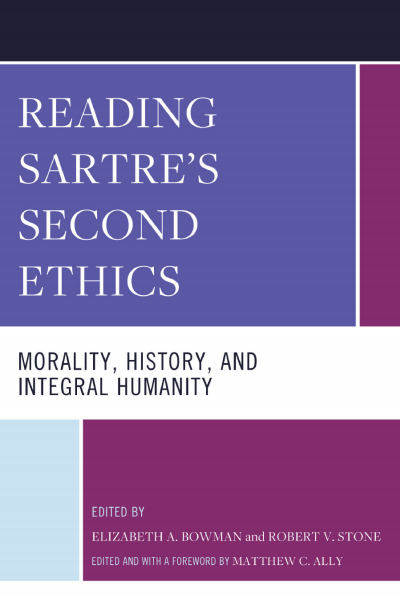
Reading Sartre's Second Ethics
Morality, History, and Integral Humanity
Authors:
|
Publisher:
2023
Summary
In Reading Sartre’s Second Ethics, Elizabeth A. Bowman and Robert V. Stone provide a comprehensive, reconstructive, and critical interpretation of Jean-Paul Sartre’s mature dialectical ethics. The key Sartrean texts are two posthumously published lectures, one delivered at the Gramsci Institute in Rome in 1964, the other scheduled to be delivered at Cornell University in 1965 but cancelled by Sartre in protest of U.S. foreign policy. Though different in content, method, and intended audience, Sartre gave both lectures the shared title “Morality and History.” As Bowman and Stone argue, these texts comprise a single, systematic ethic in two parts. The Cornell lecture focuses primarily on a regressive and phenomenological analysis of normativity and its ambiguous place in lived moral experience; the Rome lecture focuses primarily on a progressive and dialectical synthesis of the ends or goals of historical conduct. Taken together, the two texts demonstrate that “integral humanity” is always possible because the means to it can always be freely invented.
Keywords
Search publication
Bibliographic data
Edition
1/2023
Copyright Year
2023
ISBN-Print
978-1-7936-4651-4
ISBN-Online
978-1-7936-4652-1
Publisher
Lexington, Lanham
Language
English
Pages
398
Product Type
Monograph
Table of contents
ChapterPages
Contents No access
Foreword No access
Preface No access
Acknowledgments No access
Introduction No access Pages 1 - 8
Abbreviations No access Pages 9 - 10
Unveiling Socialism’s “Ethical Structure” No access
The Everyday Experience of Morality No access
The Types of Norms and What They Share No access
The Livability of Norms I No access
The Livability of Norms II No access
Invention I No access
Invention II No access
The Paradox of Ethos I No access
The Paradox of Ethos II No access
The Root of Ethics I No access
The Root of Ethics II No access
“Socialist Morality” and the Conduct of Revolution No access