Ever more complex technical systems increase the number of disciplines involved and the complexity of product development. The proposed method is intended to help identify the impact of changes and the interdisciplinary development of an optimal...
Ever increasing external requirements, growing complexity of systems, and new demands on interdisciplinary collaboration pose challenges for companies. Advanced Systems Engineering (ASE) describes methods and technologies for handling these...
The digital twin is an essential component of digitization in Industry 4.0. The twin system consists of physical and virtual representation, in combination with a complex software system, for which a complex engineering process is necessary. This...
Manufacturing companies have always been confronted with an increasing number and complexity of requirements, which is reinforced by sustainability requirements from legislators, customers, and investors. It is important to consider these new...
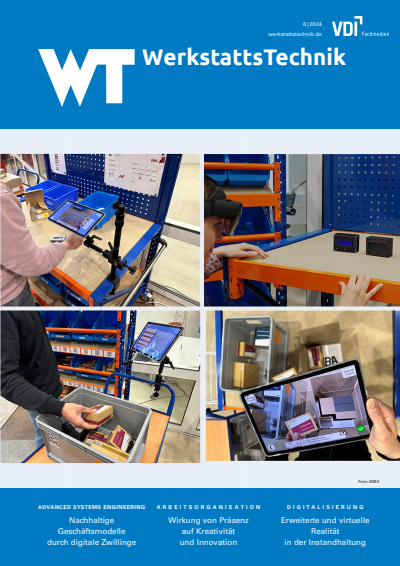
This article deals with the integration of mixed reality technologies in industrial maintenance. The advantages of AR in maintenance are demonstrated by use cases in which maintenance information can be provided in a context-sensitive manner....
To ensure the future viability of manufacturing companies in the VUCA world, it is necessary to identify specific measures and implement them at an early stage. These measures may refer to various areas, such as resilience and -resource efficiency,...
Dynamic markets, scarce space, and increasing automation reshaped the conditions for factory planning and reduced the applicability of established methods. Especially in the early phase of factory planning, a reliable estimate of space requirements...
In today‘s working world, increasing hybridity changes the frequency and nature of personal encounters. The physical office, however, is still important with a view to innovation in organisations. This paper presents extracts from an empirical...
The article analyzes how the strategic introduction of New Work concepts can serve as an effective response to existing external challenges. Design principles, implementation approaches and strategic value contributions were analyzed by means of...
Making use of the potential of intelligent AR assistance systems for decision support in intralogistics is closely linked to their tailored design in accordance with the technological possibilities of these systems and the process-specific...
A bibliometric analysis of 208 conference papers confirms a comprehensive discussion of constitutive concepts of human factors/ergonomics, such as human-centricity and interdisciplinarity. However, the analysis shows that a core concept is missing...
In a qualitative, explorative study, aspects that influence the usability of machine tools were identified. Interviews and observations were conducted with developers, educators and operators of machine tools. The aspects identified were then...
Manufacturing companies often consider process planning and production control sequentially and thus decoupled from each other. However, their integrated consideration promises the potential for optimization for certain production systems by...
Decentralized manufacturing and digital fabrication tools drive open-source methods‘ importance, as shown by the OLSK Small Laser. This paper explores OLSK Small Laser‘s second version development, emphasizing accessibility and...
Complementing conventional sinter-based processes such as metal injection molding, the metal binder jetting process enables more economical production of sintered components in smaller quantities. Due to different green part properties, different...
Industry 4.0 provides not only a large number of potentials, but also a considerable increase in complexity. Demonstrators offer a value-adding contribution to counter this effectively. Their utilization enables user-centered system development with...