The European Criminal Law Review (EuCLR) is a journal dedicated to the development of European Criminal Law and the cooperation in criminal matters within the European Union. In these areas the Lisbon Treaty has supposedly brought about the most important changes and also the greatest challenges for the future.It is the journal’s ambition to provide a primary forum for comprehensive discussion and critical analysis of all questions arising in relation to European Criminal Law. It will include articles and relevant material on topics such as- the harmonisation of national criminal law in consideration of European legal instruments,- the implementation of the principle of mutual recognition in the area of cooperation in criminal matters and the development towards the creation of a European Public Prosecutor,- the emergence of a balanced European Criminal Policy based on fundamental rights, freedom and democracy with particular reference to the Charter of Fundamental Rights of the European Union and the European Convention on Human Rights.
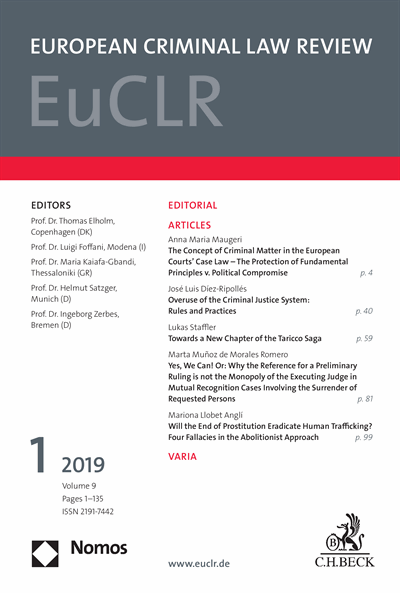
I. The concept of criminal matter. - II. The Engel criteria. The first one: classification of the offence under national law. -1. The second one: the nature of the infringement. - 2. The third one: the nature and the severity of the sanction. - 3....
The study proposes a characterization of contemporary criminal justice policy in accordance to the overuse that public authorities make of crime control interventions. As a guideline for describing and evaluating the overuse, the article chooses the...
Recently, the conflict between the Italian Constitutional Court (ICC) and the European Court of Justice (ECJ) in the so-called Taricco Saga came to an end. In fact, the dialogue between the courts, which began in 2015 after the decision of the Grand...
The competence of the issuing judge in mutual recognition cases to refer for a preliminary ruling before the European Court of Justice (ECJ) is a complex question. The ECJ has nevertheless recognized that competence in its ruling in the AY case, of...
The purpose of this paper is to illustrate the ‘war of data’ on prostitution brought on by scholars, politicians, NGOs and the media. The paper also tackles the misleading wordings and realities in place, which significantly shake the empirical...
One of the measures adopted by the government of the United Kingdom (the UK) in its effort to combat money laundering and corruption was to enact the Criminal Finances Act of 2017 to amend the Proceeds of Crime Act of 2002 to introduce Unexplained...