, to see if you have full access to this publication.
Monograph No access
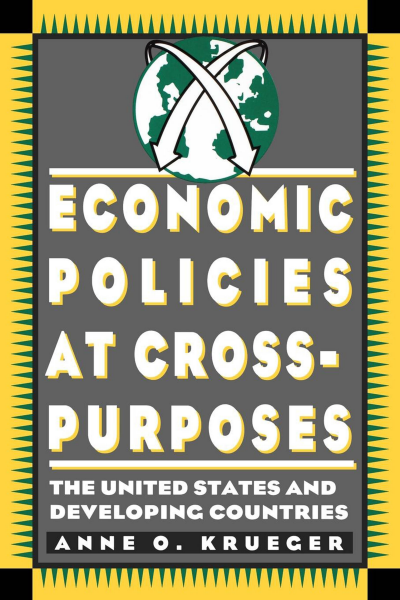
Economic Policies at Cross Purposes
The United States and Developing Countries
Authors:
Publisher:
2010
Summary
As developing countries become increasingly important in the international economy, there is an urgent need to reassess U.S. policies. This book examines the various U.S. international economic policies that affect developing countries and shows that American policies regarding trade, aid, debt, and the multilateral institutions are undertaken largely without coordination and often conflict with each other. Tracing the evolution of foreign aid, Anna Krueger explains that just after World War II American economic policies toward developing countries consisted almost entirely of foreign aid. This approach was highly successful at first, but then the ability of USAID officials to carry out their mandate eroded over time because of political constraints and conflicting objectives of the aid program. She assesses the U.S. role toward the International Monetary Fund and the World Bank and argues that the United States could have been far more effective in these institutions. Krueger then addresses trade policy. Although U.S. leadership to obtain an open multilateral trading system was regarded as a policy oriented toward developed countries, the resulting growth of the world trading system permitted rapid growth of developing countries. As developing countries have adopted realistic economic policies that are conducive to economic efficiency and growth, they have become more important trading partners for the United States and other developed countries. Looking at the evolution of U.S. policy toward the heavy debt burdens of developing countries, Krueger explains that U.S. policy has generally been one step behind the realities of the era. Illustrating how trade, aid, and debt policies interact, Krueger examines two cases: The Caribbean Basin Initiative and Korea. She shows that in Korea, for example, highly successful aid policies of the 1950s helped lay the foundations for rapid economic growth, while the success of Korea's exports then led to acrimonious relations over its trade and exchange rate policies. Krueger concludes by calling for a firmer U.S. commitment to an open multilateral trading system, and points to the interdependence between foreign and trade policies.
Search publication
Bibliographic data
Edition
1/2010
Copyright Year
2010
ISBN-Print
978-0-8157-5053-6
ISBN-Online
978-0-8157-0738-7
Publisher
Rowman & Littlefield, Lanham
Language
English
Pages
253
Product Type
Monograph
Table of contents
ChapterPages
Contents No access
1. Introduction No access Pages 1 - 6
2. The United States and the Developing Countries No access Pages 7 - 17
Development Thought in the Early Years No access
Development Policies in the Early Years No access
Development Experience up to the 1980s No access
The Experience of the 1980s No access
The Evolution of U.S. Foreign Aid No access
The Effectiveness of Foreign Aid No access
Aid at Cross-Purposes with Other U.S. Policies No access
Appendix: Definition and Measurement of Foreign Aid No access
The Multilateral Lending Institutions No access
U.S. Financial Support for the Multilaterals No access
U.S. Policy toward the Multilaterals during the Debt Crisis No access
Missed Opportunities vis-à-vis the Multilaterals No access
The Importance of Developing Countries as Trading Nations No access
Global U.S. Trading Policy: An Overview No access
U.S. Protection against Imports from Developing Countries No access
The Uruguay Round and Regional Trading Arrangements No access
U.S. Interest and Caribbean Development No access
Provisions of the Initiative No access
U.S. Coordination with the Multilaterals in Facilitating Policy Reform and in Debt Policy No access
U.S. Aid to Korea No access
Korea's Growth after Policy Reform No access
U.S. Pressures on Korean Macroeconomic Policies in the Late 1980s No access
U.S.-Korea Trade Relations in the 1980s No access
Conclusion No access
Bilateralism or Multilateralism? No access
Improving Policy Effectiveness No access
Changing U.S. Understanding of the Developing Countries and Their Role No access
Yusif Idies, Sven Bergmann, Kathrin Eitel, Friederike Gesing, Tobias Gumbert, Johanna Kramm, Stefan Laser, Aleksandra Ross, Nicolas Schlitz, Sarah Schönbauer, Waste in Motion-Kollektiv