, to see if you have full access to this publication.
Monograph No access
The Compassionate Temperament
Care and Cruelty in Modern Society
Authors:
Publisher:
2000
Summary
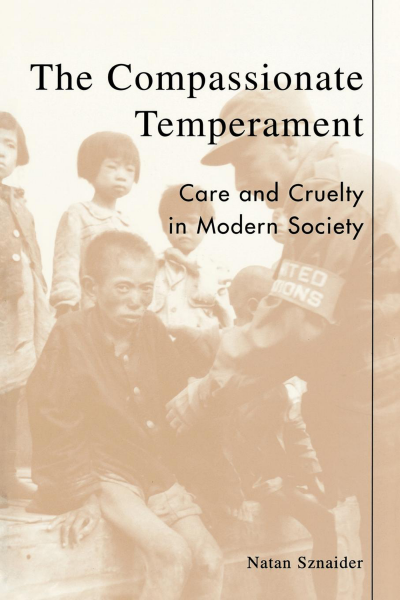
The argument of this book is that it is in the nature of modernity to foster compassion. Most critics tend to think of modernity as corrosive of moral sentiments. They see clearly the way in which modernity breaks down older social bonds, but they are much less attentive to the ways in which it also builds new ones. This book offers an historically informed corrective to this common view. Sznaider demonstrates that compassion, understood as the organized campaign to lessen the suffering of strangers, is a distinctly modern form of morality. It played an important role in the rise of modern society, and it continues to play an important role today. And when waves of compassion break out into demands for political action, these demands need to be understood rather than criticized as excuses or irrelevancies. Incorporating and critiquing the work of Arendt, Foucault, and other social theorists, this book is both erudite and historically rich—sure to be both controversial and influential among those who debate modernity, morality, and social justice.
Search publication
Bibliographic data
Edition
1/2000
Copyright Year
2000
ISBN-Print
978-0-8476-9555-3
ISBN-Online
978-0-7425-7452-6
Publisher
Rowman & Littlefield, Lanham
Language
English
Pages
129
Product Type
Monograph
Table of contents
ChapterPages
Table of Contents No access
Acknowledgments No access
Introduction No access Pages 1 - 6
Chapter 1: The Sociology of Public Compassion No access Pages 7 - 24
Chapter 2: Pain and Compassion No access Pages 25 - 44
Chapter 3: Cruelty to Children No access Pages 45 - 60
Chapter 4: Democracy and Child Welfare No access Pages 61 - 82
Chapter 5: The Universalization of Compassion No access Pages 83 - 98