KNOWLEDGE ORGANIZATION is a forum for all those interested in the organization of knowledge on a universal or a domain-specific scale, using concept-analytical or concept-synthetical approaches, as well as quantitative and qualitative methodologies. KNOWLEDGE ORGANIZATION also addresses the intellectual and automatic compilation and use of classification systems and thesauri in all fields of knowledge, with special attention being given to the problems of terminology. KNOWLEDGE ORGANIZATION publishes original articles, reports on conferences and similar communications, as well as book reviews, letters to the editor, and an extensive annotated bibliography of recent classification and indexing literature. KNOWLEDGE ORGANIZATION should therefore be available at every university and research library of every country, at every information center, at colleges and schools of library and information science, in the hands of everybody interested in the fields mentioned above and thus also at every office for updating information on any topic related to the problems of order in our information-flooded times.
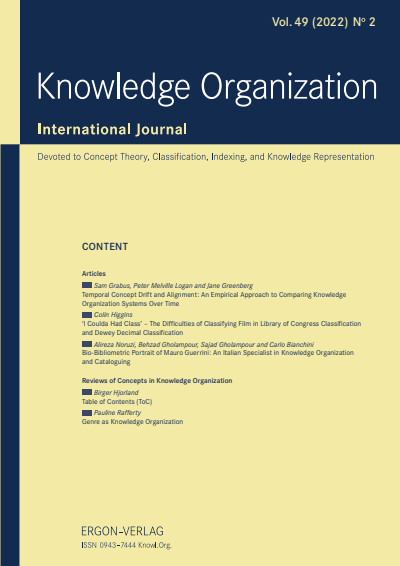
This research explores temporal concept drift and temporal alignment in knowledge organization systems (KOS). A comparative analysis is pursued using the 1910 Library of Congress Subject Headings, 2020 FAST Topical, and automatic indexing. The use...
This paper analyzes how two systems of classification - Library of Congress Classification and Dewey Decimal Classification - are applied to physical collections of films within libraries. It studies the history of the evolving approach to...
The main objective of the current review was to evaluate the research performance of Mauro Guerrini during his profession from 2007 to 2021. Professor Mauro Guerrini is one of the most influential Italian researchers in the field of knowledge...
A table of contents (ToC) is a kind of document representation as well as a paratext and a kind of finding device to the document it represents. TOCs are very common in books and some other kinds of documents, but not in all kinds. This article...
This article examines genre as knowledge organization. Genres are fluid and historically changing categories, and there are different views about the scope and membership of specific genres. The literature generally agrees that genre is a matter of...