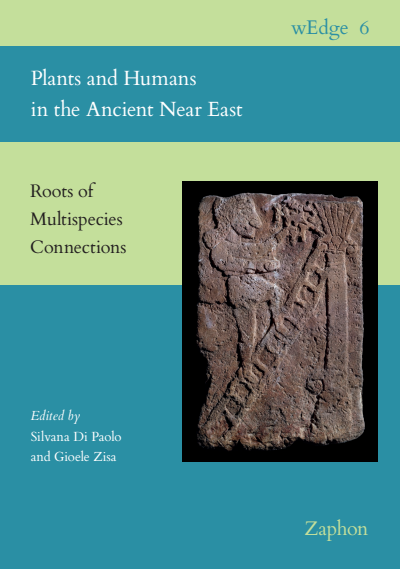
This volume explores the role of plants in the ancient Near East through a multidisciplinary approach that integrates archaeology, philology, archaeobotany, and the history of religions. It examines the significance of plant species not only as economic and dietary resources (passive role) but also as fundamental elements in the co-production of space with humans to forge symbolic systems, religious practices, and artistic representations. By carefully analyzing textual sources, archaeological and iconographic evidence, and archaeobotanical remains, this volume presents selected case studies on the interactions between human societies and the plant world in the region. In recent years, scholarly interest in plants within the context of the ancient Near East has grown significantly, aligning with the development of the Environmental Humanities and the emergence of Critical Plant Studies. This evolving theoretical and methodological perspective forms the core of two research initiatives: the BioANE project (Biodiversity in the Ancient Near East), directed by Silvana Di Paolo and Gioele Zisa, and the PLANET project (Plants in the Ancient Near Eastern Texts), coordinated by Gioele Zisa. This volume stands at the intersection of these two projects, offering fresh insights into how ancient Near Eastern cultures perceived, utilized, and represented plants. But not only that: the collected studies highlight the complexity of these relationships, challenging anthropocentric perspectives and proposing an interpretation that acknowledges plants as active participants in the region’s cultural and environmental history. By exploring the intricate relationships between humans and plants in the ancient Near East, this volume challenges anthropocentric perspectives and highlights the agency of vegetal beings in shaping cultural, religious, and economic landscapes. In doing so, it contributes to a growing scholarly discourse that redefines our understanding of the natural world as an active participant in historical processes, urging us to rethink the boundaries between nature and culture.
Reihe
wEdge - 6
Search publication
Bibliographic data
Edition
1/2026
Copyright Year
2026
ISBN-Print
978-3-96327-320-9
ISBN-Online
978-3-96327-321-6
Publisher
Zaphon, Münster
Series
wEdge / Cutting-Edge Research in Cuneiform Studies
Volume
6
Language
English
Pages
367
Product Type
Edited Book
Table of contents
ChapterPages
Authors: |
Authors:
Authors:
Authors: | |
Authors: | | |
Authors:
Authors:
Authors:
Authors:
Authors:
Authors:
Authors:
Authors:
Authors:
Authors: |
Similar publications
from the series "wEdge / Cutting-Edge Research in Cuneiform Studies"