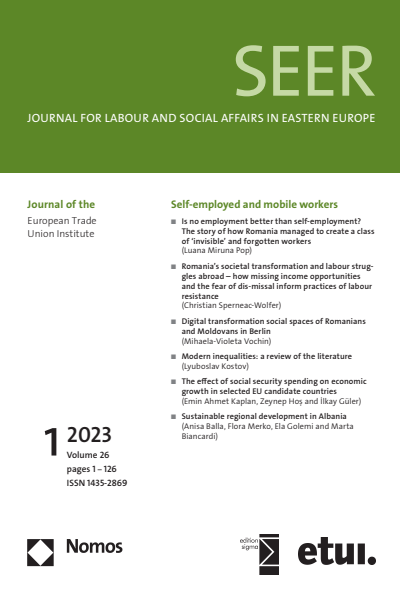
SEER tries to stimulate the exchange of information among researchers, trade unionists and people who have a special interest in the political, social and economic development of the region of south-east Europe. The journal tries to draw attention to new research results and the latest analyses about the ongoing process of political and social changes in the south-east of Europe. It tries to create more understanding for the importance of the elaboration of democratic structures in industrial relations. The SEER combines contributions from different disciplines and »political schools« into an information package of interest for policy makers, researchers, academics and trade unionists from various backgrounds. Website: www.seer.nomos.de
Romania has been, for the past decade, not only the country with the highest in-work poverty among EU member states, but – unlike most of the others – also a country with a steadily growing welfare polarisation of the workforce. This article...
Romania's transformation from a socialist to a capitalist market society resulted in massive negative social and economic consequences which, ultimately, have become push factors for labour migration. However, little research has been done on the...
This study focuses on the online community of Romanian-speaking mobile migrants who live or regularly return to Berlin. Engaging with theories on transnationalism and social media, this article addresses how digital transnational social spaces...
This article reviews the main results of recent empirical research on the topic of income and wealth inequalities, with a special focus on Bulgaria, taking extensive account of the impact of Covid-19 which, according to the data, is responsible for...
The concept of social security – a contemporary, global norm – and the accompanying public expenditures are the products of a search for security against the dangers that may be faced by individuals in society. Social security spending is...
During the last three decades, Albania has maintained steady economic growth which has significantly improved the poverty rate and living standards. However, demographic change has influenced differences in regional development, pressuring the...