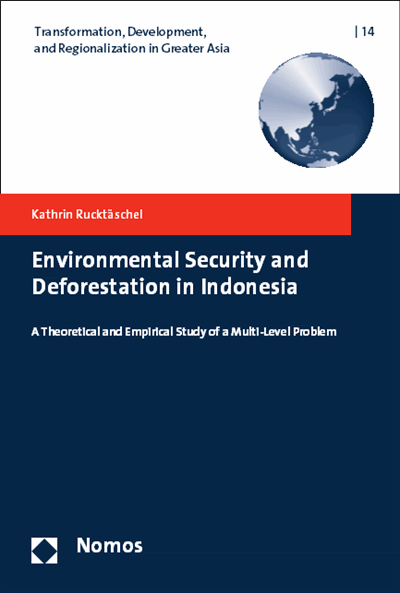
Environmental Security and Deforestation in Indonesia
A Theoretical and Empirical Study of a Multi-Level Problem- Authors:
- Series:
- Transformation, Development, and Regionalization in Greater Asia, Volume 14
- Publisher:
- 2016
Summary
Environmental problems and their impact are of growing relevance within the current debate about non-traditional security. This book analyses these security issues and develops them from a theoretical perspective by focusing on environmental security. The empirical case study the book presents focuses on deforestation in Indonesia. It reveals the impacts and consequences of recurring forest fires, which are often started intentionally, on and for individuals, the Indonesian state, the regional level and the global level. Based on set theoretical concepts, the book analyses how environmental destruction is affecting the various aforementioned levels, how they are handling it, and what strategies are being devised and how they can be evaluated. This study will appeal to researchers and lecturers in political science, environmental studies and Indonesian studies, as well as those involved in environmental politics and environmental protection.
Search publication
Bibliographic data
- Copyright year
- 2016
- ISBN-Print
- 978-3-8487-0696-9
- ISBN-Online
- 978-3-8452-4907-0
- Publisher
- Nomos, Baden-Baden
- Series
- Transformation, Development, and Regionalization in Greater Asia
- Volume
- 14
- Language
- English
- Pages
- 258
- Product type
- Book Titles
Table of contents
- Titelei/Inhaltsverzeichnis No access Pages 1 - 14
- I.1 Research Focus No access
- I.2 Review on Current International Research and Literature No access
- I.3 Methodology No access
- I.4 Structure No access
- II.1.1 ‘Security for Whom?’ – Levels of Security Based on Objects of Reference No access
- II.1.2 ‘What Threatens Security?’ – Defining Security Threats No access
- II.1.3 The Relationship between Various Levels of Security and NTS Threats No access
- II.2.1 Global Importance No access
- II.2.2 Regional Importance No access
- II.2.3 Importance for the Nation-State No access
- II.2.4 Individual Importance – Human Security No access
- II.3 National Environmental Policy Capacity – Or, Is a State Well-Equipped to Handle Environmental Threats? No access
- II.4.1 Global Importance No access
- II.4.2 Regional Importance – Cross-Border Effects No access
- II.4.3 National Importance No access
- II.4.4 Individual, Human Security No access
- III.1.1 Political-Institutional Framework Conditions No access
- III.1.2 Cognitive-Informational Framework Conditions No access
- III.2.1 Forest Degradation and Logging Activities No access
- III.2.2 Forest Fires No access
- III.2.3 Land Transformation No access
- III.3.1 Small Farmers, Local Communities – Securing Subsistence No access
- III.3.2 National and Transnational Corporations No access
- III.3.3 Illegal Loggers No access
- III.3.4 Politicians, Government Officials, and Civil Servants No access
- IV.1.1 Individual Impacts at the Local Level No access
- IV.1.2 Indonesia’s Local Responsibilities No access
- IV.2.1 National Impacts No access
- IV.2.2 Indonesia’s Responsibilities towards Its Own Nation No access
- IV.3.1 Regional Impacts No access
- IV.3.2 Indonesia’s Regional Responsibilities No access
- IV.4.1 Global Impacts No access
- IV.4.2 Global Responsibilities No access
- V. Conclusion No access Pages 235 - 240
- References No access Pages 241 - 258