, to see if you have full access to this publication.
Monograph No access
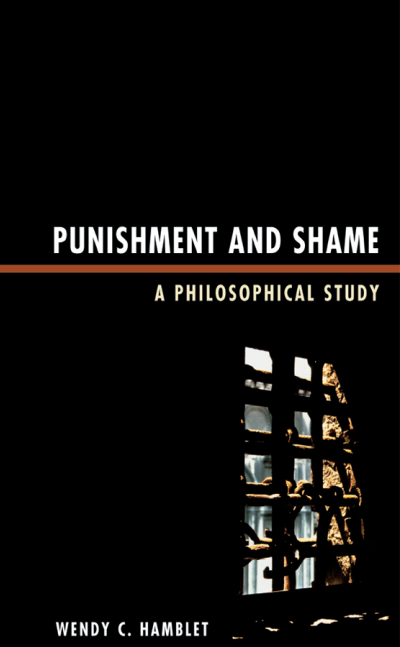
Punishment and Shame
A Philosophical Study
Authors:
Publisher:
2010
Summary
Punishment is the imposition, by a legitimate authority, of a painful consequence upon one who has offended the social order by indulging in acts contrary to the social good. Punishment is understood to serve a primary objective in any society: it rehabilitates or reforms (re-forms or shapes anew) the psyches of social offenders to bring them in line with prevailing codes of behavior. Punishment thus is a highly conservative force, affirming simultaneously the codes of conduct deemed desirable within the society and the status quo of power relations that hold sway in the society. Punishment is a form of social teaching. One of the favorite forms of didactic pain to which legitimate authorities turn, in teaching conformity to social regulations, is the psychological pain of shame. Shame is a special favorite in the penology of societies of the Western world, whose governing logic is already grounded in the shame-based religions of Judaism and Christianity. Parents, school teachers, religious leaders, and state authorities readily employ shame as an effective method for teaching social lessons. Shame is a powerful force that reaches deep into the psyche of the offender and gnaws away at her sense of self-worth and identity, with longstanding and devastating existential effects. Shame has profound and enduring effects, because it has the capacity to transform an empirical fact (of having done something unacceptable) into an ontological reality (of being unacceptable as a human being). Shame dehumanizes. Shame is a powerfully effective tool for altering behavior, but because shame dehumanizes, it often fails to have the effect that the punisher is seeking to bring about. Shame sickens souls, rather than cures them. It sickens them to such a degree that shame more often acts as a promoter of criminality than as a teacher of the social good.
Keywords
Search publication
Bibliographic data
Edition
1/2010
Copyright Year
2010
ISBN-Print
978-0-7391-4937-9
ISBN-Online
978-1-4616-3407-2
Publisher
Lexington, Lanham
Language
English
Pages
203
Product Type
Monograph
Table of contents
ChapterPages
Table of Contents No access
Introduction No access Pages 1 - 12
Chapter 1: Justice and the Cosmic Order in Greek Mythology No access
Chapter 2: Justice and Punishment in Greek Tragedy No access
Chapter 3: Honor and Shame in the Heroic Worldview No access
Chapter 4: Justice and Punishment in Classical Athens No access
Chapter 5: From Avenging to Healing No access
Chapter 6: Shame as Witness to Education No access
Chapter 7: Plato's Revolutionary Penology No access
Chapter 8: The Science of Penal Measure No access
Chapter 9: A Christian Penology No access
Chapter 10: From Karitas to Penal Spectacle No access
Chapter 11: The Business of Punishment No access
Chapter 12: Modernity's Shameful Penology No access
Chapter 13: Shame, Social Injustice, and the Poor's Right to Crime No access