KNOWLEDGE ORGANIZATION is a forum for all those interested in the organization of knowledge on a universal or a domain-specific scale, using concept-analytical or concept-synthetical approaches, as well as quantitative and qualitative methodologies. KNOWLEDGE ORGANIZATION also addresses the intellectual and automatic compilation and use of classification systems and thesauri in all fields of knowledge, with special attention being given to the problems of terminology. KNOWLEDGE ORGANIZATION publishes original articles, reports on conferences and similar communications, as well as book reviews, letters to the editor, and an extensive annotated bibliography of recent classification and indexing literature. KNOWLEDGE ORGANIZATION should therefore be available at every university and research library of every country, at every information center, at colleges and schools of library and information science, in the hands of everybody interested in the fields mentioned above and thus also at every office for updating information on any topic related to the problems of order in our information-flooded times.
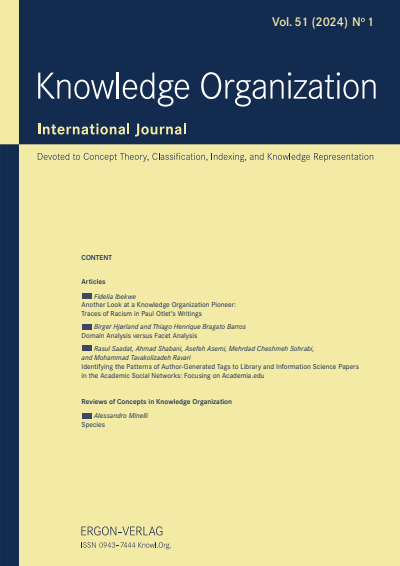
Critical strand of studies in Knowledge Organization (KO) and Library and Information Science (LIS) have been focused on gender bias and power inherent in the classification of knowledge artefacts. From the mid-2000s, attention turned to other...
This paper delves into the complexities and theoretical underpinnings of knowledge organization systems (KOS), focusing on domain analysis and facet analysis as methodologies, such as improving the Library of Congress Subject Headings (LCSH). The...
This research aims to identify some patterns of author (as user) generated tags to the papers of library and information science field in Academia.edu. The research method is typically based on text analysis and word frequency distribution. The...
This article discusses the many usages and meanings of the term species in biology, as currently applied (1) to named taxa such as Homo sapiens and Panthera tigris, (2) to a rank (usually but not necessarily the lowest and/or the most fundamental...