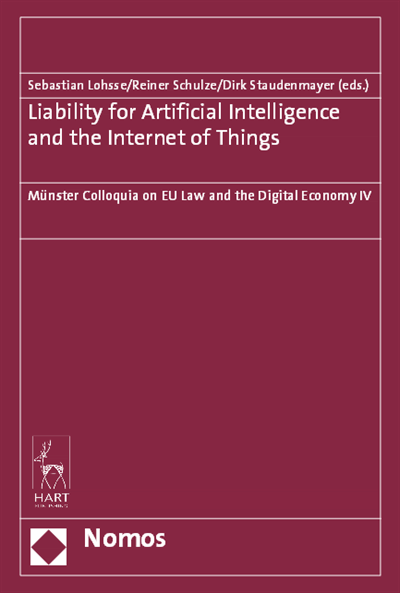
Liability for Artificial Intelligence and the Internet of Things
Münster Colloquia on EU Law and the Digital Economy IV- Editors:
- | |
- Publisher:
- 2019
Summary
Wissenschaftler und Praktiker aus mehreren europäischen Ländern befassen sich in dem Band mit Grundfragen der Haftung für die Herstellung und Verwendung künstlicher Intelligenz. Sie entwickeln vor dem Hintergrund der Gesetzgebungsinitiativen auf nationaler und europäischer Ebene (wie der Resolution des Europäischen Parlaments über „Civil Law Rules on Robotics“) Analysen und Lösungsvorschläge zur Fortentwicklung der Produkthaftung, zur Anpassung traditioneller Konzepte des Deliktsrechts und zur Funktion von Gefährdungshaftungstatbeständen. Die Reihe der „Münster Colloquia on EU Law and the Digital Economy“ wendet sich damit einer vordringlichen Herausforderung für Rechtswissenschaft und Praxis zu.
Mit Beiträgen von
Cristina Amato, Georg Borges, Jean-Sébastien Borghetti, Giovanni Comandé, Ernst Karner, Bernhard Koch, Sebastian Lohsse, Eva Lux, Miquel Martín-Casals, Reiner Schulze, Gerald Spindler, Dirk Staudenmayer, Gerhard Wagner, Herbert Zech
Keywords
Search publication
Bibliographic data
- Edition
- 1/2019
- Copyright Year
- 2019
- ISBN-Print
- 978-3-8487-5293-5
- ISBN-Online
- 978-3-8452-9479-7
- Publisher
- Nomos, Baden-Baden
- Language
- English
- Pages
- 235
- Product Type
- Edited Book
Table of contents
- Titelei/Inhaltsverzeichnis No access Pages 1 - 8
- Authors: | |
- I. Artificial Intelligence and Liability Challenges No accessAuthors: | |
- II. Appropriate Regulatory Level No accessAuthors: | |
- III. Actors to be held responsible No accessAuthors: | |
- IV. Overall Concept of Liability No accessAuthors: | |
- V. Outlook No accessAuthors: | |
- Authors:
- I. The Concepts of Robots, Autonomous Systems and IoT-Devices No accessAuthors:
- II. The European Parliament Resolution of February 2017 No accessAuthors:
- III. The Commission Communication on ‘Building a European Data Economy’ No accessAuthors:
- IV. Normative Foundations No accessAuthors:
- V. The Range of Responsible Parties No accessAuthors:
- Authors:
- 1. National Tort Law as the Default System No accessAuthors:
- 2. The Products Liability Directive No accessAuthors:
- 3. The Proposed Directive on the Liability of Service Providers No accessAuthors:
- 4. Conclusion No accessAuthors:
- Authors:
- 1. The Shift from User Control to Manufacturer Control No accessAuthors:
- 2. Dispersion of Control: Unbundling No accessAuthors:
- Authors:
- 1. The Manufacturer as Best Cost Avoider No accessAuthors:
- 2. The Scope of the Products Liability Directive No accessAuthors:
- 3. The Requirement of a Defect No accessAuthors:
- 4. Burden of Proof – Strict Liability as a Response? No accessAuthors:
- 5. Unbundled Products No accessAuthors:
- IX. Liability of Users No accessAuthors:
- Authors:
- 1. A Legal, not a Philosophical Question No accessAuthors:
- 2. Externalisation of Risk through Recognition of ePersons as ‘Liability Subjects’ No accessAuthors:
- 3. Incentives for Robots? No accessAuthors:
- 4. Risk Internalisation through Asset Requirements and Insurance Mandates No accessAuthors:
- 5. The Benefit of Robots as Liability Subjects No accessAuthors:
- XI. Conclusions No accessAuthors:
- Authors:
- Authors:
- 1. Comparing the outcome of the algorithm with the behaviour of a reasonable human being No accessAuthors:
- Authors:
- a) Comparing the outcome of the algorithm in the situation under investigation with the outcome of another algorithm in the same situation No accessAuthors:
- b) Comparing the overall outcomes of the algorithm with the overall outcomes of another algorithm No accessAuthors:
- Authors:
- 1. Autonomous vehicles No accessAuthors:
- 2. Medical robots and algorithms No accessAuthors:
- 3. Domestic robots No accessAuthors:
- Authors:
- I. Introduction No accessAuthors:
- II. At the Roots of the Problem: National Courts and the Burden of Proof of Defectiveness No accessAuthors:
- Authors:
- 1. Social State of Art v Technical Standards No accessAuthors:
- 2. The European Layout of the New Approach and the New Legislative Framework No accessAuthors:
- Authors:
- 1. Safety and Defectiveness No accessAuthors:
- 2. Non-Compliance with Harmonised Standards and Exclusion of the Presumption of Compliance No accessAuthors:
- 3. Compliance with Harmonised Standards and Presumption of Conformity No accessAuthors:
- V. Final Remarks No accessAuthors:
- Authors:
- I. Introduction No accessAuthors:
- II. Traditional Bases of Liability No accessAuthors:
- III. Product Liability in the Digital Age No accessAuthors:
- Authors:
- 1. Recoverable Loss No accessAuthors:
- 2. Product No accessAuthors:
- 3. Liable Person No accessAuthors:
- 4. Defect No accessAuthors:
- 5. Burden of Proof No accessAuthors:
- V. Reasons for Allocating the Loss No accessAuthors:
- VI. The Needle in the Haystack No accessAuthors:
- VII. One Size Does Not Fit All No accessAuthors:
- VIII. Liability of E-Persons? No accessAuthors:
- IX. Conclusions No accessAuthors:
- Authors:
- I. Starting Point No accessAuthors:
- II. Fault Liability No accessAuthors:
- III. Product Liability No accessAuthors:
- IV. Machines as Auxiliaries No accessAuthors:
- Authors:
- 1. Self-driving cars against the background of existing non-contractual liability No accessAuthors:
- 2. The need for a general rule for risk-based liability No accessAuthors:
- VI. A need for an e-person? No accessAuthors:
- VII. Summary No accessAuthors:
- Authors:
- I. Introduction No accessAuthors:
- II. Basic Risks No accessAuthors:
- Authors:
- 1. Product liability directive No accessAuthors:
- 2. Traditional liability rules – Negligence No accessAuthors:
- 3. Liability of Intermediaries No accessAuthors:
- 4. User/Operator liability No accessAuthors:
- 5. Impact of contractual provisions No accessAuthors:
- Authors:
- 1. Principles: The scale of regulation from product security to product liability No accessAuthors:
- Authors:
- Authors:
- aa) The case for strict liability for IoT and AI-products No accessAuthors:
- bb) Negligence based liability No accessAuthors:
- cc) Causality No accessAuthors:
- dd) Redress problems No accessAuthors:
- ee) In sum: a concept for hybrid liability: Contracts – strict liability – negligence No accessAuthors:
- b) User/Operators No accessAuthors:
- 3. Intermediaries No accessAuthors:
- 4. Interplay with Product Security No accessAuthors:
- IV. Conclusion No accessAuthors:
- Authors:
- Authors:
- 1. Autonomous systems and damage as an everyday occurrence No accessAuthors:
- 2. The role of insurance and compensation funds in the current discussion No accessAuthors:
- Authors:
- 1. Insurance for autonomous systems in the current discussion No accessAuthors:
- 2. The liability system for autonomous systems No accessAuthors:
- Authors:
- a) Purpose of compulsory insurance No accessAuthors:
- b) Compulsory insurance for the operator of autonomous systems No accessAuthors:
- c) Compulsory insurance for the manufacturers of autonomous systems No accessAuthors:
- Authors:
- 1. Compensation funds in the Resolution No accessAuthors:
- 2. Compensation funds for lack of insurance cover No accessAuthors:
- Authors:
- a) Possible advantages of a compensation system No accessAuthors:
- b) Communitisation of the risks through compensation funds No accessAuthors:
- c) The disadvantages of compensation funds replacing liability No accessAuthors:
- d) Potential of compensation funds in the transformation process No accessAuthors:
- IV. Conclusion No accessAuthors:
- Authors:
- I. The networking society and the internet of humans: an introduction No accessAuthors:
- II. Automation, autonomy and unpredictable behaviours No accessAuthors:
- III. First policy implications No accessAuthors:
- IV. The debate on Autonomous vehicles as an example of an insufficient path. No accessAuthors:
- V. Towards a multilayered liability approach based on accountability No accessAuthors:
- VI. For a theory of layered liability: accountable multilevel liability No accessAuthors:
- VII. Blending liability and accountability for selecting AI liability regimes No accessAuthors:
- Authors:
- I. Current AI – the phenomenon No accessAuthors:
- Authors:
- 1. Self-learning (autonomy) No accessAuthors:
- 2. Multi-layered neural networks (deep learning) No accessAuthors:
- Authors:
- 1. Autonomy risk (self-learning risk) No accessAuthors:
- 2. Probability risk of deep learning No accessAuthors:
- 3. Intransparency problem (creating legal risks) No accessAuthors:
- IV. New and old risks No accessAuthors:
- Authors:
- 1. Regulatory law No accessAuthors:
- 2. Fault-based liability (tort law, contract law) No accessAuthors:
- 3. Product liability (defective products) No accessAuthors:
- 4. Strict liability No accessAuthors:
- VI. Summary and outlook No accessAuthors:
- Authors:
- Authors:
- 1. IoT multiple layers and players No accessAuthors:
- 2. Technological change and legal response No accessAuthors:
- Authors:
- 1. Causation in the Products Liability Directive and its shortcomings No accessAuthors:
- 2. Different legal approaches to causation in Europe No accessAuthors:
- Authors:
- a) General v Specific causation No accessAuthors:
- b) Causation versus scope of liability No accessAuthors:
- c) Burden of proof of causation and possible ‘alleviating’ devices No accessAuthors:
- Authors:
- 1. ‘All-or-Nothing’ v. ‘proportional liability’ No accessAuthors:
- 2. Hybrid systems and channelling No accessAuthors:
- Authors:
- 1. Foreseeability as a problem in the IoT No accessAuthors:
- 2. The relevance of intervening causation in the IoT technologies No accessAuthors:
- V. Conclusion No accessAuthors:
- Consequences of Digitalization from the National Legislator’s Point of View – Report on a Working Group No accessAuthors:
- Contributors No access Pages 235 - 235