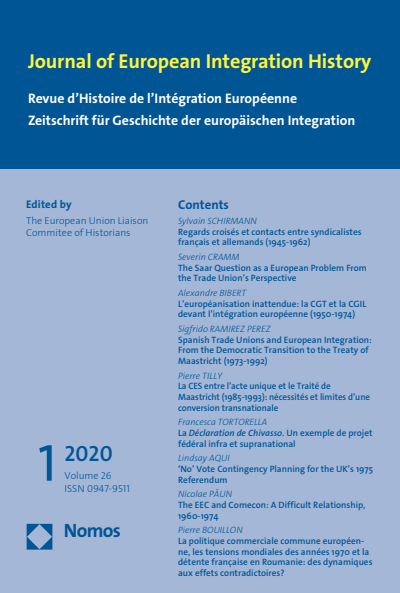
The animosity which often prevails among French and German trade unionists in the wake of World War I disappears in the aftermath of the Second conflict. The meetings are more numerous, certain positions converge and the demands related to specific...
The Saar region did not immediately become part of the Federal Republic of Germany in 1949, but was gradually given the status of a semi-protectorate of France from 1947 onwards. The region's high-quality coal and the iron and steel industries were...
The contribution of Spanish trade unions to the process of transition and consolidation of the Spanish democracy has been very much underestimated. The dominating historiographical interpretation has considered them as simple transmission belt of...
When the European Trade Union Confederation (ETUC) in the late 1980s said yes to the internal market as the EU’s pivotal project, it was accepted in consideration with the Commission's promises to deliver a strong social dimension. For the ETUC,...
During Second World War, Italian resistance fighters from the Aosta Valley and the Vaudois valleys meet in Chivasso to think about an international system for the post- war era. They defend a republican and democratic political system, and, far...
This article investigates the contingency plan developed by Harold Wilson’s Labour government for a ‘no’ vote in the UK’s 1975 referendum on European Community (EC) membership. The decision to prepare for the possibility of leaving the EC...
The degree of economic integration attained within Comecon never came close to the one fostered by the policies within the European Economic Community, notably the Common Commercial Policy. Moreover, the relations between the two entities were...
The policy of trade liberalization led by the EEC and by France towards a state-trading country like Romania proved to be a specific issue with regard to the implementation of the European common trade policy. It was all the more complicated than...