, to see if you have full access to this publication.
Monograph No access
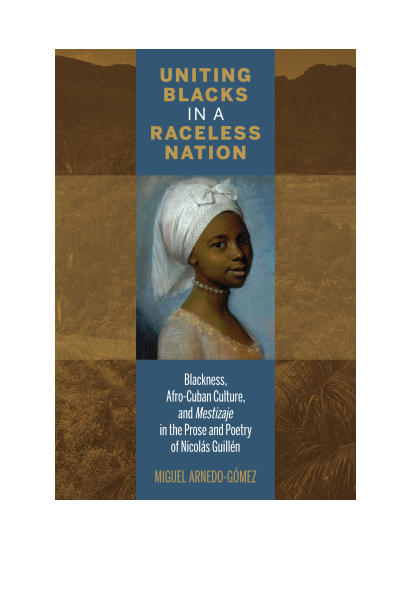
Uniting Blacks in a Raceless Nation
Blackness, Afro-Cuban Culture, and Mestizaje in the Prose and Poetry of Nicolás Guillén
Authors:
Publisher:
2016
Summary
The Cuban writer Nicolás Guillén has traditionally been considered a poet of mestizaje, a term that, whilst denoting racial mixture, also refers to a homogenizing nationalist discourse that proclaims the harmonious nature of Cuban identity. Yet, many aspects of Guillén’s work enhance black Cuban and Afro-Cuban identities. Miguel Arnedo-Gómez explores this paradox in Guillén’s pre-Cuban Revolution writings placing them alongside contemporaneous intellectual discourses that feigned adherence to the homogenizing ideology whilst upholding black interests. On the basis of links with these and other 1930s Cuban discourses, Arnedo-Gómez shows Guillén’s work to contain a message of black unity aimed at the black middle classes. Furthermore, against a tendency to seek a single authorial consciousness—be it mulatto or based on a North American construction of blackness—Guillén’s prose and poetry are also characterized as a struggle for a viable identity in a socio-culturally heterogeneous society.
Keywords
Search publication
Bibliographic data
Edition
1/2016
Copyright Year
2016
ISBN-Print
978-1-61148-758-9
ISBN-Online
978-1-61148-759-6
Publisher
University Press Copublishing, Lanham
Language
English
Pages
237
Product Type
Monograph
Table of contents
ChapterPages
Contents No access
Acknowledgments No access
Introduction No access
Chapter One: Afro-Cuban Reformulations of Afrocubanismo and Mestizaje in 1930s Cuba No access Pages 1 - 38
Chapter Two: Racism and the Myth of Racial Equality in Nicolás Guillén’s 1930s Essays on Racial Inequality No access Pages 39 - 62
Chapter Three: Guillén’s Afro-Cuban Other and Black Intraracial Discrimination in Motivos de son No access Pages 63 - 92
Chapter Four: The Search for a Mulatto Identity in Motivos de son, “Balada de los dos abuelos,” “El apellido,” and “Son número 6” No access Pages 93 - 134
Chapter Five: Renegrifying Sóngoro cosongo and “La canción del bongó” No access Pages 135 - 172
Chapter Six: Guillén’s Black Masculinist Visions of the Mulata’s Cross-Racial Proclivities No access Pages 173 - 208
Conclusion: Reaffirming the Afro-Cuban Subject, from Mestizaje to Heterogeneity No access Pages 209 - 216