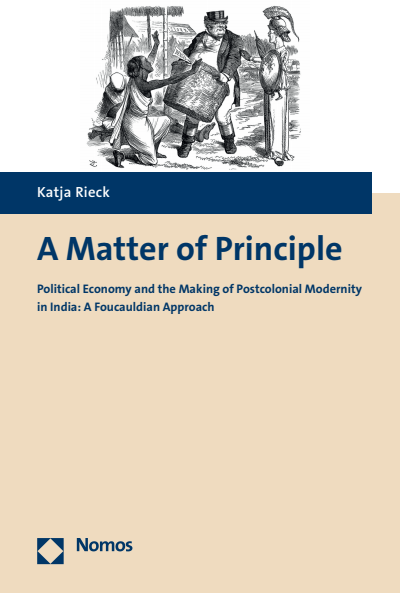
A Matter of Principle
Political Economy and the Making of Postcolonial Modernity in India: A Foucauldian Approach- Authors:
- Publisher:
- 2020
Summary
Ausgehend von Michel Foucaults Beobachtung, dass die Wissenschaft der politischen Ökonomie eine für die Moderne konstitutive Form der Macht hervorgebracht hat, berücksichtigt diese Studie den imperialen Kontext dieser historischen Wende.
Der erste Teil analysiert, wie sich im Kontext des British Empire durch diesen neuen Wissenskorpus ein Dispositiv herausbildete, das neue Identitäten, soziale Praktiken sowie Formen der politischen Intervention und des Widerstands ermöglichte. Der zweite Teil zeigt, wie diese globalen Verflechtungen die Bedingungen für die Entstehung von anti- und postkolonialen Gegendiskursen und -praktiken in Indien geprägt haben. Indem die Studie untersucht, wie die Vorstellungen indischer Eliten von postkolonialer Moderne und damit einhergehende Widerstandspraktiken aus deren Auseinandersetzungen mit global zirkulierenden Diskursen über die politische Ökonomie entstanden sind, zeigt sie die gegenseitige Verflechtung westlicher Moderne und ihrer postkolonialen Alternativen.
Search publication
Bibliographic data
- Edition
- 1/2020
- Copyright Year
- 2020
- ISBN-Print
- 978-3-8487-6292-7
- ISBN-Online
- 978-3-7489-0399-4
- Publisher
- Nomos, Baden-Baden
- Language
- English
- Pages
- 486
- Product Type
- Monograph
Table of contents
- Titelei/Inhaltsverzeichnis No access Pages 1 - 10
- Chapter I Anthropology and the Study of Modernity/ies: Past and Present No access
- Chapter II Conceptual Framework for a Foucauldian Analysis of Modernity and its Others and an Overview of the Present Study No access
- Chapter III Towards a New Mode of Governance: Re-imagining the Nation as Company in 16th- and 17th-Century Britain No access
- Chapter IV From National Commerce to Commercial Nation: The Making of a Commercial Society in the 17th Century No access
- Chapter V From Discourses on Trade to Political Economy: The Emergence of a Science of Government and Public Administration No access
- Chapter VI Political Economy and the Modern British Nation-State: From Managing the State to Calls for Ac-countable Government No access
- Chapter VII Economy and the New Imperial Order: Ac-countable Colonial Governance in 19th-Cenutry India No access
- Chapter VIII Economy and Empire’s Civilising Mission: The Project of Indian Improvement No access
- Chapter IX From Accountability to Nationalist Calls to Account: Economy and the Contestation of the Imperial Common-Wealth No access
- Chapter X The Common-Wealth vs. National Economy: Critiques of British Hegemony and The Emergence of an Alternative Order No access
- Chapter XI National Economy and the Reconceptualization of Indian Improvement No access
- Chapter XII Swadeshi and Alternative Approaches to Indian Improvement: From Critique to the Construction of a (post)Colonial Economy No access
- Chapter XIII Commercial Society’s Other: The Village as Object of Knowledge and the Relativisation of Political Economy No access
- Chapter XIV The Indian Village: From Object of Improvement to Civilisational Exemplar No access
- Chapter XV The Indian Village Economy: Commercial Society’s Other and the Remaking of the Project of Improvement No access
- Chapter XVI Conclusion No access
- Bibliography No access Pages 445 - 486
Bibliography (734 entries)
No match found. Try another term.
- Abu Lughod, Leila (2000): “Modern Subjects: Egyptian Melodrama and Postcolonial Difference”. In Timothy Mitchell (ed.) (2000): Questions of Modernity. Minneapolis: University of Minnesota Press. Open Google Scholar DOI: 10.5771/9783748903994
- Aiyar, Mani Shankar (2002): “Panchayati Raj: The Way Forward”, Economic and Political Weekly, 37(31), 3293–3297. Open Google Scholar DOI: 10.5771/9783748903994
- Allen, William R. (1970): “Modern Defenders of Mercantilist Theory”, History of Political Economy, 2(2), 381–397. Open Google Scholar DOI: 10.5771/9783748903994
- Alter, Joseph S. (2000): Gandhi’s Body: Sex, Diet, and the Politics of Nationalism. Philadelphia: University of Pennsylvania Press. Open Google Scholar DOI: 10.5771/9783748903994
- Ambirajan, S. (1976): “Malthusian Population Theory and Indian Famine Policy in the Nineteenth Century”, Population Studies, 30(1), 5–14. Open Google Scholar DOI: 10.5771/9783748903994
- ——— (1977): “Economics and Economists in the Formation of a Monetary Policy for India, 1873–1893”, History of Political Economy, 9(1), 122–143. Open Google Scholar DOI: 10.5771/9783748903994
- ——— (1978): Classical Political Economy and British Policy in India. Cambridge: Cambridge University Press. Open Google Scholar DOI: 10.5771/9783748903994
- ——— (1981): “India: The Aftermath of Empire”, History of Political Economy, 13(3), 436–470. Open Google Scholar DOI: 10.5771/9783748903994
- American Historical Review (2011): “Introductions: Historians and the Question of ‘Modernity’”. http://ahr.oxfordjournals.org/content/116/3/631.full.pdf (accessed on 4 December 2016). Open Google Scholar DOI: 10.5771/9783748903994
- Anderson, Benedict (1991a): Imagined Communities. Rev. ed. London: Verso. Open Google Scholar DOI: 10.5771/9783748903994
- ——— (1991b): “Official Nationalism and Imperialism”. In ibid. (1991): Imagined Communities. Rev. ed. London: Verso. Open Google Scholar DOI: 10.5771/9783748903994
- ——— (1991c): “The Last Wave”. In ibid. (1991): Imagined Communities. Rev. ed. London: Verso. Open Google Scholar DOI: 10.5771/9783748903994
- ——— (1991d): “Census, Map, Museum”. In ibid. (1991): Imagined Communities. Rev. ed. London: Verso. Open Google Scholar DOI: 10.5771/9783748903994
- Anonymous ([1680] 1995): “Britannia Languens, or, a Discourse on Trade”. Rpt. in J. R. McCulloch (ed.) ([1856] 1995): A Select Collection of Early English Tracts on Commerce. Classical Writings on Economics, vol. 1. London: William Pickering. Open Google Scholar DOI: 10.5771/9783748903994
- Anonymous ([1744?] 1995): “An Essay on the Causes and Decline of Foreign Trade”. Rpt. in J. R. McCulloch (ed.) ([1856] 1995): A Select Collection of Scarce and Valuable Tracts on Commerce. Classical Writings on Economics, vol. 5. London: William Pickering. Open Google Scholar DOI: 10.5771/9783748903994
- Ansari, K. H. (1986): “Pan-Islam and the Making of the Early Indian Muslim Socialists”, Modern Asian Studies, 20(3), 509–537. Open Google Scholar DOI: 10.5771/9783748903994
- Appadurai, Arjun (ed.) (1986): The Social Life of Things: Commodities in Cultural Perspective. Cambridge: Cambridge University Press. Open Google Scholar DOI: 10.5771/9783748903994
- ——— (1993): “Number in the Colonial Imagination”. In Carol A. Breckendridge and Peter Van der Veer (eds.) (1993): Orientalism and the Postcolonial Predicament. Philadelphia: University of Pennsylvania Press, 314–340. Open Google Scholar DOI: 10.5771/9783748903994
- ——— (1996): Modernity at Large: Cultural Dimensions of Globalization. 5th ed. Minneapolis: University of Minnesota Press. Open Google Scholar DOI: 10.5771/9783748903994
- Arnason, Johann P. (2000): “Communism and Modernity”, Daedalus (special issue: Multiple Modernities), 129(1), 61–90. Open Google Scholar DOI: 10.5771/9783748903994
- Arnold, David ([1977] 1998): “The Colonial Prison: Power, Knowledge, and Penology in Nineteenth-Century India”. In Ranajit Guha (ed.) (1988): A Subaltern Studies Reader, 1986–1995. Delhi: Oxford University Press. Open Google Scholar DOI: 10.5771/9783748903994
- ——— (1988): “Touching the Body: Perspectives on the Indian Plague”. In Ranajit Guha and Gayatri Chakravorty Spivak (eds.) (1988): Selected Subaltern Studies. New York & Oxford: Oxford University Press. Open Google Scholar DOI: 10.5771/9783748903994
- Arnold, Matthew ([1869] 1993): Culture and Anarchy and Other Writings. Ed. Stefan Collini. Cambridge: Cambridge University Press. Open Google Scholar DOI: 10.5771/9783748903994
- Asad, Talal: (ed.) (1973): Anthropology and the Colonial Encounter. London: Ithaca Press. Open Google Scholar DOI: 10.5771/9783748903994
- ——— ([1986] 1996): “The Idea of an Anthropology of Islam”. Center for Contemporary Arab Studies Occasional Paper Series. Washington, DC: Georgetown University. Open Google Scholar DOI: 10.5771/9783748903994
- ——— (1993): Genealogies of Religion: Discipline and Reasons of Power in Christianity and Islam. Baltimore: Johns Hopkins University Press. Open Google Scholar DOI: 10.5771/9783748903994
- Ashley, W. J. (1894): “The Village in India”, Political Science Quarterly, 9(1), 119–130. Open Google Scholar DOI: 10.5771/9783748903994
- Bagchi, Amiya Kumar (1970): “European and Indian Entrepreneurship in India, 1900–1930”. In Edmund Leach and S. N. Mukherjee (eds.) (1970): Elites in South Asia. Cambridge: Cambridge University Press. Open Google Scholar DOI: 10.5771/9783748903994
- Bailey, Frederick. G. (1960): Tribe, Caste, and Nation; a Study of Political Activity and Political Change in Highland Orissa. New York: Humanities Press. Open Google Scholar DOI: 10.5771/9783748903994
- Bailey, Frederick. G. (1963): Politics and Social Change; Orissa in 1959 Berkeley: University of California Press. Open Google Scholar DOI: 10.5771/9783748903994
- ——— (1973): Debate and Compromise; the Politics of Innovation. Totowa, N.J.: Rowman and Littlefield. Open Google Scholar DOI: 10.5771/9783748903994
- Ballantyne, Tony (2002): Orientalism and Race: Aryanism in the British Empire. New York: Palgrave Macmillan Open Google Scholar DOI: 10.5771/9783748903994
- Bandyopadhyay, D., Salia K. Ghosh and Buddhadeb Ghosh (2003): “Dependency versus Autonomy: Identity Crisis of India’s Panchayats”, Economic and Political Weekly, 3984–3991. Open Google Scholar DOI: 10.5771/9783748903994
- Bandyopadhyay, Sekhar (2004): Caste, Culture and Hegemony: Social Dominance in Colonial Bengal. New Delhi: Sage. Open Google Scholar DOI: 10.5771/9783748903994
- Bannerjee, Hironmoy and Biplab K. Majumdar (1995): The Tagores of Jorasanko. New Delhi: Gyan Publishing. Open Google Scholar DOI: 10.5771/9783748903994
- Barber, Benjamin (1992): “Jihad vs. McWorld”, The Atlantic, March. http://www.theatlantic.com/magazine/archive/1992/03/jihad-vs-mcworld/303882/ (accessed on 4 December 2016). Open Google Scholar DOI: 10.5771/9783748903994
- Barber, William J. (1975): British Economic Thought and India, 1600–1858: A Study in the History of Development Economics. Oxford: Clarendon Press. Open Google Scholar DOI: 10.5771/9783748903994
- Barnes, John A. (1951): Marriage in a Changing Society; a Study in Structural Change Among the Fort Jameson Ngoni, by J.A. Barnes. Cape Town & New York: Published for the Rhodes-Livingstone Institute by Oxford University Press. Open Google Scholar DOI: 10.5771/9783748903994
- ——— (1954): Politics in a Changing Society; a Political History of the Fort Jameson Ngoni. Cape Town & New York: Published for the Rhodes-Livingston Institute by Oxford University Press. Open Google Scholar DOI: 10.5771/9783748903994
- Barry, Andrew (1996): “Lines of Communication and Spaces of Rule”. In Andrew Barry, Thomas Osborne and Nikolas Rose (eds.) (1996): Foucault and Political Reason: Liberalism, Neo-Liberalism and Rationalities of Government. Chicago: University of Chicago Press. Open Google Scholar DOI: 10.5771/9783748903994
- Barry, Andrew, Thomas Osborne and Nikolas Rose (eds.) (1996): Foucault and Political Reason: Liberalism, Neo-Liberalism and Rationalities of Government. Chicago: University of Chicago Press. Open Google Scholar DOI: 10.5771/9783748903994
- Baumann, Zygmunt (1989): Modernity and the Holocaust. Cambridge: Polity Press. Open Google Scholar DOI: 10.5771/9783748903994
- Bayly, C. A. (1986): “The Origins of Swadeshi (home industry): Cloth and Indian Society, 1700–1930”. In Arjun Appadurai (ed.) (1986): The Social Life of Things: Commodities in Cultural Perspective. Cambridge: Cambridge University Press. Open Google Scholar DOI: 10.5771/9783748903994
- ——— (1988): Indian Society and the Making of the British Empire. The New Cambridge History of India, vol. 2. Cambridge: Cambridge University Press. Open Google Scholar DOI: 10.5771/9783748903994
- ——— (1991): “Maine and Change in Nineteenth-Century India”. In Alan Diamond (ed.) (1991): The Victorian Achievement of Sir Henry Maine: A Centennial Reappraisal. Cambridge: Cambridge University Press. Open Google Scholar DOI: 10.5771/9783748903994
- ——— (1993): “Knowing the Country: Empire and Information in India”, Modern Asian Studies (special issue: How Social, Political and Cultural Information Is Collected, Defined and Analysed), 27(1), 3–43. Open Google Scholar DOI: 10.5771/9783748903994
- ——— (2000): “Ireland, India and the Empire: 1780–1914”, Transactions of the Royal Historical Society (sixth series), 10, 377–397. Open Google Scholar DOI: 10.5771/9783748903994
- Bearce, George D., Jr. (1956): “Lord William Bentnick: The Application of Liberalism to India”, The Journal of Modern History, 28(3), 234–246. Open Google Scholar DOI: 10.5771/9783748903994
- Beck, Ulrich, Anthony Giddens and Scott Lash (eds.) (1994): Reflexive Modernization: Politics, Tradition and Aesthetics in the Modern Social Order. Stanford, CA: Stanford University Press. Open Google Scholar DOI: 10.5771/9783748903994
- Beck, Ulrich (1994): “The Reinvention of Politics: Towards a Theory of Reflexive Modernization”. In Ulrich Beck, Anthony Giddens and Scott Lash (eds.) (1994): Reflexive Modernization: Politics, Tradition and Aesthetics in the Modern Social Order. Stanford, CA: Stanford University Press. Open Google Scholar DOI: 10.5771/9783748903994
- Beckett, J. V. and Michael Turner (1990): “Taxation and Economic Growth in Eighteenth-Century England”, The Economic History Review, 43(3), 337–403. Open Google Scholar DOI: 10.5771/9783748903994
- Belmekki, Belkacem (2008): “A Wind of Chance: The New British Colonial Policy in Post-Revolt India”, Atlantis, 30(2), 111–124. Open Google Scholar DOI: 10.5771/9783748903994
- Berger, Peter ([1969] 1990): The Sacred Canopy: Elements of a Sociological Theory of Religion. New York Anchor Books Open Google Scholar DOI: 10.5771/9783748903994
- ——— (1970). A Rumor of Angels: Modern Society and the Rediscovery of the Supernatural Garden. Garden City, NY: Doubleday. Open Google Scholar DOI: 10.5771/9783748903994
- ——— ([2008] 2016): Religious America, Secular Europe? A Theme and Variations. New York: Routledge. Open Google Scholar DOI: 10.5771/9783748903994
- Berreman, Gerald D. ([1969] 1974): “Bringing it All Back Home: Malaise in Anthropology”. In Dell Hymes (ed.) (1974): Reinventing Anthropology. New York: Vintage Books. Open Google Scholar DOI: 10.5771/9783748903994
- Bevir, Mark (1994): “The West Turns Eastward: Madame Blavatsky and the Transformation of the Occult Tradition”, Journal of the American Academy of Religion, 62(3), 747–767. Open Google Scholar DOI: 10.5771/9783748903994
- ——— (2003): “Theosophy and the Origins of the Indian National Congress”, Journal of Hindu Studies, 7(1), 99–115. Open Google Scholar DOI: 10.5771/9783748903994
- Bhabha, Homi K. (1994): The Location of Culture. London & New York: Routledge. Open Google Scholar DOI: 10.5771/9783748903994
- Bierschenk, Thomas, Matthias Krings, and Carola Lentz (2015): Anthropology in the Twenty-First Century: A View of, and from, Germany. Working Papers of the Department of Anthropology and African Studies. IFEASWorking Paper lentz http://www.ifeas.uni-mainz.de/Dateien/AP_160.pdf (accessed on 4 December 2016). Open Google Scholar DOI: 10.5771/9783748903994
- Blaug, Mark (1958): “The Classical Economists and the Factory-Acts — A re-examination”. Rpt. in A. W. Coats (ed.) (1971): Classical Economics and Economic Policy. London: Methuen. Open Google Scholar DOI: 10.5771/9783748903994
- ——— (ed.) (1991a): The Early Mercantilists: Thomas Mun (1571–1641), Edward Missleden (1608–1634), Gerard de Malynes (1586–1623). Pioneers in Economics, vol. 4. Aldershot: Elgar. Open Google Scholar DOI: 10.5771/9783748903994
- ——— (ed.) (1991b): The Later Mercantilists: Josiah Child (1603–169) and John Locke (1632–1704). Pioneers in Economics, vol. 5. Aldershot: Elgar. Open Google Scholar DOI: 10.5771/9783748903994
- ——— (ed.) (1991c): Richard Cantillon (1680–1734) and Jacques Turgot (1727–1781). Pioneers in Economics, vol. 9. Aldershot: Elgar. Open Google Scholar DOI: 10.5771/9783748903994
- ——— (ed.) (1991d): David Hume (1711–1776) and James Steuart (1712–1780). Pioneers in Economics, vol. 11. Aldershot: Elgar. Open Google Scholar DOI: 10.5771/9783748903994
- ——— (ed.) (1991e): Henry Thornton (1760–1815), Jeremy Bentham (1748–1832), James Lauderdale (1759–1839), Simon de Sismondi (1773–1842). Pioneers in Economics, vol. 13. Aldershot: Elgar. Open Google Scholar DOI: 10.5771/9783748903994
- Blim, Michael (2000): “Capitalisms in Late Modernity”, Annual Review of Anthropology, 29, 25–38. Open Google Scholar DOI: 10.5771/9783748903994
- Blitz, R. C. (1967): “Mercantilist Policies and the Pattern of World Trade, 1500–1700”, Journal of Economic History, 27(1), 39–55. Open Google Scholar DOI: 10.5771/9783748903994
- Bock, Kenneth E. (1974): “The Contribution of Henry Maine”, Comparative Studies in Society and History, 16(2), 232–262. Open Google Scholar DOI: 10.5771/9783748903994
- ——— (1976): “The Moral Philosophy of Sir Henry Sumner Maine”, Journal of the History of Ideas, 37(1), 147–154. Open Google Scholar DOI: 10.5771/9783748903994
- Bolton, Carol (2008): “Romantic Literature and Colonialism”, Literature Compass, 5(3), 541–553. Open Google Scholar DOI: 10.5771/9783748903994
- Bolton, G. C. (1966): “The Founding of the Second British Empire”, The Economic History Review, 19(1), 195–200. Open Google Scholar DOI: 10.5771/9783748903994
- Booth, William James (1994): “On the Idea of the Moral Economy”, The American Political Science Review, 88(3), 653–667. Open Google Scholar DOI: 10.5771/9783748903994
- Boucher, David (ed.) (1997): The British Idealists. Cambridge: Cambridge University Press. Open Google Scholar DOI: 10.5771/9783748903994
- ——— (1997b): “Introduction”. In David Boucher (ed.) (1997): The British Idealists. Cambridge: Cambridge University Press. Open Google Scholar DOI: 10.5771/9783748903994
- Bowles, Paul (1986): “Adam Smith and the ‘Natural Progress of Opulence’”, Economica, 53 (February), 109–118. Open Google Scholar DOI: 10.5771/9783748903994
- Bowles, Samuel and Herbert Gintis (1988): “Contested Exchange: Political Economy and Modern Economic Theory”. Papers and Proceedings of the One-Hundredth Annual Meeting of the American Economic Association, The American Economic Review, 78(2), 145–150. Open Google Scholar DOI: 10.5771/9783748903994
- ——— (1992): “Power and Wealth in a Competitive Capitalist Economy”, Philosophy and Public Affairs, 21(4), 324–353. Open Google Scholar DOI: 10.5771/9783748903994
- Boylan, Thomas A. and Timothy P. Foley (1992): Political Economy and Colonial Ireland: The Propagation and Ideological Function of Economic Discourse in the Nineteenth Century. London: Routledge. Open Google Scholar DOI: 10.5771/9783748903994
- Brantlinger, Patrick (1996): “A Postindustrial Prelude to Postcolonialism: John Ruskin, William Morris and Gandhism”, Critical Enquiry, 22(3), 466–485. Open Google Scholar DOI: 10.5771/9783748903994
- Brasted, Howard (1980): “Indian Nationalist Development and the Influence of Irish Home Rule 1870–1886”, Modern Asian Studies, 14(1), 37–63. Open Google Scholar DOI: 10.5771/9783748903994
- Breckenridge, Carol. A. (ed.) (1995): Consuming Modernity. Public Culture in a South Asian World. Minneapolis: University of Minnesota Press. Open Google Scholar DOI: 10.5771/9783748903994
- Breckenridge, Carol A. and Peter Van der Veer (1994): Orientalism and the Postcolonial Predicament: Perspectives on South Asia. Philadelphia: University of Pennsylvania Press. Open Google Scholar DOI: 10.5771/9783748903994
- Brewer, John (1989): The Sinews of Power: War, Money and the English State, 1688–1783. London: Unwin Hyman. Open Google Scholar DOI: 10.5771/9783748903994
- Briggs, Asa (1956): “Middle-Class Consciousness in English Politics, 1780–1846”, Past & Present, 9 (April), 65–74. Open Google Scholar DOI: 10.5771/9783748903994
- Brökling, Ulrich, Susanne Krasmann, and Thomas Lemke (eds.) (2011): Governmentality. Current Issues and Future Challenges. New York & London: Routledge. Open Google Scholar DOI: 10.5771/9783748903994
- Brooks, Colin (1974): “Public Finance and Political Stability: The Administration of the Land Tax, 1688–1720”, The Historical Review, 17(2), 281–300. Open Google Scholar DOI: 10.5771/9783748903994
- ——— (1982): “Projecting, Political Arithmetic and the Act of 1695”, The English Historical Review, 97(382), 31–53. Open Google Scholar DOI: 10.5771/9783748903994
- Buck-Morss, Susan (1995): “Envisioning Capital: Political Economy on Display”, Critical Enquiry, 21(2), 434–467. Open Google Scholar DOI: 10.5771/9783748903994
- Bührmann, Andrea D. and Werner Schneider (2008): Vom Diskurs zum Dispositiv. Eine Einführung in die Dispositivanalyse. Bielefeld: transcript. Open Google Scholar DOI: 10.5771/9783748903994
- Burchell, Graham, Colin Gordon and Peter Miller (eds.) (1991): The Foucault Effect: Studies in Governmentality. Chicago: University of Chicago Press. Open Google Scholar DOI: 10.5771/9783748903994
- Burrow, John W. (1991): “Henry Maine and mid-Victorian Ideas of Progress”. In Alan Diamond (ed.) (1991): The Victorian Achievement of Sir Henry Maine: A Centennial Reappraisal. Cambridge: Cambridge University Press. Open Google Scholar DOI: 10.5771/9783748903994
- Buruma, Ian and Avishai Margalit (2004): Occidentalism: The West in the Eyes of its Enemies. New York: Penguin Press. Open Google Scholar DOI: 10.5771/9783748903994
- Cain, P. J. and A. G. Hopkins (1980): “The Political Economy of British Expansion Overseas, 1750–1914”, The Economic History Review, 33(4), 463–490. Open Google Scholar DOI: 10.5771/9783748903994
- ——— (1986): “Gentlemanly Capitalism and British Expansion Overseas I: The Old Colonial System, 1688–1850”, The Economic History Review, 39(4), 501–525. Open Google Scholar DOI: 10.5771/9783748903994
- ——— (1987): “Gentlemanly Capitalism and British Expansion Overseas II: New Imperialism 1850–1845”, The Economic History Review, 40(1), 1–26. Open Google Scholar DOI: 10.5771/9783748903994
- ——— (1993a): British Imperialism: Innovation and Expansion, 1688–1914. London: Longman. Open Google Scholar DOI: 10.5771/9783748903994
- ——— (1993b): British Imperialism: Crisis and Deconstruction, 1914–1990. London: Longman. http://books.google.de/books?id=Wo1CAAAAIAAJ&printsec=frontcover&hl=de&source=gbs_ge_summary_r&cad=0#v=onepage&q&f=false (accessed on 3 September 2012). Open Google Scholar DOI: 10.5771/9783748903994
- Campbell, George (1852): Modern India, a Sketch of the System of Civil Government to Which Is Prefaced Some Account of the Natives and Native Institutions. London: John Murray. Open Google Scholar DOI: 10.5771/9783748903994
- Carey, Henry Charles ([1852] 2005): “The Harmony of Interests”. In Henry Charles Carey: The Miscellaneous Works of Henry C. Carey. Ann Arbor: University of Michigan Library. http://name.umdl.umich.edu/ajb88689.0001.001 (accessed on 22 April 2006). Open Google Scholar DOI: 10.5771/9783748903994
- Carlyle, Thomas ([1829] 2006): “Signs of the Times”. Victorian Web. http://www.victorianweb.org/authors/carlyle/signs/signs1.html (accessed on 2 January 2012). Open Google Scholar DOI: 10.5771/9783748903994
- Carrier, James G. (1992): “Occidentalism: The World Turned Upside-down”, American Ethnologist, 19(2), 195–212. Open Google Scholar DOI: 10.5771/9783748903994
- ——— (ed.) (1997): Meanings of the Market: The Free Market in Western Culture. Oxford: Berg. Open Google Scholar DOI: 10.5771/9783748903994
- Carter, Ian (2003): “Positive and Negative Liberty”. In Edward N. Zalta (ed.): The Stanford Encyclopedia of Philosophy (Spring 2003 Edition), http://plato.stanford.edu/archives/spr2003/entries/liberty-positive-negative/ (accessed on 16 July 2006). Open Google Scholar DOI: 10.5771/9783748903994
- Caulfied, Mina Davis ([1969] 1974): “Culture and Imperialism: Proposing a New Dialectic”. In Dell Hymes (ed.) (1974): Reinventing Anthropology. New York: Vintage Books. Open Google Scholar DOI: 10.5771/9783748903994
- Chakrabarti, Pratik (2011): “Science and Swadeshi: The Establishment and Growth of the Bengal Chemical and Pharmaceutical Works, 1893–1947”. In Uma Das Gupta (ed.) (2011): Science and Modern India: An Institutional History, 1784–1947. History of Science, Philosophy, and Culture in Indian Civilisation, vol. XV, part 4. Delhi: Pearson Longman, https://books.google.de/books?id=lrx3wLz4itkC&pg=PA137&redir_esc=y&hl=en#v=onepage&q&f=false (accessed on 1 January 2017). Open Google Scholar DOI: 10.5771/9783748903994
- Chakrabarty, Dipesh (1988): “Condition for Knowledge of Working-Class Conditions”. In Ranajit Guha and Gayatri Chakravorty Spivak (eds.) (1988): Selected Subaltern Studies. New York & Oxford: Oxford University Press. Open Google Scholar DOI: 10.5771/9783748903994
- ——— (1989): Rethinking Working-Class History: Bengal 1890–1940. Princeton: Princeton University Press. Open Google Scholar DOI: 10.5771/9783748903994
- ——— (1997): “The Difference-Deferral of a Colonial Modernity: Pubic Debates on Domesticity in British Bengal”. In Ann Laura Stoler and Fredrick Cooper (eds.) (1997): Tensions of Empire: Colonial Cultures in a Bourgeois World. Berkeley & Los Angeles: University of California Press. Open Google Scholar DOI: 10.5771/9783748903994
- ——— (1998): “Postcoloniality and the Artifice of History: Who Speaks for ‘Indian’ Pasts?”. In Ranajit Guha (ed.) (1998): A Subaltern Studies Reader, 1986–1995. Delhi: Oxford University Press. Open Google Scholar DOI: 10.5771/9783748903994
- ——— (2000): Provincializing Europe: Postcolonial Thought and Historical Difference. Princeton: Princeton University Press. Open Google Scholar DOI: 10.5771/9783748903994
- ——— (2002): Habitations of Modernity: Essays in the Wake of Subaltern Studies. Chicago & London: Chicago University Press. Open Google Scholar DOI: 10.5771/9783748903994
- Chalk, A. F. (1951): “Natural Law and the Rise of Economic Individualism in England”, Journal of Political Economy, 59 (August), 332–347. Open Google Scholar DOI: 10.5771/9783748903994
- Chandra, Bipan (1966): Economic Nationalism in India: Economic Policies of Indian National Leadership, 1880–1905. New Delhi: People’s Publishing House. Open Google Scholar DOI: 10.5771/9783748903994
- Chatterjee, Partha (1985): “The Big Indian Bourgeoisie: Comprador or National?”. In ibid. ([1997] 2009): A Possible India: Essays in Political Criticism. The Partha Chatterjee Omnibus. Oxford: Oxford University Press. Open Google Scholar DOI: 10.5771/9783748903994
- ——— (1986): Nationalist Thought and the Colonial World: A Derivative Discourse? In ibid. (2009): The Partha Chatterjee Omnibus. Oxford: Oxford University Press. Open Google Scholar DOI: 10.5771/9783748903994
- ——— (1988): “More on Modes of Power and the Peasantry”. In Ranajit Guha and Gayatri Chakravorty Spivak (eds.) (1988): Selected Subaltern Studies. New York & Oxford: Oxford University Press. Open Google Scholar DOI: 10.5771/9783748903994
- ——— (1993): The Nation and Its Fragments. In ibid. (2009): The Partha Chatterjee Omnibus. Oxford: Oxford University Press. Open Google Scholar DOI: 10.5771/9783748903994
- ——— (1998): “The Nation and Its Women”. In Ranajit Guha (ed.) (1998): A Subaltern Studies Reader, 1986–1995. Delhi: Oxford University Press. Open Google Scholar DOI: 10.5771/9783748903994
- ——— (2001): “On Civil and Political Society in Post-Colonial Democracies”. In Sudipta Kaviraj and Sunil Khilnani (eds.) (2001): Civil Society. History and Possibilities. Cambridge: Cambridge University Press. Open Google Scholar DOI: 10.5771/9783748903994
- Chaudhary, Vijay Chandra Prasad (1968): Imperial Policy of British in India (1876–1880): Birth of Indian Nationalism. Calcutta: Punthi Pustak. Open Google Scholar DOI: 10.5771/9783748903994
- Chaudhuri, K. N. (1968): “India’s International Economy in the Nineteenth Century: An Historical Survey”, Modern Asian Studies, 2(1), 31–50. Open Google Scholar DOI: 10.5771/9783748903994
- Chaudhuri, Rosinka (2006): Cutlets or Fish Curry? Debating Indian Authenticity in Late Nineteenth-Century Bengal”, Modern Asian Studies, 40(2), 257–272. Open Google Scholar DOI: 10.5771/9783748903994
- Checkland, S. G. (1949): “The Propagation of Ricardian Economics in England”, Economica, 16(61), 40–52. Open Google Scholar DOI: 10.5771/9783748903994
- ——— (1952): “Economic Attitudes in Liverpool, 1793–1807”, The Economic History Review, 5(1), 58–75. Open Google Scholar DOI: 10.5771/9783748903994
- Chibber, Vivek (2013): Postcolonial Theory and the Specter of Capital. London & New York: Verso Books. Open Google Scholar DOI: 10.5771/9783748903994
- Chua, Cathy (1986): “Development of Capitalism in Indian Agriculture: Gujarat 1850–1900”, Economic and Political Weekly, (21)48, 2092–2099. Open Google Scholar DOI: 10.5771/9783748903994
- Clark, George (1970): Science and Social Welfare in the Age of Newton. 2nd ed. Oxford: Clarendon. Open Google Scholar DOI: 10.5771/9783748903994
- Clarke, J. J. (1997): Oriental Enlightenment: The Encounter Between Asian and Western Thought. New York & London: Routledge. Open Google Scholar DOI: 10.5771/9783748903994
- Clifford, James (1986): “Introduction: Partial Truths”. In James Clifford and George E. Marcus (eds.) (1986): Writing Culture: The Poetics and Politics of Ethnography. Berkely & Los Angeles: University of California Press. Open Google Scholar DOI: 10.5771/9783748903994
- ——— (1988): The Predicament of Culture: Twentieth-Century Ethnography, Literature, and Art. Cambridge, MA: Harvard University Press. Open Google Scholar DOI: 10.5771/9783748903994
- Clifford, James and George E. Marcus (eds.) (1986): Writing Culture: The Poetics and Politics of Ethnography. Berkely & Los Angeles: University of California Press. Open Google Scholar DOI: 10.5771/9783748903994
- Coats, A. W. (1954): “The Historicist Reaction in English Political Economy, 1870–1890”, Economica (new series), 21, 143–153. Open Google Scholar DOI: 10.5771/9783748903994
- ——— (1958): “Changing Attitudes to Labour in the Mid-Eighteenth Century”, The Economic History Review, 11(1), 35–51. Open Google Scholar DOI: 10.5771/9783748903994
- ——— (1960): “Economic Thought and Poor Law Policy in the Eighteenth Century”, The Economic History Review, 13(1), 39–51. Open Google Scholar DOI: 10.5771/9783748903994
- ——— (ed.) (1971a): The Classical Economists and Economic Policy. London: Methuen. Open Google Scholar DOI: 10.5771/9783748903994
- ——— (1971b): “Introduction”. In A. W. Coats (ed.) (1971): The Classical Economists and Economic Policy. London: Methuen, 1–32. Open Google Scholar DOI: 10.5771/9783748903994
- ——— (1973): “The Interpretation of Mercantilist Economics: Some Historiographical Problems”, History of Political Economy, 5(2), 485–498. Open Google Scholar DOI: 10.5771/9783748903994
- Cobbett, William ([1821] 2007): Cottage Economy. New York: Cosmo Classics. Open Google Scholar DOI: 10.5771/9783748903994
- ——— ([1885] 1992): Selections from William Cobbett’s Illustrated Rural Rides, 1821–1832. Intro. and annotation by Christopher Morris. Waltham Abbey Essex: Fraser Stewart Books. Open Google Scholar DOI: 10.5771/9783748903994
- Cocks, R. C. J. (1988): Sir Henry Maine. Cambridge: Cambridge University Press. Open Google Scholar DOI: 10.5771/9783748903994
- Cohen, Abner (1965): Arab Border-Villages in Israel: A Study of Continuity and Change in Social Organization. Manchester: Manchester University Press. Open Google Scholar DOI: 10.5771/9783748903994
- ——— (1969): Custom and Politics in Urban Africa: A Study of Hausa Migrants in Yoruba Towns. Berkeley: University of California Press Open Google Scholar DOI: 10.5771/9783748903994
- ——— (1981): The Politics of Elite Culture: Explorations in the Dramaturgy of Power in a Modern African Society. Berkeley: University of California Press. Open Google Scholar DOI: 10.5771/9783748903994
- Cohen, Edward S. (1989): “Justice and Political Economy in Commercial Society: Adam Smith’s ‘Science of a Legislator’”, The Journal of Politics, 51(1), 50–72. Open Google Scholar DOI: 10.5771/9783748903994
- Cohn, Bernard S. ([1960] 1987): “The Initial British Impact on India: A Case Study of the Benares Region”. In ibid. (1987): An Anthropologist among the Historians and Other Essays. Delhi: Oxford University Press. Open Google Scholar DOI: 10.5771/9783748903994
- ——— ([1961] 1987): “From Indian Status to British Contract”. In ibid. (1987): An Anthropologist among the Historians and Other Essays. Delhi: Oxford University Press. Open Google Scholar DOI: 10.5771/9783748903994
- ——— ([1962] 1987): “The British in Benares: A Nineteenth Century Colonial Society”. In ibid. (1987): An Anthropologist among the Historians and Other Essays. Delhi: Oxford University Press. Open Google Scholar DOI: 10.5771/9783748903994
- ——— ([1966] 1987): “The Recruitment and Training of British Civil Servants in India”. In ibid. (1987): An Anthropologist among the Historians and Other Essays. Delhi: Oxford University Press. Open Google Scholar DOI: 10.5771/9783748903994
- ——— ([1968] 1987): “Notes on the History of the Study of Indian Society and Culture”. In ibid. (1987): An Anthropologist among the Historians and Other Essays. Delhi: Oxford University Press. Open Google Scholar DOI: 10.5771/9783748903994
- ——— ([1969] 1987): “Structural Change in Indian Rural Society, 1596–1885”. In ibid. (1987): An Anthropologist among the Historians and Other Essays. Delhi: Oxford University Press. Open Google Scholar DOI: 10.5771/9783748903994
- ——— ([1970] 1987): “Is There a New Indian History? Society and Social Change Under the Raj”. In ibid. (1987): An Anthropologist among the Historians and Other Essays. Delhi: Oxford University Press. Open Google Scholar DOI: 10.5771/9783748903994
- ——— (1983): “Representing Authority in Victorian India”. In Eric Hobsbawm and Terrence Ranger (eds.) (1983): The Invention of Tradition. Cambridge: Cambridge University Press. Open Google Scholar DOI: 10.5771/9783748903994
- ——— (1987a): An Anthropologist among the Historians and Other Essays. Delhi: Oxford University Press. Open Google Scholar DOI: 10.5771/9783748903994
- ——— (1987b): “The Census, Social Structure and Objectification in South Asia”. In ibid. (1987): An Anthropologist among the Historians and Other Essays. Delhi: Oxford University Press. Open Google Scholar DOI: 10.5771/9783748903994
- ——— (1996a): “Introduction”. In ibid. (1996): Colonialism and Its Forms of Knowledge: The British in India. Princeton, NJ: Princeton University Press. Open Google Scholar DOI: 10.5771/9783748903994
- ——— (1996b): “The Command of Language and the Language of Command”. In ibid. (1996): Colonialism and Its Forms of Knowledge: The British in India. Princeton, NJ: Princeton University Press. Open Google Scholar DOI: 10.5771/9783748903994
- ——— (1996c) “Law and the Colonial State in India”. In ibid. (1996): Colonialism and Its Forms of Knowledge: The British in India. Princeton, NJ: Princeton University Press. Open Google Scholar DOI: 10.5771/9783748903994
- ——— (1996d): “The Transformation of Objects into Artefacts, Antiquities, and Art in Nineteenth-Century India”. In ibid. (1996): Colonialism and Its Forms of Knowledge: The British in India. Princeton, NJ: Princeton University Press. Open Google Scholar DOI: 10.5771/9783748903994
- ——— (1996e): “Cloth, Clothes, and Colonialism: India in the Nineteenth Century”. In ibid. (1996): Colonialism and Its Forms of Knowledge: The British in India. Princeton, NJ: Princeton University Press. Open Google Scholar DOI: 10.5771/9783748903994
- Coleman, D. C. (1956): “Labour in the English Economy of the Seventeenth Century”, Economic History Review, 8(3), 280–295. Open Google Scholar DOI: 10.5771/9783748903994
- ——— (1957): “Eli Heckscher and the Idea of Mercantilism”, Scandinavian Economic History Review, 5(1), 3–25. Open Google Scholar DOI: 10.5771/9783748903994
- Collier Stephen J. and Andrew Lakoff (2005): “On Regimes of Living”. In Aihwa Ong and Stephen J. Collier (eds.) (2005): Global Assemblages: Technology, Politics and Ethics as Anthropological Problems. Malden, MA: Blackwell. Open Google Scholar DOI: 10.5771/9783748903994
- Collier, Stephen J. and Aihwa Ong (2005): “Global Assemblages, Anthropological Problems”. In Aihwa Ong and Stephen J. Collier (eds.) (2005): Global Assemblages: Technology, Politics, and Ethics as Anthropological Problems. Malden, MA: Blackwell. Open Google Scholar DOI: 10.5771/9783748903994
- Collini, Stefan (1976): “Hobhouse, Bosanquet and the State: Philosophical Idealism and Political Argument in England, 1880–1918”, Past & Present, 72, 86–111. Open Google Scholar DOI: 10.5771/9783748903994
- ——— (1991): Public Moralists: Political Thought and Intellectual Life in Britain, 1850–1930. Oxford: Oxford University Press. Open Google Scholar DOI: 10.5771/9783748903994
- Collini, Stefan, Donald Winch and John Burrow (1983): That Noble Science of Politics: A study in nineteenth-century intellectual history. Cambridge: Cambridge University Press. Open Google Scholar DOI: 10.5771/9783748903994
- Collison-Black, R. D. (1953): “The Classical Economists and the Irish Problem”, Oxford Economic Papers, 5(1), 26–40. Open Google Scholar DOI: 10.5771/9783748903994
- ——— (1960): “The Classical View of Ireland’s Economy”. Rpt. in A. W. Coats (ed.) (1971): The Classical Economists and Economic Policy. London: Methuen. Open Google Scholar DOI: 10.5771/9783748903994
- ——— (1968): “Economic Policy in Ireland and India in the Time of J. S. Mill”, The Economic History Review, 21(2), 321–336. Open Google Scholar DOI: 10.5771/9783748903994
- ——— (1976): “Smith’s Contribution in Historical Perspective”. In Thomas Wilson and Andrew S. Skinner (eds.) (1976): The Market and the State: Essays in Honour of Adam Smith. Oxford: Clarendon Press, 42–72. Open Google Scholar DOI: 10.5771/9783748903994
- Comaroff, Jean and John L. (eds.) (1993): Modernity and Its Malcontents: Ritual and Power in Postcolonial Africa. Chicago: University of Chicago Pres. Open Google Scholar DOI: 10.5771/9783748903994
- Comaroff, John L. (2011): “The End of Anthropology, Again: On the Future of an In/Discipline”. In Holger Jebens and Karl-Heinz Kohl (eds.) (2011): The End of Anthropology? Wantage: Sean Kingston Publishing. Open Google Scholar DOI: 10.5771/9783748903994
- Comaroff, John L. and Jean Comaroff (1991): Of Revelation and Revolution: Christianity, Colonialism and Consciousness in South Africa, vol. 1. Chicago: University of Chicago Press. Open Google Scholar DOI: 10.5771/9783748903994
- ——— (1997): Of Revelation and Revolution: The Dialects of Modernity on a South African Frontier, vol. 2. Chicago: University of Chicago Press. Open Google Scholar DOI: 10.5771/9783748903994
- ——— (2009): Ethnicity, Inc. Chicago: University of Chicago Press. Open Google Scholar DOI: 10.5771/9783748903994
- Connell, Philip (2001): Romanticism, Economics and the Question of ‘Culture’. Oxford & New York: Oxford University Press. Open Google Scholar DOI: 10.5771/9783748903994
- Conrad, Sebastian and Shalini Randeria (2002): “Geteilte Geschichten–Europa in einer postkolonialen Welt”. In ibid. (eds.) (2002): Jenseits des Eurozentrismus: Postkoloniale Perspektiven in den Geschichts- und Kulturwissenschaften. Frankfurt/Main & New York: Campus. Open Google Scholar DOI: 10.5771/9783748903994
- Cooper, Frederick and Ann Laura Stoler (eds.) (1997): Tensions of Empire: Colonial Cultures in a Bourgeois World. Berkeley & Los Angeles: University of California Press. Open Google Scholar DOI: 10.5771/9783748903994
- ——— (1997): “The Dialectics of Decolonization: Nationalism and Labor Movements in Postwar French Africa”. In Fredrick Cooper and Ann Laura Stoler (eds.) (1997): Tensions of Empire: Colonial Cultures in a Bourgeois World. Berkeley & Los Angeles: University of California Press. Open Google Scholar DOI: 10.5771/9783748903994
- Cooper, Frederick (2005): Colonialism in Question: Theory, Knowledge, History. Berkeley & Los Angeles: University of California Press. Open Google Scholar DOI: 10.5771/9783748903994
- Coomaraswamy, Ananda K. (1908): The Village Community and Modern Progress. Colombo: Colombo Apothecaries Co., Ltd. Open Google Scholar DOI: 10.5771/9783748903994
- ——— (1909): The Indian Craftsman. London: Probsthain & Co. Open Google Scholar DOI: 10.5771/9783748903994
- Crapanzano, Vincent (1980): Tuhami, Portrait of a Moroccan. Chicago: University of Chicago Press. Open Google Scholar DOI: 10.5771/9783748903994
- ——— (2003): Imaginary Horizons: An Essay in Literary-Philosophical Anthropology. Chicago: Chicago University. Open Google Scholar DOI: 10.5771/9783748903994
- Crowley, John E. (1990): “Neo-Mercantilism and The Wealth of Nations: British Commercial Policy after the American Revolution”, The Historical Journal, 33(2), 339–360. Open Google Scholar DOI: 10.5771/9783748903994
- Dales, J. H. (1955): “The Discoveries and Mercantilism: An Essay in History and Theory”, Canadian Journal of Economics and Political Science, 21(2), 141–153. Rpt. in Mark Blaug (ed.) (1991): The Early Mercantilists: Thomas Mun (1571–1641), Edward Missleden (1608–1634), Gerard de Malynes (1586–1623). Pioneers in Economics, vol. 4. Aldershot: Elgar. Open Google Scholar DOI: 10.5771/9783748903994
- Dalton, George (1961): “Economic Theory and Primitive Society”, American Anthropologist, 63, 1–25. Open Google Scholar DOI: 10.5771/9783748903994
- Daly, Glyn (1991): “The Discursive Construction of Economic Space: Logics of Organization and Disorganization”, Economy and Society, 20(1), 79–102. Open Google Scholar DOI: 10.5771/9783748903994
- Das, Soumitra (2008): “The Chemistry of Nationalism”, The Telegraph India, 7. December. http://www.telegraphindia.com/1081207/jsp/calcutta/story_10215243.jsp (accessed on 28 August 2016). Open Google Scholar DOI: 10.5771/9783748903994
- Dasgupta, Ajit K. (1993): A History of Indian Economic Thought. London: Routledge. Open Google Scholar DOI: 10.5771/9783748903994
- Das Gupta, Uma (1977): “The Indian Press, 1870–1880: A Small World of Journalism”, Modern Asian Studies, 11(2), 213–235. Open Google Scholar DOI: 10.5771/9783748903994
- Dhareshwar, Vivek and R- Srivatsan (1996): “Rowdy Sheeters’: An Essay on Subalternity and Politics”. In Shahid Amin and Dipesh Chakrabarty (eds.) (1996): Subaltern Studies, IX: Writings on South Asian History and Society. Delhi: Oxford University Press. Open Google Scholar DOI: 10.5771/9783748903994
- Davin, Anna (1997): “Imperialism and Motherhood”. In Frederick Cooper and Ann Laura Stoler (eds.) (1997): Tensions of Empire: Colonial Cultures in a Bourgeois World. Berkeley & Los Angeles: University of California Press. Open Google Scholar DOI: 10.5771/9783748903994
- Davis, Ralph (1966): “The Rise of Protectionism in England, 1689–1786”, Economic History Review, 19(2), 306–317. Open Google Scholar DOI: 10.5771/9783748903994
- Dean, Mitchell (2010): Governmentality: Power and Rule in Modern Society. London: Sage. Open Google Scholar DOI: 10.5771/9783748903994
- Deb, Chitra (1990): “Jorasko and the Thakur Family”. In Sukanta Chaudhuri (ed.) (1990): Calcutta the Living City, Vol I. Oxford. Oxford University Press. Open Google Scholar DOI: 10.5771/9783748903994
- Defoe, Daniel ([1704] 1995): “Giving Alms No Charity, and Employing the Poor a Grievance to the Nation. Addressed to the Parliament of England”. Rpt. in J. R. McCulloch (ed.) ([1856] 1995): A Select Collection of Scarce and Valuable Economical Tracts. Classical Writings on Economics, vol. 6. London: William Pickering. Open Google Scholar DOI: 10.5771/9783748903994
- ——— ([1728] 1995): “Extracts from a Plan of the English Commerce, being a Compleat Prospect of the Trade of this Nation, as well the Home Trade as the Foreign”. Rpt. in J. R. McCulloch (ed.) ([1856] 1995): A Select Collection of Scarce and Valuable Tracts on Commerce. Classical Writings on Economics, vol. 5. London: William Pickering. Open Google Scholar DOI: 10.5771/9783748903994
- Derrida, Jacques ([1972] 1982): Margins of Philosophy, trans. Alan Bass. Chicago: University of Chicago Press. Open Google Scholar DOI: 10.5771/9783748903994
- ——— (1993): Aporias, trans. Thomas Dutoit. Stanford: Stanford University Press. Open Google Scholar DOI: 10.5771/9783748903994
- ——— (2000): Writing and Difference. London: Routledge & Kegan Paul. Open Google Scholar DOI: 10.5771/9783748903994
- Dewey, Clive J. (1972): “Images of the Village Community: A Study in Anglo-Indian Ideology”, Modern Asian Studies, 6(3), 291–328. Open Google Scholar DOI: 10.5771/9783748903994
- ——— (1974): “The Rehabilitation of the Peasant Proprietor in Nineteenth-Century Economic Thought”, History of Political Economy, 5(2), 17–47. Open Google Scholar DOI: 10.5771/9783748903994
- ——— (1991): “The Influence of Sir Henry Maine on Agrarian Policy in India”. In Alan Diamond (ed.): The Victorian Achievement of Sir Henry Maine: A Centennial Reappraisal. Cambridge: Cambridge University Press. Open Google Scholar DOI: 10.5771/9783748903994
- Diamond, Stanley ([1969] 1974): “Anthropology in Question”. In Dell Hymes (ed.) (1974): Reinventing Anthropology. New York: Vintage Books. Open Google Scholar DOI: 10.5771/9783748903994
- Dilley, Roy (ed.) (1992): Contesting Markets: Analyses of Ideology, Discourse and Practice. Edinburgh: Edinburgh University Press. Open Google Scholar DOI: 10.5771/9783748903994
- Dilley, Roy (1992): “Contesting Markets”. In Roy Dilley (ed.) (1992): Contesting Market: Analyses of Ideology, Discourse and Practice. Edinburgh: Edinburgh University Press. Open Google Scholar DOI: 10.5771/9783748903994
- Dirks, Nicholas (1992a): “Introduction”. In ibid. (ed.) (1992): Colonialism and Culture. Ann Arbor: University of Michigan Press. Open Google Scholar DOI: 10.5771/9783748903994
- ——— (1992b): “From Little King to Landlord: Colonial Discourse and Colonial Rule”. In ibid. (ed.) (1992): Colonialism and Culture. Ann Arbor: University of Michigan Press. Open Google Scholar DOI: 10.5771/9783748903994
- ——— (1992c): “Castes of mind”, Representations (special issue: Imperial Fantasies and Postcolonial Histories), 37, 56–78. Open Google Scholar DOI: 10.5771/9783748903994
- ——— (2006): The Scandal of Empire: India and the Creation of Imperial Britain. Cambridge, MA: Harvard University Press. Open Google Scholar DOI: 10.5771/9783748903994
- Dirlik, Arif (2004): “Spectres of the Third World: Global Modernity and the End of the Three Worlds”, Third World Quarterly (special issue: After the Third World?), 25(1), 131–148. Open Google Scholar DOI: 10.5771/9783748903994
- Donzelot, Jacques ([1982] 1991): “The Mobilization of Society”, trans. Colin Gordon. In Graham Burchell, Colin Gordon and Peter Miller (eds.) (1991): The Foucault Effect: Studies in Governmentality. Chicago: University of Chicago Press. Open Google Scholar DOI: 10.5771/9783748903994
- Downie, J. A. (1976): “The Commission of Public Accounts and the Formation of the Country Party”, The English Historical Review, 91(358), 33–51. Open Google Scholar DOI: 10.5771/9783748903994
- Duffy, Michael (1996): “William Pitt and the Origins of the Loyalist Association Movement of 1792”, The Historical Journal, 39(4), 943–962. Open Google Scholar DOI: 10.5771/9783748903994
- Dumont, Louis (1966): “The ‘Village Community’ From Munro to Maine”. In Contributions to Indian Sociology, vol. 6. Paris und Den Haag: Mouton & Co. Open Google Scholar DOI: 10.5771/9783748903994
- Dutt, Romesh ([1906] 1956): The Economic History of India. 2 vols. London: Routledge & Kegan Paul. Open Google Scholar DOI: 10.5771/9783748903994
- Dwyer, Kevin and Faqir Muhammad (1987): Moroccan Dialogues: Anthropology in Question. Long Grove, IL: Waveland Press. Open Google Scholar DOI: 10.5771/9783748903994
- Eagleton, Terry (1996): Literary Theory: An Introduction. Oxford: Blackwell. Open Google Scholar DOI: 10.5771/9783748903994
- Eastwood, David (1989): “‘Amplifying the Province of the Legislature’: The Flow of Information and the English State in the Early Nineteenth Century”, Historical Research, 62(149), 276–294. Open Google Scholar DOI: 10.5771/9783748903994
- Eaton, Richard M. (1987): “The Growth of Muslim Identity in Eighteenth-Century Bengal”. In Nehemia Levtzion and John O. Voll (eds.) (1987): Eighteenth-Century Renewal and Reform in Islam. Syracuse, NY: Syracuse University Press. Open Google Scholar DOI: 10.5771/9783748903994
- Eisenstadt, Schmuel N. (2000): “Multiple Modernities”, Daedalus (special issue: Multiple Modernities), 129(1), 1–29. Open Google Scholar DOI: 10.5771/9783748903994
- Eisenstadt, Schmuel N. and Wolfgang Schluchter (1998): “Introduction to Early Modernities: A Comparative View”, Daedalus (special issue: Early Modernities), 127(3), 1–18. Open Google Scholar DOI: 10.5771/9783748903994
- Ekelund, Robert B., Jr. (1966): “A British Rejection of Economic Orthodoxy”, Southwestern Social Science Quarterly, 47, 172–180. Open Google Scholar DOI: 10.5771/9783748903994
- Ekelund, Robert B., Jr. and Emilie S. Olsen (1973): “Comte, Mill, and Cairnes: The Positivist-Empiricist Interlude in Late Classical Economics”, Journal of Economic Issues, 7(3), 383–416. Open Google Scholar DOI: 10.5771/9783748903994
- Epstein, Arnold L. (1981): Urbanization and Kinship: The Domestic Domain on the Copperbelt of Zambia, 1950–1956. London & New York: Academic Press. Open Google Scholar DOI: 10.5771/9783748903994
- ——— (1984): The Experience of Shame in Melanesia: An Essay in the Anthropology of Affect / by A.L. Epstein. London: Royal Anthropological Institute of Great Britain and Ireland. Open Google Scholar DOI: 10.5771/9783748903994
- Evans, Timothy H. (1988): “Folklore as Utopia: English Medievalists and the Ideology of Revivalism”, Western Folklore, 47(4), 245–268. Open Google Scholar DOI: 10.5771/9783748903994
- Evensky, Jerry (1989): “The Two Voices of Adam Smith: Moral Philosopher and Social Critic”, History of Political Economy, 19(3), 447–468. Open Google Scholar DOI: 10.5771/9783748903994
- Fabian, Johannes (1983): Time and the Other: How Anthropology Makes Its Object. New York: Columbia University Press. Open Google Scholar DOI: 10.5771/9783748903994
- Feaver, George A. (1965): “The Political Attitudes of Sir Henry Maine: Conscience of a 19th-Century Conservative”, The Journal of Politics, 27(2), 290–317. Open Google Scholar DOI: 10.5771/9783748903994
- Ferguson, James (2006): Global Shadows: Africa in the Neoliberal World Order. Durham & London: Duke University Press. Open Google Scholar DOI: 10.5771/9783748903994
- Fetter, Frank W. (1965): “The Relation of the History of Economic Thought to Economic History”, The American Economic Review, 55(1/2), 136–142. Open Google Scholar DOI: 10.5771/9783748903994
- ——— (1975): “The Influence of Economists in Parliament on British Legislation from Ricardo to John Stuart Mill”, The Journal of Political Economy, 83(5), 1051–1064. Open Google Scholar DOI: 10.5771/9783748903994
- ——— (1980): The Economist in Parliament, 1780–1868. Durham, NC: Duke University Press. Open Google Scholar DOI: 10.5771/9783748903994
- Firth, Raymond (1939): Primitive Polynesian Economy. London: Routledge. Open Google Scholar DOI: 10.5771/9783748903994
- ——— (1953a): “Social Changes in the Western Pacific”. In ibid. (1964): Essays on Social Organization and Values. London: Athlone Press. Open Google Scholar DOI: 10.5771/9783748903994
- ——— (1953b): “The Study of Values by Social Anthropologists”. In ibid. (1964): Essays on Social Organization and Values. London: Athlone Press. Open Google Scholar DOI: 10.5771/9783748903994
- ——— (1954): “Social Organization and Social Change”. In ibid. (1964): Essays on Social Organization and Values. London: Athlone Press. Open Google Scholar DOI: 10.5771/9783748903994
- ——— (1959): Social Change in Tikopia: Re-Study of a Polynesian Community After a Generation. London: Allen and Unwin. Open Google Scholar DOI: 10.5771/9783748903994
- ——— (1962): “Comment on ‘Dynamic Theory’ in Social Anthropology”. In ibid. (1964): Essays on Social Organization and Values. London: Athlone Press. Open Google Scholar DOI: 10.5771/9783748903994
- Foreman-Peck, James (1989): “Foreign Investment and Imperial Exploitations: Balance of Payments Reconstruction for Nineteenth-Century Britain and India”, The Economic History Review, 42(3), 354–374. Open Google Scholar DOI: 10.5771/9783748903994
- Fortrey, Samuel ([1673] 1995): “England’s Interest and Improvement: Consisting in the Increase of the Store, and Trade of this Kingdom”. Rpt. in J. R. McCulloch (ed.) ([1856] 1995): A Select Collection of Early English Tracts on Commerce. Classical Writings on Economics, vol. 1. London: William Pickering. Open Google Scholar DOI: 10.5771/9783748903994
- Foucault, Michel ([1961] 1988): Madness and Civilization: A History of Insanity in the Age of Reason, trans. Richard Howard. New York: Vintage Books. Open Google Scholar DOI: 10.5771/9783748903994
- ——— ([1966] 1994): The Order of Things: An Archaeology of the Human Sciences. New York: Vintage Books. Open Google Scholar DOI: 10.5771/9783748903994
- ——— ([1969] 1972): The Archaeology of Knowledge, trans. A. M. Sheridan Smith. In ibid. (1972): The Archaeology of Knowledge and the Discourse on Language. New York: Pantheon Books. Open Google Scholar DOI: 10.5771/9783748903994
- ——— ([1971] 1972): The Discourse on Language, trans. A. M. Sheridan Smith. In ibid. (1972): The Archaeology of Knowledge and the Discourse on Language. New York: Pantheon Books. Open Google Scholar DOI: 10.5771/9783748903994
- ——— ([1975] (1979): Discipline and Punish: The Birth of the Prison, trans. Alan Sheridan. New York: Vintage Books. Open Google Scholar DOI: 10.5771/9783748903994
- ——— ([1976] 1990): The History of Sexuality: An Introduction, vol. 1, trans. Robert Hurley. New York: Vintage Books. Open Google Scholar DOI: 10.5771/9783748903994
- ——— ([1977] 1980): “Confessions of the Flesh”, trans. Colin Gordon. In Colin Gordon (ed.) (1980): Power Knowledge: Selected Interviews and Other Writings. New York: Pantheon Books. Open Google Scholar DOI: 10.5771/9783748903994
- ——— 1977 [1980b]: “Powers and Strategies”, trans. Colin Gordon. In Colin Gordon (ed.) (1980): Power Knowledge: Selected Interviews and Other Writings. New York: Pantheon Books. Open Google Scholar DOI: 10.5771/9783748903994
- ——— ([1965)1988): Madness and Civilization: A History of Insanity in the Age of Reason, trans. Richard Howard. New York: Vintage Books. Open Google Scholar DOI: 10.5771/9783748903994
- ——— ([1968] 1991a): “Politics and the Study of Discourse”, trans. Colin Gordon. In Graham Burchell, Colin Gordon and Peter Miller (eds.) (1991): The Foucault Effect: Studies in Governmentality. Chicago: University of Chicago Press. Open Google Scholar DOI: 10.5771/9783748903994
- ——— ([1978] 1991b): “Questions of Method”, trans. Colin Gordon. In Graham Burchell, Colin Gordon and Peter Miller (eds.) (1991): The Foucault Effect: Studies in Governmentality. Chicago: University of Chicago Press. Open Google Scholar DOI: 10.5771/9783748903994
- ——— ([1978] 1991c): “Governmentality”, trans. Rosi Braidotti. In Graham Burchell, Colin Gordon and Peter Miller (eds.) (1991): The Foucault Effect: Studies in Governmentality. Chicago: University of Chicago Press. Open Google Scholar DOI: 10.5771/9783748903994
- ——— (2000a): “The Will to Knowledge”. In Paul Rabinow (ed.) (2000): Ethics: Subjectivity and Truth. Essential Works of Foucault 1954–1984, vol. 1. New York: Penguin. Open Google Scholar DOI: 10.5771/9783748903994
- ——— (2000b): “Society Must Be Defended”. In Paul Rabinow (ed.) (2000): Ethics: Subjectivity and Truth. Essential Works of Foucault 1954–1984, vol. 1. New York: Penguin. Open Google Scholar DOI: 10.5771/9783748903994
- ——— (2000c): “Security, Territory, and Population”. In Paul Rabinow (ed.) (2000): Ethics: Subjectivity and Truth. Essential Works of Foucault 1954–1984, vol. 1. New York: Penguin. Open Google Scholar DOI: 10.5771/9783748903994
- ——— (2000d): “The Birth of Biopolitics”. In Paul Rabinow (ed.) (2000): Ethics: Subjectivity and Truth. Essential Works of Foucault 1954–1984, vol. 1. New York: Penguin. Open Google Scholar DOI: 10.5771/9783748903994
- ——— (2000e): “On the Government of the Living”. In Paul Rabinow (ed.) (2000): Ethics: Subjectivity and Truth. Essential Works of Foucault 1954–1984, vol. 1. New York: Penguin. Open Google Scholar DOI: 10.5771/9783748903994
- ——— (2000f): “Subjectivity and Truth”. In Paul Rabinow (ed.) (2000): Ethics: Subjectivity and Truth. Essential Works of Foucault 1954–1984, vol. 1. New York: Penguin. Open Google Scholar DOI: 10.5771/9783748903994
- ——— (2000g): “The Hermeneutics of the Subject”. In Paul Rabinow (ed.) (2000): Ethics: Subjectivity and Truth. Essential Works of Foucault 1954–1984, vol. 1. New York: Penguin. Open Google Scholar DOI: 10.5771/9783748903994
- ——— (2000h): “Polemics, Politics, and Problematizations”. In Paul Rabinow (ed.) (2000): Ethics: Subjectivity and Truth. Essential Works of Foucault 1954–1984, vol. 1. New York: Penguin. Open Google Scholar DOI: 10.5771/9783748903994
- ——— (2000i): “Sex, Power, and the Politics of Identity”. In Paul Rabinow (ed.) (2000): Ethics: Subjectivity and Truth. Essential Works of Foucault 1954–1984, vol. 1. New York: Penguin. Open Google Scholar DOI: 10.5771/9783748903994
- ——— (2000j): “The Battle for Chastity”. In Paul Rabinow (ed.) (2000): Ethics: Subjectivity and Truth. Essential Works of Foucault 1954–1984, vol. 1. New York: Penguin. Open Google Scholar DOI: 10.5771/9783748903994
- ——— (2000k): “Preface to The History of Sexuality, Volume II”. In Paul Rabinow (ed.) (2000): Ethics: Subjectivity and Truth. Essential Works of Foucault 1954–1984, vol. 1. New York: Penguin. Open Google Scholar DOI: 10.5771/9783748903994
- ——— (2000l): “Self-Writing”. In Paul Rabinow (ed.) (2000): Ethics: Subjectivity and Truth. Essential Works of Foucault 1954–1984, vol. 1. New York: Penguin. Open Google Scholar DOI: 10.5771/9783748903994
- ——— (2000m): “Technologies of the Self”. In Paul Rabinow (ed.) (2000): Ethics: Subjectivity and Truth. Essential Works of Foucault 1954–1984, vol. 1. New York: Penguin. Open Google Scholar DOI: 10.5771/9783748903994
- ——— (2000n): “On the Genealogy of Ethics: An Overview of Work in Progress”. In Paul Rabinow (ed.) (2000): Ethics: Subjectivity and Truth. Essential Works of Foucault 1954–1984, vol. 1. New York: Penguin. Open Google Scholar DOI: 10.5771/9783748903994
- ——— (2000o): “The Ethics of the Concern for Self as a Practice of Freedom”. In Paul Rabinow (ed.) (2000): Ethics: Subjectivity and Truth. Essential Works of Foucault 1954–1984, vol. 1. New York: Penguin. Open Google Scholar DOI: 10.5771/9783748903994
- ——— (2000p): “What is Enlightenment?”. In Paul Rabinow (ed.) (2000): Ethics: Subjectivity and Truth. Essential Works of Foucault 1954–1984, vol. 1. New York: Penguin. Open Google Scholar DOI: 10.5771/9783748903994
- ——— (2000q): “Sexuality and Solitude”. In Paul Rabinow (ed.) (2000): Ethics: Subjectivity and Truth. Essential Works of Foucault 1954–1984, vol. 1. New York: Penguin. Open Google Scholar DOI: 10.5771/9783748903994
- ——— ([1984] 2000r): “Different Spaces”, trans. Robert Hurley. In James D. Faubion (ed.) (1994): Aesthetics, Method, and Epistemology. Essential Works of Foucault, 1954–1984, vol. 2. New York: Penguin. Open Google Scholar DOI: 10.5771/9783748903994
- ——— ([1997] 2003): Society Must Be Defended. Lectures at the Collège de France, 1975–1976. Ed. Arnold I. Davidson, trans. David Macey. New York: Picador. Open Google Scholar DOI: 10.5771/9783748903994
- ——— ([2004] 2007): Security, Territory, Population. Lectures at the Collège de France, 1977–1978. Ed. Arnold I. Davidson, trans. Graham Burchell. New York: Picador. Open Google Scholar DOI: 10.5771/9783748903994
- ——— ([2004] 2008): The Birth of Biopolitics. Lectures at the Collège de France, 1978–1979. Ed. Arnold I. Davidson, trans. Graham Burchell. New York: Picador. Open Google Scholar DOI: 10.5771/9783748903994
- Fox, Richard G. (1989): Gandhian Utopia: Experiments with Culture. Boston: Beacon Press. Open Google Scholar DOI: 10.5771/9783748903994
- ——— (ed.) (1991): Recapturing Anthropology: Working in the Present. Santa Fe: School of American Research Press. Open Google Scholar DOI: 10.5771/9783748903994
- Frankenberg, Ronald (1957): Village on the Border; a Social Study of Religion, Politics and Football in a North Wales Community. London.: Cohen & West. Open Google Scholar DOI: 10.5771/9783748903994
- Frankenberg, Ronald (ed.) (1982): Custom and Conflict in British Society. Manchester: Manchester University Press. Open Google Scholar DOI: 10.5771/9783748903994
- Froese, Paul (2004): “Forced Secularization in Soviet Russia: Why an Atheistic Monopoly Failed”, Journal for the Scientific Study of Religion, 43(1): 35–50. Open Google Scholar DOI: 10.5771/9783748903994
- Frost, Mark Ravinder (2009): “That Great Ocean of Idealism: Calcutta and the ‘Tagore’ Circle and the Idea of Asia, 1900–1920”. Nalanda Sriajaya Centre Working Paper, 3. https://www.iseas.edu.sg/images/pdf/nsc_working_paper_series_3.pdf (accessed on 29 October 2015). Open Google Scholar DOI: 10.5771/9783748903994
- Furniss, Edgar S. (1920): The Position of the Labourer in a System of Nationalism: A Study in the Labour Theories of the Later English Mercantilists. Boston: Houghton Mifflin. Open Google Scholar DOI: 10.5771/9783748903994
- Gambles, Anna (2000): “Free Trade and State Formation: The Political Economy of Fisheries Policy in Britain and the United Kingdom circa 1780–1850”, Journal of British Studies, 39(3), 288–316. Open Google Scholar DOI: 10.5771/9783748903994
- Gandhi, Mohandas K. (1938): Hind Swaraj or Indian Home Rule. Ahmedabad: Navajivan Publishing House. Open Google Scholar DOI: 10.5771/9783748903994
- ——— (1998): The Gospel of Swadeshi. Ed. Anand T. Hingorani. 2nd ed. Mumbai: Bharatiya Vidya Bhavan. Open Google Scholar DOI: 10.5771/9783748903994
- Gaonkar, Dilip Parameshwar (2001): “On Alternative Modernities”. In ibid. (ed.): Alternative Modernities. Durham and London. Duke University Press. Open Google Scholar DOI: 10.5771/9783748903994
- Gatrell, Peter (1982): “Historians and Peasants: Studies of Medieval English Society in a Russian Context”, Past & Present, 96, 22–50. Open Google Scholar DOI: 10.5771/9783748903994
- Geertz, Clifford (1973): The Interpretation of Cultures. New York: Basic Books. Open Google Scholar DOI: 10.5771/9783748903994
- ——— (1995): “Modernities”. In ibid.: After the Fact: Two Countries, Four Decades, One Anthropologist. Cambridge, MA: Harvard University Press. Open Google Scholar DOI: 10.5771/9783748903994
- ——— (2000a): Available Light: Anthropological Reflections on Philosophical Topics. Princeton: Princeton University Press. Open Google Scholar DOI: 10.5771/9783748903994
- ——— (2000b): “The World in Pieces: Culture and Politics at the End of the Century. In ibid. (2000): Available Light: Anthropological Reflections on Philosophical Topics. Princeton: Princeton University Press. Open Google Scholar DOI: 10.5771/9783748903994
- Gehrig, Hans (1950): “Friedrich List [Einleitung]”. In Friedrich List ([1841] 1950): Das Nationale System der Politischen Ökonomie. Ed. Hans Gehrig. 6th ed. Jena: Verlag von Gustav Fischer. Open Google Scholar DOI: 10.5771/9783748903994
- Gellner, Ernest (1992): Reason and Culture: The Historic Role of Rationality and Rationalism. Oxford: Basil Blackwell Publishers. Open Google Scholar DOI: 10.5771/9783748903994
- ——— (1994): “Foreword”. In Akbar S. Ahmed and Hastings Donnan (eds.) (1994): Islam, Globalization and Postmodernity. London: Routledge. Open Google Scholar DOI: 10.5771/9783748903994
- Geschiere, Peter (1997): The Modernity of Witchcraft: Politics and the Occult in Postcolonial Africa. Charlottesville: University Press of Virginia. Open Google Scholar DOI: 10.5771/9783748903994
- Giddens, Anthony (1971): Capitalism and Modern Social Theory: An Analysis of the Writings of Marx, Durkheim and Max Weber. Cambridge: Cambridge University Press. Open Google Scholar DOI: 10.5771/9783748903994
- ——— (1990): The Consequences of Modernity. Oxford: Polity Press. Open Google Scholar DOI: 10.5771/9783748903994
- ——— (1994): “Living in a Post-Traditional Society”. In Ulrich Beck, Anthony Giddens and Scott Lash (eds.) (1994): Reflexive Modernization: Politics, Tradition and Aesthetics in the Modern Social Order. Stanford, CA: Stanford University Press. Open Google Scholar DOI: 10.5771/9783748903994
- Giddings, Franklin Henry (1896): “Demogenic Association”. In ibid. (1896): The Principles of Sociology: An Analysis of the Phenomena of Association and Social Organisation. New York: Macmillan & Co. http://www.unz.org/Pub/GiddingsFranklin-1896-00299 (accessed on 5 December 2016). Open Google Scholar DOI: 10.5771/9783748903994
- Gilmour, Robin (1967): “The Gradgrind School: Political Economy in the Classroom”, Victorian Studies, 11(2), 207–224. Open Google Scholar DOI: 10.5771/9783748903994
- Ginter, Donald E. (1966): “The Loyalist Association Movement of 1792–3 and British Public Opinion”, The Historical Journal, 9(2), 179–190. Open Google Scholar DOI: 10.5771/9783748903994
- Ghose, Sankar (1971): Socialism in India. Calcutta: Allied Publishers Pvt., Ltd. Open Google Scholar DOI: 10.5771/9783748903994
- ——— (1973): Socialism, Nationalism and Democracy in India. Calcutta: Allied Publishers Pvt., Ltd. Open Google Scholar DOI: 10.5771/9783748903994
- Gluckman, Max (1945) “Human Problems in British Central Africa”, Journal of the Rhodes-Livingston Institute, 4. December, 1–32. In Wim van Bimsbergen, (2006): Photographic Essay: Manchester School and Background. http://www.shikanda.net/ethnicity/illustrations_manch/manchest.htm. (accessed on 8 November 2015). Open Google Scholar DOI: 10.5771/9783748903994
- ——— (1954): Rituals of Rebellion in South-East Africa. Manchester: Manchester University Press. Open Google Scholar DOI: 10.5771/9783748903994
- ——— (1955): Custom and Conflict in Africa. Oxford: Blackwell. Open Google Scholar DOI: 10.5771/9783748903994
- ——— (1963): Order and Rebellion in Tribal Africa; Collected Essays, with an Autobiographical Introduction. New York: Free Press of Glencoe. Open Google Scholar DOI: 10.5771/9783748903994
- ——— (1964): Closed Systems and Open Minds: The Limits of Naïvety in Social Anthropology. Chicago: Aldine Publishing Co. Open Google Scholar DOI: 10.5771/9783748903994
- ——— (1965): Politics, Law and Ritual in Tribal Society. Chicago: Aldine Publishing Co. Open Google Scholar DOI: 10.5771/9783748903994
- ——— (1967): The Judicial Process Among the Barotse of Northern Rhodesia. 2nd ed. Manchester: Manchester University Press. Open Google Scholar DOI: 10.5771/9783748903994
- ——— (1972): The Ideas in Barotse Jurisprudence. Manchester: Manchester University Press. Open Google Scholar DOI: 10.5771/9783748903994
- Gokhale, Balkrishna Govind (1972): “Gandhi and History”, History and Theory, 11(2), 214–225. Open Google Scholar DOI: 10.5771/9783748903994
- Gonsalves, Peter (2010): Clothing for Liberation: A Communication Analysis of Gandhi’s Swadeshi Revolution. Los Angeles & London: Sage. Open Google Scholar DOI: 10.5771/9783748903994
- Goodland, Lauren M. E. (2000): “‘A Middle Class Cut into Two’: Historiography and Victorian National Character”, ELH, 67(1), 143–178. Open Google Scholar DOI: 10.5771/9783748903994
- Gordon, Barry (1963): “Aristotle and Hesiod: The Economic Problem in Greek Thought”, Review of Social Economy, 21 (September), 147–156. Open Google Scholar DOI: 10.5771/9783748903994
- Gordon, Colin (1991): “Governmental Rationality: An Introduction”. In Graham Burchell, Colin Gordon, and Peter Miller (eds.) (1991): The Foucault Effect: Studies in Governmentality. Chicago: University of Chicago Press. Open Google Scholar DOI: 10.5771/9783748903994
- Gordon, H. Scott (1971): “The Ideology of Laissez-Faire”. In A. W. Coats (ed.) (1971): The Classical Economists and Economic Policy. London: Methuen. Open Google Scholar DOI: 10.5771/9783748903994
- Gough, Kathleen (1968): “Anthropology: The Child of Imperialism”, Monthly Review, 19(11): 12–27. Open Google Scholar DOI: 10.5771/9783748903994
- Goswami, Manu (1996): “From Swadeshi to Swaraj: Nation, Economy, Territory in Colonial South Asia, 1870–1907”, Comparative Studies in Society and History, 40(4), 609–636. Open Google Scholar DOI: 10.5771/9783748903994
- ——— (2004): Producing India: From Colonial Economy to National Space. Chicago: University of Chicago Press. Open Google Scholar DOI: 10.5771/9783748903994
- Gould, J. D. (1955): “The Trade Crisis of the Early 1620s and English Economic Thought”, Journal of Economic History, 15(2), 121–133. Open Google Scholar DOI: 10.5771/9783748903994
- Ó Grada, Cormac. (2004): “Ireland's Great Famine”. In Robert Whaples (ed.): EH.Net Encyclopedia. http://eh.net/encyclopedia/article/ograda.famine (accessed on 28 July 2006). Open Google Scholar DOI: 10.5771/9783748903994
- Grampp, William D. (1952): “The Liberal Elements in English Mercantilism”, The Quarterly Journal of Economics, 66(4), 465–501. Open Google Scholar DOI: 10.5771/9783748903994
- Gray, Peter (2006): “Famine and Land in Ireland and India, 1845–1880: James Caird and the Political Economy of Hunger”, The Historical Journal, 49(1), 193–215. Open Google Scholar DOI: 10.5771/9783748903994
- Gregory, T. E. (1921): “The Economics of Employment in England, 1660–1713”, Economica, 1 & 2(1), 37–51. Open Google Scholar DOI: 10.5771/9783748903994
- Grover, Verinder (ed.) (1990): Dadabhai Naoroji. Political Thinkers of Modern India, 12. New Delhi: Deep & Deep Publications. Open Google Scholar DOI: 10.5771/9783748903994
- Gudeman, Stephen (1986): Economics as Culture: Models and Metaphors. London: Routledge & Kegan Paul. Open Google Scholar DOI: 10.5771/9783748903994
- Guha, Ranajit (1996): “The Small Voice of History”. In Shahid Amin and Dipesh Chakrabarty (eds.) (1996): Subaltern Studies, IX: Writings on South Asian History and Society. Delhi: Oxford University Press. Open Google Scholar DOI: 10.5771/9783748903994
- ——— (1997): Dominance Without Hegemony: History and Power in Colonial India. Cambridge, MA: Harvard University Press. Open Google Scholar DOI: 10.5771/9783748903994
- ——— (ed.) (1998a): A Subaltern Studies Reader, 1986–1995. Delhi: Oxford University Press. Open Google Scholar DOI: 10.5771/9783748903994
- ——— (1998b): “Introduction”. In ibid. (ed) (1998): A Subaltern Studies Reader, 1986–1995. Delhi: Oxford University Press. Open Google Scholar DOI: 10.5771/9783748903994
- Gupta, Akhil and James Ferguson (eds.) (1997): Culture, Power, Place: Explorations in Critical Anthropology. Durham & London. Duke University Press. Open Google Scholar DOI: 10.5771/9783748903994
- Haakonssen, Knud (1981): The Science of a Legislator: The Natural Jurisprudence of David Hume and Adam Smith. Cambridge: Cambridge University Press. Open Google Scholar DOI: 10.5771/9783748903994
- Habermas, Jürgen (1980): “Moderne–ein unvollendetes Projekt“, Die Zeit, 19. September. http://www.zeit.de/1980/39/die-moderne-ein-unvollendetes-projekt (accessed on 15 January 2017). Open Google Scholar DOI: 10.5771/9783748903994
- ——— ([1984] 1986): “Taking Aim at the Heart of the Present”. In D. Hoy (ed.) (1986): Foucault: A Critical Reader. Oxford: Basil Blackwell. Open Google Scholar DOI: 10.5771/9783748903994
- Habib, Irfan (1975): “Colonialization of the Indian Economy, 1757–1900”, Social Scientist, 3(8), 25–53. Open Google Scholar DOI: 10.5771/9783748903994
- Hacking, Ian (1991): “How Should We Do the History of Statistics?” In Graham Burchell, Colin Gordon and Peter Miller (eds.) (1991): The Foucault Effect: Studies in Governmentality. Chicago: University of Chicago Press. Open Google Scholar DOI: 10.5771/9783748903994
- Halbfass, Wilhelm (1985): “India and the Comparative Method”, Philosophy East and West, 35(1), 3–15. Open Google Scholar DOI: 10.5771/9783748903994
- ——— (1988): India and Europe: An Essay in Understanding. Albany: SUNY Press. Open Google Scholar DOI: 10.5771/9783748903994
- Hall, Catherine, Keith McClelland and Jane Rendall (2000): Defining the Victorian Nation: Class, Race, Gender and the Reform Act of 1867. Cambridge: Cambridge University Press. Open Google Scholar DOI: 10.5771/9783748903994
- Hamilton, Alexander ([1787/1788] 1999a): “The Utility of the Union in Respect to Commercial Relations and a Navy”. In Alexander Hamilton, James Madison and John Jay ([1787/1788] 1999): The Federalist Papers. Ed. Charles R. Kesler and Clinton Rossiter. New York: Mentor. Open Google Scholar DOI: 10.5771/9783748903994
- ——— ([1787/1788] 1999b): “The Utility of the Union in Respect to Revenue”. In Alexander Hamilton, James Madison and John Jay ([1787/1788] 1999): The Federalist Papers. Ed. Charles R. Kesler and Clinton Rossiter. New York: Mentor. Open Google Scholar DOI: 10.5771/9783748903994
- ——— ([1787/1788] 1999c): “The Utility of the Union in Respect to Economy in Government”. In Alexander Hamilton, James Madison and John Jay ([1787/1788] 1999): The Federalist Papers. Ed. Charles R. Kesler and Clinton Rossiter. New York: Mentor. Open Google Scholar DOI: 10.5771/9783748903994
- ——— (1791): Report on Manufactures (excerpts). Submitted to the Secretary of the Treasury December 5, 1791. WayBack Machine Internet Archive. Oberlin: Oberlin College. http://www.oberlin.edu/~gkornbl/Hist258/ReportMfres.html (accessed on 22 July 2006). Open Google Scholar DOI: 10.5771/9783748903994
- Hamilton, Alexander, James Madison and John Jay ([1787/1788] 1999): The Federalist Papers. Ed. Charles R. Kesler and Clinton Rossiter. New York: Mentor. Open Google Scholar DOI: 10.5771/9783748903994
- Hannerz, Ulf (1996): “The Global Ecumene as a Landscape of Modernity”. In ibid. (1996): Transnational Connections: Culture, People, Places. London & New York: Routledge. Open Google Scholar DOI: 10.5771/9783748903994
- Harling, Philip (1995): “Rethinking ‘Old Corruption’”, Past & Present, 147 (May), 127–158. Open Google Scholar DOI: 10.5771/9783748903994
- Harling, Philip and Peter Mandler (1993): “From ‘Fiscal-Military’ State to Laissez-Faire State, 1760–1850”, The Journal of British Studies, 32(1), 44–70. Open Google Scholar DOI: 10.5771/9783748903994
- Harnetty, P. (1962): “The Indian Cotton Duties Controversy, 1894–1896”, The English Historical Review, 77(305), 684–702. Open Google Scholar DOI: 10.5771/9783748903994
- ——— (1965): “The Imperialism of Free Trade: Lancashire and the Indian Cotton Duties, 1859–1862”, The Economic History Review, 18(2), 333–349. Open Google Scholar DOI: 10.5771/9783748903994
- Harrison, Frederic (1906): John Ruskin. London: Macmillan & Co. Open Google Scholar DOI: 10.5771/9783748903994
- Hedge, Sasheej (2009): “Modernity: Thinking at the Limit”, Social Scientist, 37(9), 66–88. Open Google Scholar DOI: 10.5771/9783748903994
- Heideking, Jürgen (2000): “The Pattern of American Modernity from the Revolution to the Civil War”, Daedalus (special issue: Multiple Modernities), 129(1), 219–247. Open Google Scholar DOI: 10.5771/9783748903994
- Herkless, John L. (1987): “Economic Change and the Idealist Revival in Histiography at the Turn of the Century”, History and Theory, 26(2), 166–179. Open Google Scholar DOI: 10.5771/9783748903994
- Herlitz, Lars (1964): “The Concept of Mercantilism”, Scandinavian Economic History Review, 12(2), 101–120. Open Google Scholar DOI: 10.5771/9783748903994
- Herzfeld, Michael (2001): Anthropology: Theoretical Practice in Culture and Society. Malden, MA: Blackwell. Open Google Scholar DOI: 10.5771/9783748903994
- Herskovits, Melville J. (1927): “Acculturation and the American Negro”, Southwestern Political and Social Science Quarterly [Southwestern Social Science Quarterly], 8, 211–224. Open Google Scholar DOI: 10.5771/9783748903994
- Higgs, Henry (1891): “Richard Cantillon”, Economic Journal, 1, 262–291. Rpt. in Blaug, Mark (ed.) (1991): Richard Cantillon (1680–1734) and Jacques Turgot (1727–1781). Pioneers in Economics, vol. 9. Aldershot: Elgar. Open Google Scholar DOI: 10.5771/9783748903994
- ——— (1892): “Cantillon’s Place in Economics”, Quarterly Journal of Economics, 6, 436–56. Rpt. in Mark Blaug (ed.) (1991): Richard Cantillon (1680–1734) and Jacques Turgot (1727–1781). Pioneers in Economics, vol. 9. Aldershot: Elgar. Open Google Scholar DOI: 10.5771/9783748903994
- Hilton, Boyd (1988): The Age of Atonement: The Influence of Evangelicalism on Social and Economic Thought, 1795–1865. Oxford: Clarendon Press. Open Google Scholar DOI: 10.5771/9783748903994
- Hindess, Barry (1996): “Liberalism, Socialism and Democracy”. In Andrew Barry, Thomas Osborne and Nikolas Rose (eds.) (1996): Foucault and Political Reason: Liberalism, Neo-Liberalism and Rationalities of Government. Chicago: University of Chicago Press. Open Google Scholar DOI: 10.5771/9783748903994
- Hinton, R. W. K. (1955): “The Mercantile System in the Time of Thomas Mun”, Economic History Review (2nd series), 7(3), 277–290. Open Google Scholar DOI: 10.5771/9783748903994
- Hirschauer, Stefan (2014): “Un/doing Differences. Die Kontingenz sozialer Zugehörigkeiten”, Zeitschrift für Soziologie, 43(3), 170–191. Open Google Scholar DOI: 10.5771/9783748903994
- Hobsbawm, E. J. ([1968] 1980): Industry and Empire: An Economic History of Britain since 1750. London: Weidenfeld & Nicolson. Open Google Scholar DOI: 10.5771/9783748903994
- Hobsbawm, Eric and Terrence Ranger (eds.) (1983): The Invention of Tradition. Cambridge: Cambridge University Press. Open Google Scholar DOI: 10.5771/9783748903994
- Hogbin, Herbert I. (1958): Social Change. London: Watts. Open Google Scholar DOI: 10.5771/9783748903994
- Holmes, Douglas R. and George E. Marcus (2005): “Cultures of Expertise and the Management of Globalization: Toward the Re-functioning of Ethnography”. In Aihwa Ong and Stephen J. Collier (eds.) (2005): Global Assemblages: Technology, Politics and Ethics as Anthropological Problems. Malden, MA: Blackwell. Open Google Scholar DOI: 10.5771/9783748903994
- Hone, Joseph (1944): “Richard Cantillon, Economist—Biographical Note”, Economic Journal, 54, 96–100. Open Google Scholar DOI: 10.5771/9783748903994
- Hoppit, Julian (1996): “Political Arithmetic in Eighteenth-Century England”, Economic History Review, 49(3), 516–540. Open Google Scholar DOI: 10.5771/9783748903994
- Huggan, Graham (1998): “(Post)colonialism, and the Magic of Mimesis”, Cultural Critique, 38, 91–106. Open Google Scholar DOI: 10.5771/9783748903994
- Hull, Charles Henry (1900): “Petty’s Place in the History of Economic Theory”, Quarterly Journal of Economics, 14 (May), 307–340. Open Google Scholar DOI: 10.5771/9783748903994
- ——— (ed.) (1963a): The Economic Writings of Sir William Petty. Vols. 1 & 2. Reprints of Economic Classics. New York: Augustus M. Kelley. Open Google Scholar DOI: 10.5771/9783748903994
- ——— (1963b): “Introduction”. In Charles Henry Hull: The Economic Writings of Sir William Petty, vol. 1. Open Google Scholar DOI: 10.5771/9783748903994
- Hutchison, T. W. (1956): “Bentham as an Economist”, Economic Journal, 66 (June), 288–306. Open Google Scholar DOI: 10.5771/9783748903994
- ——— (1969): “Economists and Economic Policy in Britain after 1870”, History of Political Economy, 1(2), 231–55. Open Google Scholar DOI: 10.5771/9783748903994
- Hymes, Dell (ed.) ([1969] 1974): Reinventing Anthropology. New York: Vintage Books. Open Google Scholar DOI: 10.5771/9783748903994
- Iliopolu, Despina (2001): “The Uncertainty of Private Property: Indigenous versus Colonial Law in the Restructuring of Social Relations in British India”, Dialectical Anthropology, 26(1), 65–88. Open Google Scholar DOI: 10.5771/9783748903994
- Inda, Jonathan Xavier (2005). “Analytics of the Modern: An Introduction” In ibid. (ed) (2005): Anthropologies of Modernity: Foucault, Governmentality and Life Politics. Malden, MA: Blackwell. Open Google Scholar DOI: 10.5771/9783748903994
- Inden, Ronald (1986): “Orientalist Constructions of India”, Modern Asian Studies, 20(3), 401–446. Open Google Scholar DOI: 10.5771/9783748903994
- ——— (2000): Imagining India. London: Hurst & Co. Open Google Scholar DOI: 10.5771/9783748903994
- Ingham, Barbara (1992): “Shaping Opinion on Development Policy: Economists at the Colonial Office during World War II”, History of Political Economy, 24(3), 689–710. Open Google Scholar DOI: 10.5771/9783748903994
- International Encyclopedia of the Social Sciences (1968): “Acculturation”. Encyclopedia.com. http.//www.encyclopedia.com (accessed on 5 November 2015). Open Google Scholar DOI: 10.5771/9783748903994
- Jevons, William Stanley ([1879] 1888): The Theory of Political Economy. London: Macmillan and Co. http://www.econlib.org/library/YPDBooks/Jevons/jvnPE1.html (accessed on 17 November 2016). Open Google Scholar DOI: 10.5771/9783748903994
- Jodhka, Surinder S. (2002): “Nation and Village: Images of Rural India in Gandhi, Nehru and Ambedkar”, Economic and Political Weekly, 37(32), 3343–3353. Open Google Scholar DOI: 10.5771/9783748903994
- Joshi, P.C. (1986): “Founders of the Lucknow School and Their Legacy: Radhakamal Mukerjee and D P Mukerji: Some Reflections”, Economic and Political Weekly, 21(33), 1455–1469. Open Google Scholar DOI: 10.5771/9783748903994
- Johnson, Gordon (1991): “India and Henry Maine”. In Alan Diamond (ed.) (1991): The Victorian Achievement of Sir Henry Maine: A Centennial Reappraisal. Cambridge: Cambridge University Press. Open Google Scholar DOI: 10.5771/9783748903994
- Joyce, Patrick (2002): “Introduction”. In ibid. (ed.) (2002): The Social in Question: New Bearings in History and the Social Sciences. London and New York: Routledge. Open Google Scholar DOI: 10.5771/9783748903994
- ——— (2003): The Rule of Freedom: Liberalism and the Modern City. London & New York: Verso. Open Google Scholar DOI: 10.5771/9783748903994
- Judges, A. V. (1939): “The Idea of a Mercantilist State”, Transactions of the Royal Historical Society, 4th series, 21, 41–69. Rpt. in Mark Blaug (ed.) (1991): The Later Mercantilists: Josiah Child (1603–1699) and John Locke (1632–1704). Pioneers in Economics, vol. 5. Aldershot: Elgar. Open Google Scholar DOI: 10.5771/9783748903994
- Kahn, Joel S. (1997): “Demons, Commodities and the History of Anthropology”. In James G. Carrier (ed.) (1997): Meanings of the Market: The Free Market in Western Culture. Oxford: Berg. Open Google Scholar DOI: 10.5771/9783748903994
- ——— (2001a): “Anthropology and Modernity”, Current Anthropology, 42(5), 651–664. Open Google Scholar DOI: 10.5771/9783748903994
- ——— (2001b): “Modernity and its Others: Universal Ideals and Particular Outcomes”. In ibid. (2001): Modernity and Exclusion. London: Sage. Open Google Scholar DOI: 10.5771/9783748903994
- ——— (2001c): “Civilisational Virtues in the Malay Kampong”. In ibid. (2001): Modernity and Exclusion. London: Sage. Open Google Scholar DOI: 10.5771/9783748903994
- ——— (2001d): “Naturalising Difference: Civilisation and the Primitive in the British Imagination”. In ibid. (2001): Modernity and Exclusion. London: Sage. Open Google Scholar DOI: 10.5771/9783748903994
- Kaiwar, Vasant (1994): “The Colonial State, Capital and the Peasantry in Bombay Presidency”, Modern Asian Studies, 28(4), 793–832. Open Google Scholar DOI: 10.5771/9783748903994
- Kannangara, A. P. (1968): “Indian Millowners and Indian Nationalism before 1914”, Past & Present, 40, 147–164. Open Google Scholar DOI: 10.5771/9783748903994
- Kapferer, Bruce (2008): “Situations, Crisis, and the Anthropology of the Concrete: The Contribution of Max Gluckman”. In T.M.S. Evens and Don Handelman (eds.) (2008): The Manchester School: Practice and Ethnographic Praxis in Anthropology. New York & Oxford: Berghahn Books. Open Google Scholar DOI: 10.5771/9783748903994
- Katten; Michael (1999): “Manufacturing Village Identity and Its Village: The View from Nineteenth-Century Andhra”, Modern Asian Studies, 33(1), 87–120. Open Google Scholar DOI: 10.5771/9783748903994
- Kaviraj, Sudipta (2010): The Imaginary Institution of India: Politics and Ideas. New York: Columbia University Press. Open Google Scholar DOI: 10.5771/9783748903994
- Kaya, Ibrahim (2004): Social Theory and Later Modernities: The Turkish Experience. Liverpool: Liverpool University Press. Open Google Scholar DOI: 10.5771/9783748903994
- Knauft, Bruce (2002): Critically Modern: Alternatives, Alterities, Anthropologies. Bloomington: Indiana University Press. Open Google Scholar DOI: 10.5771/9783748903994
- Handelman (eds.): The Manchester School: Practice and Ethnographic Praxis in Anthropology. New York & Oxford: Berghahn Books. Open Google Scholar DOI: 10.5771/9783748903994
- Kaviraj, Sudipta (2010): The Imaginary Institution of India: Politics and Ideas. New York: Columbia University Press. Open Google Scholar DOI: 10.5771/9783748903994
- Kindelberger, C. P. (1976): “The Historical Background: Adam Smith and the Industrial Revolution”. In Thomas Wilson and Andrew S. Skinner (eds.) (1976): The Market and the State: Essays in Honour of Adam Smith. Oxford: Clarendon Press. Open Google Scholar DOI: 10.5771/9783748903994
- King, James E. (1948): “The Origin of the Term ‘Political Economy’”, The Journal of Modern History, 20(3), 230–231. Open Google Scholar DOI: 10.5771/9783748903994
- Kittrell, Edward R. (1965): “Bentham and Wakefield”, Western Economic Journal, 6(1), 28–40. Rpt. In Mark Blaug (ed.) (1991): Henry Thornton (1760–1815), Jeremy Bentham (1748–1832), James Lauderdale (1759–1839), Simon de Sismondi (1773–1842). Pioneers in Economics, vol. 13. Aldershot: Elgar. Open Google Scholar DOI: 10.5771/9783748903994
- Klein, Ira (2000): “Materialism, Mutiny and Modernization in British India”, Modern Asian Studies, 34(3), 545–580. Open Google Scholar DOI: 10.5771/9783748903994
- Knauft, Bruce (1996): Genealogies for the Present in Cultural Anthropology. New York & London: Routledge. Open Google Scholar DOI: 10.5771/9783748903994
- ——— (1996a): “Aperture”. In ibid (1996).: Genealogies for the Present in Cultural Anthropology. New York & London: Routledge. Open Google Scholar DOI: 10.5771/9783748903994
- ——— (1996b): “Stories, Histories, and Theories: Agendas in Cultural Anthropology”. In ibid. (1996): Genealogies for the Present in Cultural Anthropology. New York & London: Routledge. Open Google Scholar DOI: 10.5771/9783748903994
- ——— (1996c): “Critically Humanist Sensibilities”. In ibid. (1996): Genealogies for the Present in Cultural Anthropology. New York & London: Routledge. Open Google Scholar DOI: 10.5771/9783748903994
- ——— (1996d): “Moments of Knowledge and Power: Foucault and Alterities of Sex and Violence”. In ibid. (1996): Genealogies for the Present in Cultural Anthropology. New York & London: Routledge. Open Google Scholar DOI: 10.5771/9783748903994
- Knorr Cetina, Karin (1991): “Epistemic Cultures: Forms of Reason in Science”, History of Political Economy, 23(1), 105–122. Open Google Scholar DOI: 10.5771/9783748903994
- Koot, Gerard M. (1975): “T. E. Cliffe Leslie, Irish Social Reform, and the Origins of the English Historical School of Economics”, History of Political Economy, 7(3), 312–336. Open Google Scholar DOI: 10.5771/9783748903994
- ——— (1987): English Historical Economics, 1870–1926. Cambridge: Cambridge University Press. Open Google Scholar DOI: 10.5771/9783748903994
- Kopf, David (1969): British Orientalism and the Bengal Renaissance: The Dynamics of Indian Modernization, 1773–1835.Berkely: University of California Press. Open Google Scholar DOI: 10.5771/9783748903994
- ——— (1979): Brahmo Samaj and the Making of Modern India. Princeton: Princeton University Press. Open Google Scholar DOI: 10.5771/9783748903994
- Kumar, Krishnan (1991): “Maine and the Theory of Progress”. In Alan Diamond (ed.) (1991): The Victorian Achievement of Sir Henry Maine: A Centennial Reappraisal. Cambridge: Cambridge University Press. Open Google Scholar DOI: 10.5771/9783748903994
- Laclau, Ernesto (ed.) (1990): New Reflections on the Revolution of Our Time. London: Verso. Open Google Scholar DOI: 10.5771/9783748903994
- Lash, Scott (1994): “Reflexivity and its Doubles: Structure, Aesthetics, Community”. In Ulrich Beck, Anthony Giddens and Scott Lash (eds.) (1994): Reflexive Modernization: Politics, Tradition and Aesthetics in the Modern Social Order. Stanford, CA: Stanford University Press. Open Google Scholar DOI: 10.5771/9783748903994
- Lemke, Thomas (2000): “Foucault, Governmentality, and Critique”. Paper presented at the Rethinking Marxism Conference, University of Amherst (MA), September 21–24. http://www.thomaslemkeweb.de/publikationen/Foucault,%20Governmentality,%20and%20Critique%20IV-2.pdf (accessed on 24 April 2016). Open Google Scholar DOI: 10.5771/9783748903994
- ——— (2001): “The Birth of Bio-Politics: Michel Foucault’s Lecture at the College de France on Neo-Liberal Governmentality”, Economy and Society, 30(12), 190–207. Open Google Scholar DOI: 10.5771/9783748903994
- Lentz, Carola (2013): “Kultur: Ein ethnologisches Konzept zwischen Identitätsdiskursen und Wissenschaftspolitik”. In Thomas Bierschenk, Matthias Krings and Carola Lentz (eds.) (2013): Ethnologie im 21. Jahrhundert. Berlin: Reimer. Open Google Scholar DOI: 10.5771/9783748903994
- Leopold, Joan (1974): “British Applications of the Aryan Theory of Race to India, 1850–1870”, The English Historical Review, 578–603. Open Google Scholar DOI: 10.5771/9783748903994
- Lesser, Alexander (1933): The Pawnee Ghost Dance Hand Game: A Study of Cultural Change”. Columbia Contributions to Anthropology, vol. 16. New York: Columbia University Press. Open Google Scholar DOI: 10.5771/9783748903994
- Letwin, William (1963): The Origins of Scientific Economics: English Economic Thought 1660–1776. London: Methuen. Open Google Scholar DOI: 10.5771/9783748903994
- Linton, Ralph (ed.) (1940): Acculturation in Seven American Indian Tribes. New York: Appleton. Open Google Scholar DOI: 10.5771/9783748903994
- LiPuma, Edward (2001): Encompassing Others: The Magic of Modernity in Melanesia. Ann Arbor: University of Michigan Press. Open Google Scholar DOI: 10.5771/9783748903994
- List, Friedrich ([1837] 1927): Das Natürliche System der Politischen Ökonomie. Friedrich List: Werke, vol. 4. Ed. and trans. Edgar Salin and Artur Sommer. Berlin: Verlag von Reimar Hobbing. Open Google Scholar DOI: 10.5771/9783748903994
- ——— ([1841] 1950): Das Nationale System der Politischen Ökonomie. Ed. Hans Gehrig. 6th ed. Jena: Verlag von Gustav Fischer. Open Google Scholar DOI: 10.5771/9783748903994
- Lloyd, David (1996): “Outside History: Irish New Histories and the ‘Subalternity Effect’”. In Shahid Amin and Dipesh Chakrabarty (eds.) (1996): Subaltern Studies, IX: Writings on South Asian History and Society. Delhi: Oxford University Press. Open Google Scholar DOI: 10.5771/9783748903994
- Low, J. M. (1952): “An Eighteenth Century Controversy in the Theory of Economic Progress”, Manchester School of Economic and Social Studies 20, 311–330. Rpt. in Mark Blaug (ed.) (1991): David Hume (1711–1776) and James Steuart (1712–1780). Pioneers in Economics, vol. 11. Aldershot: Elgar. Open Google Scholar DOI: 10.5771/9783748903994
- Lowell, A. Lawrence (1900): Colonial Civil Service: The Selection and Training of Colonial Officials in England, Holland and France. New York: Macmillan. Open Google Scholar DOI: 10.5771/9783748903994
- Lowry, Michael (1987): “The Romantic and Marxist Critique of Modern Civilization”, Theory and Society, 16(6), 891–904. Open Google Scholar DOI: 10.5771/9783748903994
- Lowry, Todd. S. (ed.) (1992): Perspectives on the Administrative Tradition: From Antiquity to the Twentieth Century. Perspectives on the History of Economic Thought, vol. 7. Aldershot: Elgar. Open Google Scholar DOI: 10.5771/9783748903994
- Ludden, David (1992): “India’s Development Regime”. In Nicholas Dirks (ed.) (1992): Colonialism and Culture. Ann Arbor: University of Michigan Press. Open Google Scholar DOI: 10.5771/9783748903994
- ——— (1993): “Orientalist Empiricism: Transformations of Colonial Knowledge”. In Carol A. Breckendridge and Peter Van der Veer (eds.) (1993): Orientalism and the Postcolonial Predicament. Philadelphia: University of Pennsylvania Press. Open Google Scholar DOI: 10.5771/9783748903994
- Lyotard, Jean-Francois ([1979] 1984): The Postmodern Condition: A Report on Knowledge, trans. Geoff Bennington and Brian Massumi. Theory and History of Literature, vol. 10. Minneapolis: University of Minnesota Press. Open Google Scholar DOI: 10.5771/9783748903994
- Macaulay, Thomas Babington (1835): “Minute by the Hon’ble T.B. Macaulay, dated 2nd February 1835”. In H. Sharp (ed.) ([1920] 1965): Bureau of Education. Selections from Educational Records, Part I (1781–1839). New Delhi: National Archives of India, 107–117. http://www.columbia.edu/itc/mealac/pritchett/00generallinks/macaulay/txt_minute_education_1835.html. (accessed on 18 February 2012). Open Google Scholar DOI: 10.5771/9783748903994
- Maharaj, Sahat (2010): “‘Small Change of the Universal’: Beyond Modernity?”, British Journal of Sociology, 61(3), 565–578. Open Google Scholar DOI: 10.5771/9783748903994
- Maine, Henry Sumner ([1861] 1917): Ancient Law. Ed. Ernest Rhys. New York. E.P. Dutton & Co. Open Google Scholar DOI: 10.5771/9783748903994
- ——— ([1871] 1876): Village Communities in the East and West. 3rd Edition. London: John Murray. Open Google Scholar DOI: 10.5771/9783748903994
- ——— (1875): The Early History of Institutions. London: Dodo Press. Open Google Scholar DOI: 10.5771/9783748903994
- Majeed, J. (1990): “James Mill’s ‘The History of British India’ and Utilitarianism as a Rhetoric of Reform”, Modern Asian Studies, 24(2), 209–224. Open Google Scholar DOI: 10.5771/9783748903994
- Majumdar, N. A. (2002): “Rural Development: New Perceptions”, Economic and Political Weekly, 37(39), 3983–3987. Open Google Scholar DOI: 10.5771/9783748903994
- Malik, Hafeez (1968): “Sir Sayyid Ahmad Khan’s Doctrines of Muslim Nationalism and National Progress”, Modern Asian Studies, 2(3), 221–244. Open Google Scholar DOI: 10.5771/9783748903994
- Malinowski, Bronislaw (1922): Argonauts of the Western Pacific. London: Routledge. Open Google Scholar DOI: 10.5771/9783748903994
- ——— (1945): The Dynamics of Culture Change: An Inquiry into Race Relations in Africa. Ed. P.M. Kaberry. New Haven: Yale University Press. Open Google Scholar DOI: 10.5771/9783748903994
- Marcus, George E. ([1986] 1999): “Contemporary Problems of Ethnography in the Modern World System”. In James Clifford and George E. Marcus (eds.) (1999): Writing Culture: The Poetics and Politics of Ethnography. Berkely & Los Angeles: University of California Press. Open Google Scholar DOI: 10.5771/9783748903994
- Marcus, George E. and Michael M. J. Fischer ([1986] 1999): Anthropology as Cultural Critique: An Experimental Moment in the Human Sciences. 2nd. ed. Chicago: University of Chicago Press. Open Google Scholar DOI: 10.5771/9783748903994
- Martin, David E. (1976): “The Rehabilitation of the Peasant Proprietor in Nineteenth-Century Economic Thought: A Comment”, History of Political Economy, 8(2), 297–302. Open Google Scholar DOI: 10.5771/9783748903994
- Marty, Martin E. and R. Scott Appleby (eds.) (1993): Fundamentalisms and the State: Remaking Polities, Economies and Militance. The Fundamentalism Project, vol. 3. Chicago: University of Chicago Press. Open Google Scholar DOI: 10.5771/9783748903994
- Marx, Karl (1844): “Comment on James Mill”, trans. Charles Dutt: Marxists Internet Archive. http://www.marxists.org/archive/works/1844-mil/index.htm (accessed on 1 July 2006). Open Google Scholar DOI: 10.5771/9783748903994
- Mauss, Marcel ([1924] 1999): Die Gabe: Form und Funktion des Austausches in archaischen Gesellschaften. Trans. Eva Moldenhauer. 4th ed. Frankfurt am Main: Suhrkamp. Open Google Scholar DOI: 10.5771/9783748903994
- Mayaram, Shail (1996): “Speech, Silence, and the Making of Partition: Violence in Mewat”. In Shahid Amin and Dipesh Chakrabarty (eds.) (1996): Subaltern Studies, IX: Writings on South Asian History and Society. Delhi: Oxford University Press. Open Google Scholar DOI: 10.5771/9783748903994
- Mayer, Peter (1993): “Inventing Village Tradition: The Late 19th-Century Origins of the North Indian ‘Jajmani System’”, Modern Asian Studies, 27(2), 357–395. Open Google Scholar DOI: 10.5771/9783748903994
- McCulloch, J. R. (ed.) ([1856] 1995a): A Select Collection of Early English Tracts on Commerce. Classical Writings on Economics, vol. 1. London: William Pickering. Open Google Scholar DOI: 10.5771/9783748903994
- ——— (ed.) ([1856] 1995b): A Select Collection of Scarce and Valuable Tracts on Commerce. Classical Writings on Economics, vol. 5. London: William Pickering. Open Google Scholar DOI: 10.5771/9783748903994
- ——— (ed.) ([1856] 1995c): A Select Collection of Scarce and Valuable Economical Tracts. Classical Writings on Economics, vol. 6. London: William Pickering. Open Google Scholar DOI: 10.5771/9783748903994
- McGowan, Abigail (2009): Crafting the Nation in Colonial India. New York: Palgrave Macmillan. Open Google Scholar DOI: 10.5771/9783748903994
- McNulty, P. J. (1967): “A Note on the History of Perfect Competition”, Journal of Political Economy, Part. 1, 75(4), 395–399. Open Google Scholar DOI: 10.5771/9783748903994
- Mead, Margaret (1932): The Changing Culture of an Indian Tribe. Columbia University Contributions to Anthropology, vol. 15. New York: Columbia University Press. Open Google Scholar DOI: 10.5771/9783748903994
- Meek, R. L. (1950): “The Decline of Ricardian Economics in England”, Economica, 17, 43–62. Open Google Scholar DOI: 10.5771/9783748903994
- ——— (1958): “The Economics of Control Prefigured by Sir James Steuart”, Science and Society, 22(4), 289–305. Rpt. in Mark Blaug (ed.) (1991): David Hume (1711–1776) and James Steuart (1712–1780). Pioneers in Economics, vol. 11. Aldershot: Elgar. Open Google Scholar DOI: 10.5771/9783748903994
- Mehta, Uday ([1990] 1997): “Liberal Strategies of Exclusion”. In Fredrick Cooper and Ann Laura Stoler (eds.) (1997): Tensions of Empire: Colonial Cultures in a Bourgeois World. Berkeley: University of California Press. Open Google Scholar DOI: 10.5771/9783748903994
- Meredith, David (1975): “The British Government and Colonial Economic Policy, 1919–1939”, The Economic History Review, 28(3), 484–499. Open Google Scholar DOI: 10.5771/9783748903994
- Metcalf, Thomas R. (1962a): “The British and the Moneylender in Nineteenth-Century India”, The Journal of Modern History, 34(4), 390–397. Open Google Scholar DOI: 10.5771/9783748903994
- ——— (1962b): “The Struggle Over Land Tenure in India, 1860–1868”, The Journal of Asian Studies, 3, 295–307. Open Google Scholar DOI: 10.5771/9783748903994
- ——— ([1964] 1990): The Aftermath of Revolt: India 1857–1870. New Delhi: Manohar Press. Open Google Scholar DOI: 10.5771/9783748903994
- Meuret, Denis (1988): “A Political Genealogy of Political Economy”, trans. Graham Burchell. Economy and Society, 17(2), 225–250. Open Google Scholar DOI: 10.5771/9783748903994
- Mignolo, Walter (1995): The Darker Side of the Renaissance: Literacy, Territoriality, and Colonization. Ann Arbor: University of Michigan Press. Open Google Scholar DOI: 10.5771/9783748903994
- Mill, James ([1818] 1975): The History of British India. Abridged with an Introduction by William Thomas. Chicago: University of Chicago Press. Open Google Scholar DOI: 10.5771/9783748903994
- Mill, John Stuart ([1871] 1990): The Collected Works of John Stuart Mill, –Writings on India. Ed. John m. Robson, Martin Moir and Zawahir Moir. London: Routledge Kegan Paul. http://oll.libertyfund.org/title/264/21944 (accessed on 13 August 2012). Open Google Scholar DOI: 10.5771/9783748903994
- Miller, Peter and Nicholas Rose (1990): “Governing Economic Life”, Economy and Society, 19(1), 1–31. Open Google Scholar DOI: 10.5771/9783748903994
- Mintz, Sydney (1985): Sweetness and Power. New York: Viking. Open Google Scholar DOI: 10.5771/9783748903994
- Mirowski, P. (1984): “Physics and the Marginalist Revolution”, Cambridge Journal of Economics, 8 (December), 361–379 Open Google Scholar DOI: 10.5771/9783748903994
- Mitchell, Austin (1961): “The Association Movement of 1792–3”, The Historical Journal, 4(1): 56–77. Open Google Scholar DOI: 10.5771/9783748903994
- Mitchell, J. Clyde (1956): The Kalela Dance: Aspects of social Relationships Among Urban Africans in Northern Rhodesia. Manchester: Manchester University Press. Open Google Scholar DOI: 10.5771/9783748903994
- Mitchell, Timothy (1991): Colonising Egypt. Berkeley: University of California Press. Open Google Scholar DOI: 10.5771/9783748903994
- ——— (ed.) (2000a): Questions of Modernity. Minneapolis: University of Minnesota Press. Open Google Scholar DOI: 10.5771/9783748903994
- ——— (2000b): “Staging Modernity”. In Timothy Mitchell (ed.): Questions of Modernity. Minneapolis: University of Minnesota Press. Open Google Scholar DOI: 10.5771/9783748903994
- ——— (2002): Rule of Experts: Egypt, Techno-Politics, Modernity. Berkeley: University of California Press. Open Google Scholar DOI: 10.5771/9783748903994
- Morris, William ([1892] 1908): News From Nowhere. http://www.marxists.org/archive/morris/works/1890/nowhere/nowhere.htm#chap-22 (accessed on 17 November 2012). Open Google Scholar DOI: 10.5771/9783748903994
- Mouzelis, Nicos (1999): “Modernity: A Non-European Conceptualization”, British Journal of Sociology, 50(1), 141–159. Open Google Scholar DOI: 10.5771/9783748903994
- Muchmore, Lynn (1970): “A Note on Thomas Mun’s ‘England’s Treasure by Foreign Trade’”, Economic History Review, 23(3), 498–503. Open Google Scholar DOI: 10.5771/9783748903994
- Müller, Friedrich Max (1883): India—What can it teach us? A course of lectures delivered before the University of Cambridge. London: Longmans, Green and Co. http://www.scribd.com/doc/31512021/India-what-can-it-teach-us-Max-Muller. (accessed on 14 February 2012). Open Google Scholar DOI: 10.5771/9783748903994
- ——— (1879): “Sacred Books of the East”, The North American Review, 128(271), 631–646. Open Google Scholar DOI: 10.5771/9783748903994
- Muir, Ramsay ([1915] 1969): The Making of British India, 1756–1858. Lahore: Oxford University Press. Open Google Scholar DOI: 10.5771/9783748903994
- Mukerjee, Radhakamal (1916): The Foundations of Indian Economics. London: Longmans, Green & Co. Open Google Scholar DOI: 10.5771/9783748903994
- Mukherjee, S. N. (1964): “William Jones and British Attitudes Towards India”, Journal of the Royal Asiatic Society of Great Britain and Ireland, 1, 37–47. Open Google Scholar DOI: 10.5771/9783748903994
- ——— (1970): “Class, Caste and Politics in Calcutta, 1815–1838”. In Edmund Leach and S. N. Mukherjee (eds.) (1970): Elites in South Asia. Cambridge: Cambridge University Press. Open Google Scholar DOI: 10.5771/9783748903994
- Mun, Thomas ([1664] 1995). “England’s Treasure by Forraign Trade. Or, The Balance of our Forraign Trade is the Rule of our Treasure.” Rpt. in J. R. McCulloch (ed.) ([1856] 1995): A Select Collection of Early English Tracts on Commerce. Classical Writings on Economics, vol. 1. London: William Pickering. Open Google Scholar DOI: 10.5771/9783748903994
- Murphy, Antoin E. (1984): “Richard Cantillon — an Irish Banker in Paris”, Hermathena, 135, 45–74. Rpt. in Mark Blaug (ed.) (1991): Richard Cantillon (1680–1734) and Jacques Turgot (1727–1781). Pioneers in Economics, vol. 9. Aldershot: Elgar. Open Google Scholar DOI: 10.5771/9783748903994
- Naoroji, Dadabhai ([1906] 1988]: Poverty and Un-British Rule in India. New Delhi: Commonwealth Publishers. Open Google Scholar DOI: 10.5771/9783748903994
- Namier, Lewis (1961): England in the Age of the American Revolution. 2nd ed. London: MacMillan. Open Google Scholar DOI: 10.5771/9783748903994
- Narain, Iqbal (1965): “The Concept of Panchayati Raj and Its Institutional Implications in India”, Asian Survey, 5(9), 456–466. Open Google Scholar DOI: 10.5771/9783748903994
- Neederveen Pieterse, Jan (ed.) (1992): Christianity and Hegemony: Religion and Politics on the Frontiers of Social Change. New York: Berg. Open Google Scholar DOI: 10.5771/9783748903994
- ——— (1992): “Christianity, Politics, and Gramscism of the Right: Introduction”. In Jan Neederveen Pieterse (ed.) (1992): Christianity and Hegemony: Religion and Politics on the Frontiers of Social Change. New York: Berg. Open Google Scholar DOI: 10.5771/9783748903994
- Nichols, Robert (2010): “Postcolonial Studies and the Discourses of Foucault”, Foucault Studies, 9, 111–144. Open Google Scholar DOI: 10.5771/9783748903994
- North, Dudley (1691): “Discourses upon Trade”. Rpt. in J. R. McCulloch (ed.) ([1856] 1995): A Select Collection of Early English Tracts on Commerce. Classical Writings on Economics, vol. 1. London: William Pickering. Open Google Scholar DOI: 10.5771/9783748903994
- O’Brien, Patrick K. (1988): “The Political Economy of British Taxation, 1660–1815”, The Economic History Review, 41(1), 1–32. Open Google Scholar DOI: 10.5771/9783748903994
- Olds, Kris and Nigel Thrift (2005): “Cultures on the Brink: Reengineering the Soul of Capitalism—on a Global Scale”. In Aihwa Ong and Stephen J. Collier (eds.) (2005): Global Assemblages: Technology, Politics and Ethics as Anthropological Problems. Malden, MA: Blackwell. Open Google Scholar DOI: 10.5771/9783748903994
- Ong, Aihwa (1987): Spirits of Resistance and Capitalist Discipline. Factory Women in Malaysia. Albany, NY: SUNY Press. Open Google Scholar DOI: 10.5771/9783748903994
- ——— (2001): “Modernity: Anthropological Aspects”. In International Encyclopedia of the Social and Behavioral Sciences. Amsterdam: Elsevier, 9944–9949. Open Google Scholar DOI: 10.5771/9783748903994
- ——— (2005): “Ecologies of Expertise: Assembling Flows, Managing Citizenship”. In Aihwa Ong and Stephen J. Collier (eds.) (2005): Global Assemblages: Technology, Politics and Ethics as Anthropological Problems. Malden, MA: Blackwell. Open Google Scholar DOI: 10.5771/9783748903994
- Ong, Aihwa and Stephen J. Collier (eds.) (2005): Global Assemblages: Technology, Politics and Ethics as Anthropological Problems. Malden, MA: Blackwell. Open Google Scholar DOI: 10.5771/9783748903994
- Orsini, Francesca (2002): The Hindi Public Sphere, 1920–1940: Language and Literature in the Age of Nationalism. New Delhi: Oxford India Paperbacks Open Google Scholar DOI: 10.5771/9783748903994
- Osborne, John W. (1964): “William Cobbett and English Education in the Early Nineteenth Century”, History of Education Quarterly, 4(1), 3–36. Open Google Scholar DOI: 10.5771/9783748903994
- Osborne, Thomas (1996): “Security and Vitality: Drains, Liberalism and Power in the Nineteenth Century”. In Andrew Barry, Thomas Osborne and Nikolas Rose (eds.) (1996): Foucault and Political Reason: Liberalism, Neo-Liberalism and Rationalities of Government. Chicago: University of Chicago Press. Open Google Scholar DOI: 10.5771/9783748903994
- Pal, Mahi (2002): “A People-Oriented Panchayati Raj Framework”, Economic and Political Weekly, 37(8), 700–704. Open Google Scholar DOI: 10.5771/9783748903994
- Pandolfo, Stefania (2000): “The Thin Line of Modernity: Some Moroccan Debates on Subjectivity”. In Timothy Mitchell (ed.) (2000): Questions of Modernity. Minneapolis & London: University of Minnesota Press, 115–157. Open Google Scholar DOI: 10.5771/9783748903994
- Pandey, Gyanendra (1988): “Encounters and Calamities”. In Ranajit Guha and Gayatri Chakravorty Spivak (eds.) (1988): Selected Subaltern Studies. New York & Oxford: Oxford University Press. Open Google Scholar DOI: 10.5771/9783748903994
- ——— (1998): “In Defense of the Fragment: Writing about Hindu-Muslim Riots in India Today”. In Ranajit Guha (ed.) (1988): A Subaltern Studies Reader, 1986–1995. Delhi: Oxford University Press. Open Google Scholar DOI: 10.5771/9783748903994
- Parris, Henry (1969): Constitutional Bureaucracy. London: George Allen & Unwin. Open Google Scholar DOI: 10.5771/9783748903994
- Pasquino, Pasquale ([1978] 1991): “Theatrum Politicum: The Geneaology of Capital—Police and the State of Prosperity”, trans. Colin Gordon. In Graham Burchell, Colin Gordon and Peter Miller (eds.) (1991): The Foucault Effect: Studies in Governmentality. Chicago: University of Chicago Press. Open Google Scholar DOI: 10.5771/9783748903994
- Pateman, Carol (1988): The Sexual Contract. Cambridge: Polity Press. Open Google Scholar DOI: 10.5771/9783748903994
- Peacey, Jason (2004): Politicians and Pamphleteers: Propaganda during the English Civil Wars and Interregnum. Aldershot: Ashgate. Open Google Scholar DOI: 10.5771/9783748903994
- Peil, J. (1989): “A New Look at Adam Smith”, International Journal of Social Economics, 16(1), 52–72. Open Google Scholar DOI: 10.5771/9783748903994
- Perleman, Michael (2000): The Invention of Capitalism: Classical Political Economy and the Secret History of Primitive Accumulation. Durham, NC: Duke University Press. Open Google Scholar DOI: 10.5771/9783748903994
- Pesciarelli, Enzo (1986): “On Adam Smith’s Lectures on Jurisprudence”, Scottish Journal of Political Economy, 33(1), 74–85. Open Google Scholar DOI: 10.5771/9783748903994
- Petrella, Frank (1977): “Benthamism and the Demise of Classical Economic Ordnungspolitik”, History of Political Economy, 9(2), 215–236. Open Google Scholar DOI: 10.5771/9783748903994
- Petty, William ([1662] 1963): “A Treatise of Taxes and Contributions”. Rpt. in Charles Henry Hull (ed.) (1963): The Economic Writings of Sir William Petty, vol. 1. Open Google Scholar DOI: 10.5771/9783748903994
- ——— ([1691] 1963): “The Political Anatomy of Ireland”. Rpt. in Charles Henry Hull (ed.) (1963): The Economic Writings of Sir William Petty, vol. 1. Open Google Scholar DOI: 10.5771/9783748903994
- ——— ([1691] 1963): “Political Arithmetick”. Rpt. in Charles Henry Hull (ed.) (1963): The Economic Writings of Sir William Petty, vol. 1. Open Google Scholar DOI: 10.5771/9783748903994
- Philipp, Thomas (1990): “The Idea of Islamic Economics”, Die Welt des Islam, 30, 117–139. Open Google Scholar DOI: 10.5771/9783748903994
- Pickstock, Catherine (2002): “The Medieval Origins of Civil Society”. In Patrick Joyce (ed.): The Social in Question: New Bearings in History and the Social Sciences. London and New York: Routledge. Open Google Scholar DOI: 10.5771/9783748903994
- Plattner, Stuart (ed.) (1985): Economic Anthropology. Stanford, CA: Stanford University Press. Open Google Scholar DOI: 10.5771/9783748903994
- Polanyi, Karl (1944): The Great Transformation. Boston: Beacon Press. Open Google Scholar DOI: 10.5771/9783748903994
- ——— (1957): “The Economy as Instituted Process”. In Karl Polanyi, Conrad M. Arensberg and Harry W. Pearson (eds.) (1957): Trade and Market in the Early Empires: Economies in History and Theory. Glencoe, IL: Free Press. Open Google Scholar DOI: 10.5771/9783748903994
- Polanyi, Karl, Conrad M. Arensberg and Harry W. Pearson (eds.) (1957): Trade and Market in the Early Empires: Economies in History and Theory. Glencoe, IL: Free Press. Open Google Scholar DOI: 10.5771/9783748903994
- Poovey, Mary (1988): Un-Even Developments: The Ideological Work of Gender in Mid-Victorian England. Chicago: University of Chicago Press. Open Google Scholar DOI: 10.5771/9783748903994
- ——— (1995): Making a Social Body: British Cultural Formation, 1830–1864. Chicago: University of Chicago Press. Open Google Scholar DOI: 10.5771/9783748903994
- ——— (2002): “The Liberal Civil Subject and the Social in Eighteenth-Century British Moral Philosophy”, Public Culture (special issue: New Imaginaries), 14(1), 125–146. Open Google Scholar DOI: 10.5771/9783748903994
- Porter, Andrew (1985): “‘Commerce and Christianity’: The Rise and Fall of a Nineteenth-Century Missionary Slogan”, The Historical Journal, 28(3), 597–621. Open Google Scholar DOI: 10.5771/9783748903994
- Pospielovsky, Dimitry V. (1988): Soviet Anti-Religious Campaigns and Persecutions. A History of Soviet Atheism in Theory and Practice and the Believer, vol. 2. Basingstoke & London: Palgrave Macmillan. Open Google Scholar DOI: 10.5771/9783748903994
- Powdermaker, Hortense (1962): Copper Town. Changing Africa. New York: Harper & Row Publishers, Inc. Open Google Scholar DOI: 10.5771/9783748903994
- Poynter, J. R.: (1969): Society and Pauperism: English Ideas on Poor Relief, 1795–1834. London: Routledge & Kegan Paul. Open Google Scholar DOI: 10.5771/9783748903994
- Porter, James (2001): “‘Bring Me the Head of James Macpherson’: The Execution of Ossian and the Wellsprings of Folkoristic Discourse”, The Journal of American Folklore, 114(454). Open Google Scholar DOI: 10.5771/9783748903994
- Prakash, Gyan (1999): Another Reason: Science and the Imagination of Modern India. Princeton: Princeton University Press. Open Google Scholar DOI: 10.5771/9783748903994
- ——— (2000): “Body Politic in Colonial India”. In Timothy Mitchell (ed.) (2000): Questions of Modernity. Minneapolis: University of Minnesota Press. Open Google Scholar DOI: 10.5771/9783748903994
- ——— (2002): “The Colonial Genealogy of Society: Community and Political Modernity in India”. In Patrick Joyce (ed.) (2002): The Social in Question: New Bearings in History and the Social Sciences. London & New York: Routledge. Open Google Scholar DOI: 10.5771/9783748903994
- Prasad, Birendra (1979): Indian Nationalism and Asia, 1900–1947. Delhi: B. R. Publishing Corporation. Open Google Scholar DOI: 10.5771/9783748903994
- Pratt, Mary Louise (1992): Imperial Eyes: Travel Writing and Transculturation. London: Routledge. Open Google Scholar DOI: 10.5771/9783748903994
- Price, Ralph B. (1976): “The ‘New Political Economy’ and British Economic Policy for India”, American Journal of Economics and Sociology, 35(4), 401–414. Open Google Scholar DOI: 10.5771/9783748903994
- Price, W. H. (1906): “The Origin of the Phrase ‘Balance of Trade’”, Quarterly Journal of Economics, 20, 157–167. Rpt. in Mark Blaug (ed.) (1991): The Later Mercantilists: Josiah Child (1603–1699) and John Locke (1632–1704). Pioneers in Economics, vol. 5. Aldershot: Elgar. Open Google Scholar DOI: 10.5771/9783748903994
- Procacci, Giovanna (1978): “Social Economy and the Government of Poverty”, trans. Gordon, Colin. In Graham Burchell, Colin Gordon and Peter Miller (eds.) (1991): The Foucault Effect: Studies in Governmentality. Chicago: University of Chicago Press. Open Google Scholar DOI: 10.5771/9783748903994
- Rabinow, Paul (1989): French Modern: Norms and Forms of the Social Environment. Chicago: University of Chicago Press. Open Google Scholar DOI: 10.5771/9783748903994
- ——— (1996a): “Representations are Social Facts: Modernity and Postmodernity in Anthropology”. In ibid. (1996): Essays on the Anthropology of Reason. Princeton: Princeton University Press. Open Google Scholar DOI: 10.5771/9783748903994
- ——— (1996b): “On the Archaeology of Late Modernity”. In ibid. (1996): Essays on the Anthropology of Reason. Princeton: Princeton University Press. Open Google Scholar DOI: 10.5771/9783748903994
- ——— (2005): “Midst Anthropology’s Problems”. In Aihwa Ong and Stephen J. Collier (eds.) (2005): Global Assemblages: Technology, Politics and Ethics as Anthropological Problems. Malden, MA: Blackwell. Open Google Scholar DOI: 10.5771/9783748903994
- ——— (2008): Marking Time: On the Anthropology of the Contemporary. Princeton & Oxford: Princeton University Press. Open Google Scholar DOI: 10.5771/9783748903994
- Rabitoy, Neil (1975): “System v. Expediency: The Reality of Land Revenue Administration in the Bombay Presidency, 1812–1820”, Modern Asian Studies, 9(4), 529–546. Open Google Scholar DOI: 10.5771/9783748903994
- ——— (1991): “The Control of Fate and Fortune: The Origins of the Market Mentality in British Administrative Thought in South Asia”, Modern Asian Studies, 25(4), 737–764. Open Google Scholar DOI: 10.5771/9783748903994
- Radhakrishna, B. P. (19997): “Pramatha Nath Bose (1855–1934)”, Current Science, 72(3), 222–224. http://www.ias.ac.in/jarch/currsci/72/00000227.pdf (accessed on 21 March 2013). Open Google Scholar DOI: 10.5771/9783748903994
- Rag, Pankaj (1995): “Indian Nationalism 1885–1905: An Overview”, Social Scientist, 23(4), 69–97. Open Google Scholar DOI: 10.5771/9783748903994
- Raina, Dhruv and S. Irfan Habib (1991): “Technical Institutes in Colonial India, Kala Bhavan, Baroda (1890–1990)”, Economic and Political Weekly, 26(46), 2619–2624. Open Google Scholar DOI: 10.5771/9783748903994
- ——— (2004): Domesticating Modern Science: A Social History of Science and Culture in Colonial India. New Delhi: Tulika Books. Open Google Scholar DOI: 10.5771/9783748903994
- Ranade, Mahadev Govind (1890): “Industrial Conference”. In Verinder Grover (ed.) (1990): Mahadev Govind Ranade. Political Thinkers of Modern India, vol. 3. New Delhi: Deep & Deep Publications. Open Google Scholar DOI: 10.5771/9783748903994
- ——— (1892): “Indian Political Economy”. In Verinder Grover (ed.) (1990): Mahadev Govind Ranade. Political Thinkers of Modern India, vol. 3. New Delhi: Deep & Deep Publications. Open Google Scholar DOI: 10.5771/9783748903994
- ——— (1893): “The Present State of Indian Manufactures and Outlook of the Same”. In Verinder Grover (ed.) (1990): Mahadev Govind Ranade. Political Thinkers of Modern India, vol. 3. New Delhi: Deep & Deep Publications. Open Google Scholar DOI: 10.5771/9783748903994
- Randeria, Shalini (2002): “Entangled Histories of Uneven Modernities: Civil Society, Caste Solidarities and Legal Pluralism in Post-Colonial India”. In Yehuda Elkana, Ivan Krastev, Elísio Macamo and Shalini Randeria (eds.): Unraveling Ties–From Social Cohesion to New Practices of Connectedness. Frankfurt/Main & New York: Campus. Open Google Scholar DOI: 10.5771/9783748903994
- Rashid, Salim (1979): “Richard Jones and Baconian Historicism at Cambridge”, Journal of Economic Issues, 13(1), 159–173. Open Google Scholar DOI: 10.5771/9783748903994
- ——— (1982): “Adam Smith’s Rise to Fame: A Re-examination of the Evidence”, The Eighteenth Century, Winter, 64–85. Open Google Scholar DOI: 10.5771/9783748903994
- ——— (1986): “Smith, Steuart, and Mercantilism: Comment”, Southern Economic Journal, 52(3), 843–852. Open Google Scholar DOI: 10.5771/9783748903994
- Ray, Rajat K. (1979): Industrialization in India: Growth and Conflict in the Private Corporate Sector, 1914–1947. Delhi: Oxford University Press. Open Google Scholar DOI: 10.5771/9783748903994
- Raychaudhuri, T. and I. Habib (eds.) (1982): The Cambridge Economic History of India, Vol. 1, c. 1200–c. 1750. Cambridge, Cambridge University Press. Open Google Scholar DOI: 10.5771/9783748903994
- Redfield, Robert (1929): “The Material Culture of Spanish-Indian Mexico”, American Anthropologist (New Series), 31, 602–618 Open Google Scholar DOI: 10.5771/9783748903994
- ——— (1941): The Folk Culture of Yucatan. Chicago: University of Chicago Press. Open Google Scholar DOI: 10.5771/9783748903994
- ——— (1953): The Primitive World and Its Transformations. Ithaca, NY: Cornell University Press. Open Google Scholar DOI: 10.5771/9783748903994
- Redfield, Robert, Ralph Linton and Melville J. Herskovits ([1935] 1936): “Outline for the Study of Acculturation”, American Anthropologist (New Series), 38, 149–152. Open Google Scholar DOI: 10.5771/9783748903994
- Ricardo, David ([1817] 1977): On the Principles of Political Economy and Taxation. New York: Georg Olms Verlag. Open Google Scholar DOI: 10.5771/9783748903994
- Rivett, Kenneth (1959): “The Economic Thought of Mahatma Gandhi”, The British Journal of Sociology, 10(1), 1–15. Open Google Scholar DOI: 10.5771/9783748903994
- Roach, John (1973): “Liberalism and the Victorian Intelligentsia”. In Peter Stansky (ed.) (1973): The Victorian Revolution: Government and Society in Victoria’s Britain. New York: Franklin Watts. Open Google Scholar DOI: 10.5771/9783748903994
- Robb, Peter (1981): “British Rule and Indian ‘Improvement’”, The Economic History Review (New Series), 34(4), 507–523. Open Google Scholar DOI: 10.5771/9783748903994
- ——— (1988): “Law and Agrarian Society in India: The Case of Bihar and the Nineteenth-Century Tenancy Debate”, Modern Asian Studies, 22(2), 319–354. Open Google Scholar DOI: 10.5771/9783748903994
- ——— (1990): “Ideas in Agrarian History: Some Observations on the British and Nineteenth-Century Bihar”, Journal of the Royal Asiatic Society of Great Britain and Ireland, 17–43. Open Google Scholar DOI: 10.5771/9783748903994
- ——— (1997): “The Colonial State and Constructions of Indian Identity: An Example on the Northeast Frontier in the 1880s”, Modern Asian Studies, 31(2), 245–283. Open Google Scholar DOI: 10.5771/9783748903994
- Robbins, Lionel (1998): A History of Economic Thought: The LSE Lectures. Ed. Steven G. Medema and Warren J. Samuels. Princeton, NJ: Princeton University Press. Open Google Scholar DOI: 10.5771/9783748903994
- Roberts, Lewes ([1641] 1995): “The Treasure of Traffike, or a Discourse of Forraigne Trade”. Rpt. in J. R. McCulloch (ed.) ([1856] 1995): A Select Collection of Early English Tracts on Commerce. Classical Writings on Economics, vol. 1. London: William Pickering. Open Google Scholar DOI: 10.5771/9783748903994
- Robertson, Roland (1995): “Glocalization: Time-Space and Homogeneity-Heterogeneity”. In Mike Featherstone, Scott Lash and Roland Robertson (eds.) (1995): Global Modernities. London: Sage. Open Google Scholar DOI: 10.5771/9783748903994
- Roefel, Lisa ([1992] 1997): “Rethinking Modernity: Space and Factory Discipline in China”. Rpt. in Akhil Gupta and James Ferguson (eds.) (1997): Culture, Power, Place: Explorations in Critical Anthropology. Durham & London: Duke University Press. Open Google Scholar DOI: 10.5771/9783748903994
- Rössler, Martin (1999): Wirtschaftsethnologie: Eine Einführung. Berlin: Dietrich Reimer Verlag. Open Google Scholar DOI: 10.5771/9783748903994
- Rohde, Joy (2009): “Gray Matters: Social Scientists, Military Patronage and Democracy in the Cold War”, Journal of American History, 96(1), 99–122. Open Google Scholar DOI: 10.5771/9783748903994
- Rothermund, Indira (1969): “The Individual and Society in Gandhi’s Political Thought”, The Journal of Asian Studies, 28(2), 313–320. Open Google Scholar DOI: 10.5771/9783748903994
- Rosaldo, Renato ([1986] 1999]: “From the Door of His Tent: The Fieldworker and the Inquisitor”. In James Clifford and George E. Marcus (eds.) (1999): Writing Culture: The Poetics and Politics of Ethnography. Berkely & Los Angeles: University of California Press. Open Google Scholar DOI: 10.5771/9783748903994
- Rose, Nicolas (1996): Inventing Our Selves. Cambridge: Cambridge University Press. Open Google Scholar DOI: 10.5771/9783748903994
- ——— (1999): Powers of Freedom: Reframing Political Thought. Cambridge: Cambridge University Press. Open Google Scholar DOI: 10.5771/9783748903994
- Roy, Sankarsan (2012): “Pramatha Nath Bose—The First Indian Graded Geologist”, Science and Culture, 78(1–2), 37–39. www.scienceandculture-isna.org/jan_feb2012/06%20Sankarsan%20Roy.pdf (accessed on 1 January 2017). Open Google Scholar DOI: 10.5771/9783748903994
- Rudd, Andrew (2004): “Romantic Period Writing and India”, Literature Compass, 1, 1–5. Open Google Scholar DOI: 10.5771/9783748903994
- Rubinstein, W. D. (1983): “The End of ‘Old Corruption’ in Britain, 1780–1860”, Past & Present, 101 (November), 55–86. Open Google Scholar DOI: 10.5771/9783748903994
- Sahlins, Marshall (1976): Culture and Practical Reason. Chicago: University of Chicago Press. Open Google Scholar DOI: 10.5771/9783748903994
- ——— (1996): “The Sadness of Sweetness: The Native Anthropology of Western Cosmology”, Current Anthropology, 37(3), 395–428. Open Google Scholar DOI: 10.5771/9783748903994
- ——— (1999): “What is Anthropological Enlightenment? Some Lessons of the Twentieth Century”, Annual Review of Anthropology, 28, i–xxiii. Open Google Scholar DOI: 10.5771/9783748903994
- Said, Edward (1979): Orientalism. New York: Vintage Books. Open Google Scholar DOI: 10.5771/9783748903994
- ——— (1988): “Foreword”. In Ranajit Guha (ed.) (1988): A Subaltern Studies Reader, 1986–1995. Delhi: Oxford University Press. Open Google Scholar DOI: 10.5771/9783748903994
- ——— (1993): Culture and Imperialism. New York: Alfred A. Knopf. Open Google Scholar DOI: 10.5771/9783748903994
- ——— (1994): Representations of the Intellectual. New York: Pantheon Books. Open Google Scholar DOI: 10.5771/9783748903994
- Sangari, Kumkum and Sudesh Vaid (1990): Recasting Women: Essays in Indian Colonial History. New Brunswick: Rutgers University Press. Open Google Scholar DOI: 10.5771/9783748903994
- Sarkar, Sumit (1979): The Swadeshi Movement in Bengal, 1900–1908. New Delhi: People’s Publishing House. Open Google Scholar DOI: 10.5771/9783748903994
- ——— (1988): Modern India, 1885–1947. Delhi: Macmillan. Open Google Scholar DOI: 10.5771/9783748903994
- ——— (1993): “The Fascism of Sangh Parivar”, Economic and Political Weekly, 20 January 1993, 163–167. Open Google Scholar DOI: 10.5771/9783748903994
- Sarkar, Suvobrata (2010): “Technical Content and Colonial Context: Situating Technical Knowledge in Nineteenth-Century Bengal”, Social Scientist, 38(1), 37–52. Open Google Scholar DOI: 10.5771/9783748903994
- Sartori, Andrew (2008): Bengal in Global Concept History: Culturalism in the Age of Capital. Chicago: University of Chicago Press. Open Google Scholar DOI: 10.5771/9783748903994
- Bin Sayeed, Khalid (1966): “Islam and National Integration in Pakistan”. In Donald Eugene Smith (ed.) (1966): South Asian Politics and Religion. Princeton, NJ: Princeton University Press. Open Google Scholar DOI: 10.5771/9783748903994
- Schapera, Isaac (1928): “Economic Changes in South African Native Life”, Africa, 1, 170–188. Open Google Scholar DOI: 10.5771/9783748903994
- ——— (1934): Western Civilization and the Natives of South Africa: Studies in Culture Contact. London: Routledge. Open Google Scholar DOI: 10.5771/9783748903994
- ——— (1947): Migrant Labour and Tribal Life: A Study of Conditions in the Bechuanaland Protectorate. London: Oxford University Press. Open Google Scholar DOI: 10.5771/9783748903994
- Scholte, Bob ([1969] 1974): “Towards a Reflexive and Critical Anthropology”. In Dell Hymes (ed.) (1974): Reinventing Anthropology. New York: Vintage Books. Open Google Scholar DOI: 10.5771/9783748903994
- Schumpeter, Joseph A. (1954): History of Economic Analysis. New York: Oxford University Press. Open Google Scholar DOI: 10.5771/9783748903994
- Scott, David (1996): “The Aftermath of Sovereignty: Postcolonial Criticism and the Claims of Political Modernity”, Social Text, 48, 1–26. Open Google Scholar DOI: 10.5771/9783748903994
- ——— ([1999] 2005): “Colonial Governmentality”. Rpt. in Jonathan Xavier Inda (ed.): Anthropologies of Modernity: Foucault, Governmentality, and Life Politics. Malden, MA: Blackwell Publishing. Open Google Scholar DOI: 10.5771/9783748903994
- Scott, James C. (1998): Seeing Like a State: How Certain Schemes to Improve the Human Condition Have Failed. New Haven & London: Yale University Press. Open Google Scholar DOI: 10.5771/9783748903994
- Screpanti, Ernesto and Stefano Zamagni (2001): An Outline of the History of Economic Thought, trans. David Field. Oxford: Clarendon Press. Open Google Scholar DOI: 10.5771/9783748903994
- Semmel, Bernard (1961): “The Philosophic Radicals and Colonialism”, The Journal of Economic History, 21(4), 513–525. Open Google Scholar DOI: 10.5771/9783748903994
- ——— (1970): The Rise of Free Trade Imperialism: Classical Political Economy and the Empire of Free Trade and Imperialism, 1750–1850. Cambridge: Cambridge University Press. Open Google Scholar DOI: 10.5771/9783748903994
- Shapin, Steven and Barry Barnes (1977): “Science, Nature and Control: Interpreting Mechanics’ Institutes”, Social Studies of Science, 7(1), 31–74. Open Google Scholar DOI: 10.5771/9783748903994
- Shaw, A. G. L. (1969): “British Attitudes to the Colonies, ca. 1820–1850”, The Journal of British Studies, 9(1), 71–95. Open Google Scholar DOI: 10.5771/9783748903994
- Shore, Cris and Susan Wright (eds.) (1997a): Anthropology of Policy: Critical Perspectives on Governance and Power. London: Routledge. Open Google Scholar DOI: 10.5771/9783748903994
- ——— (1997b): “Policy: A New Field of Anthropology”. In Cris Shore and Susan Wright (eds.) (1997): Anthropology of Policy: Critical Perspectives on Governance and Power. London: Routledge. Open Google Scholar DOI: 10.5771/9783748903994
- Singer, Kurt (1958): “Oikonomia: An Inquiry into Beginnings of Economic Thought and Language”, Kyklos, 11, 29–57. Rpt. in Mark Blaug (ed.) (1991): Aristotle (384–322 B.C.). Pioneers in Economics, vol. 2. Aldershot: Elgar. Open Google Scholar DOI: 10.5771/9783748903994
- Sinha, Subir (2008): “Lineages of the Developmentalist State: Transnationality and Village India, 1900–1965”, Studies in Society and History, 50(1), 57–90. Open Google Scholar DOI: 10.5771/9783748903994
- Sirsikar, V. M. (1966): “Political Role of Panchayati Raj”, Economic and Political Weekly, 581–584. Open Google Scholar DOI: 10.5771/9783748903994
- Skinner, A. S. (1962): “Sir James Steuart: Economics and Politics”, Scottish Journal of Political Economy, 9, 17–37. Rpt. in Mark Blaug (ed.) (1991): David Hume (1711–1776) and James Steuart (1712–1780). Pioneers in Economics, vol. 11. Aldershot: Elgar. Open Google Scholar DOI: 10.5771/9783748903994
- ——— (1963): “Sir James Steuart: International Relations”, Economic History Review, 15, 438–450. Open Google Scholar DOI: 10.5771/9783748903994
- ——— (1965): “Economics and the Problem of Method: An Eighteenth Century View”, Scottish Journal of Political Economy, 12(3), 267–280. Rpt. in Mark Blaug (ed.) (1991): David Hume (1711–1776) and James Steuart (1712–1780). Pioneers in Economics, vol. 11. Aldershot: Elgar. Open Google Scholar DOI: 10.5771/9783748903994
- ——— (1974): Adam Smith and the Role of the State. A paper delivered in Kirkcaldy on 5th June, 1973, at a symposium to commemorate the 250th anniversary of the birth of Adam Smith. Glasgow: University of Glasgow Press. Open Google Scholar DOI: 10.5771/9783748903994
- ——— (1981): “Sir James Steuart: Author of a System”, Scottish Journal of Political Economy, 28(1), 20–42. Rpt. in Mark Blaug (ed.) (1991): David Hume (1711–1776) and James Steuart (1712–1780). Pioneers in Economics, vol. 11. Aldershot: Elgar. Open Google Scholar DOI: 10.5771/9783748903994
- Smith, Adam ([1776] 1976): An Inquiry into the Nature and Causes of the Wealth of Nations. Ed. Edwin Cannan. Chicago: University of Chicago Press. Open Google Scholar DOI: 10.5771/9783748903994
- Smith, Donald Eugene (ed.) (1966): South Asian Politics and Religion. Princeton, NJ: Princeton University Press. Open Google Scholar DOI: 10.5771/9783748903994
- Social Science Research Council ([1953] 1954): “Acculturation: An Exploratory Formulation”, American Anthropologist (New Series), 56, 973–1002. Open Google Scholar DOI: 10.5771/9783748903994
- Sockwell, W. D. (1992): “Popularizing Classical Economic Ideas in Nineteenth-Century Britain: The Education Movement”. In Todd. S. Lowry (ed) (1992): Perspectives on the Administrative Tradition: From Antiquity to the Twentieth Century. Perspectives on the History of Economic Thought, vol. 7. Aldershot: Elgar. Open Google Scholar DOI: 10.5771/9783748903994
- Solovey, Mark (2001). “Project Camelot and the 1960s Epistemological Revolution: Rethinking the Politics-Patronage-Social Science Nexus”, Social Studies of Science, 31(2), 171–206. Open Google Scholar DOI: 10.5771/9783748903994
- Spier, Leslie (1935): The Prophet Dance of the Northwest and Its Derivatives: The Source of the Ghost Dance. Menasha, WI: Banta. Open Google Scholar DOI: 10.5771/9783748903994
- Spodek, Howard (1971): “On the Origins of Gandhi’s Political Methodology: The Heritage of Kathiawad and Gujarat”, The Journal of Asian Studies, 30(2), 361–372. Open Google Scholar DOI: 10.5771/9783748903994
- Srivastava, Sushil (1998): “Constructing Hindu Identity: European Moral and Intellectual Adventurism in 18th Century India”, Economic and Political Weekly, 33(20), 1181–1189. Open Google Scholar DOI: 10.5771/9783748903994
- Stanley, Brian (1983): “‘Commerce and Christianity’: Providence Theory, the Missionary Movement, and the Imperialism of Free Trade, 1842–1860”, The Historical Journal, 26(1), 71–94. Open Google Scholar DOI: 10.5771/9783748903994
- Stansky, Peter (ed.) (1973): The Victorian Revolution: Government and Society in Victoria’s Britain. New York: Franklin Watts. Open Google Scholar DOI: 10.5771/9783748903994
- Stark, W. (1941): “Liberty and Equality or: Jeremy Bentham as an Economist, Part I”, Economic Journal, 51 (April), 56–79. Open Google Scholar DOI: 10.5771/9783748903994
- ——— (1946): “Jeremy Bentham as an Economist, Part II”, Economic Journal, 56 (December), 583–608. Open Google Scholar DOI: 10.5771/9783748903994
- Stead, David (2004): "Agricultural Tenures and Tithes". In Robert Whaples (ed.): EH.Net Encyclopedia. http://eh.net/encyclopedia/article/stead.tenures.tithes.final (accessed on 28 June 2006). Open Google Scholar DOI: 10.5771/9783748903994
- Stephens, H. Morse (1900): “An Account of the East India College at Haileybury (1806–1857)”. In A. Lawrence Lowell (ed.) (1900): Colonial Civil Service: The Selection and Training of Colonial Officials in England, Holland and France. New York: Macmillan. Open Google Scholar DOI: 10.5771/9783748903994
- Steuart, James ([1770] 1992): An Inquiry into the Principles of Political Oeconomy: Being an Essay on the Science of Domestic Policy in Free Nations. 3 Vols. London & Tokyo: Routledge/Thoemmes Press. Open Google Scholar DOI: 10.5771/9783748903994
- Stokes, Eric (1963): The English Utilitarians and India. Oxford: Clarendon Press. Open Google Scholar DOI: 10.5771/9783748903994
- Stoler, Ann Laura and Fredrick Cooper (eds.) (1997a): Tensions of Empire: Colonial Cultures in a Bourgeois World. Berkeley: University of California Press. Open Google Scholar DOI: 10.5771/9783748903994
- ——— (1997b): “Between Metropole and Colony: Rethinking a Research Agenda”. In Frederick Cooper and Ann Laura Stoler (eds.) (1997): Tensions of Empire: Colonial Cultures in a Bourgeois World. Berkeley: University of California Press. Open Google Scholar DOI: 10.5771/9783748903994
- Stoler, Ann Laura (1995): Race and the Education of Desire: Foucault’s History of Sexuality and the Colonial Order of Things. Durham: Duke University Press. Open Google Scholar DOI: 10.5771/9783748903994
- ——— (1997): “Sexual Affronts and Racial Frontiers: European Identities and the Politics of Exclusion in Colonial Southeast Asia”. In Ann Laura Stoler and Fredrick Cooper (eds.) (1997): Tensions of Empire: Colonial Cultures in a Bourgeois World. Berkeley: University of California Press. Open Google Scholar DOI: 10.5771/9783748903994
- ——— (2008): “Imperial Debris: Reflections on Ruins and Ruination”, Cultural Anthropology, 23(2), 191–219. Open Google Scholar DOI: 10.5771/9783748903994
- ——— (2010): Carnal Knowledge and Imperial Power: Race and the Intimate in Colonial Rule. Berkeley & Los Angeles: University of California Press. Open Google Scholar DOI: 10.5771/9783748903994
- Streng, Frederick (1973): “The Ethics of Moral Coercion: Gandhi and Political Revolution”, Philosophy East and West, 23(3), 283–290. Open Google Scholar DOI: 10.5771/9783748903994
- Subramanian, Lakshmi (1987): “Banias and the British: The Role of Indigenous Credit in the Process of Imperial Expansion in Western India in the Second Half of the Eighteenth Century”, Modern Asian Studies, 21(3), 473–510. Open Google Scholar DOI: 10.5771/9783748903994
- Sullivan, Eileen P. (1983): “Liberalism and Imperialism: J. S. Mill’s Defense of the British Empire”, Journal of the History of Ideas, 44(4), 599–617. Open Google Scholar DOI: 10.5771/9783748903994
- Suri, K.C. (1987): “The Agrarian Question in India during the National Movement, 1885–1947”, Social Scientist, 15(19), 25–50. Open Google Scholar DOI: 10.5771/9783748903994
- Tarlo, Emma (1996): Clothing Matters: Dress and Identity in India. Chicago: University of Chicago Press. Open Google Scholar DOI: 10.5771/9783748903994
- Taussig, Michael (1983): The Devil and Commodity Fetishism in South America. Raleigh: University of North Carolina Press. Open Google Scholar DOI: 10.5771/9783748903994
- ——— (1992): The Nervous System. New York: Routledge Press. Open Google Scholar DOI: 10.5771/9783748903994
- ——— (1997): The Magic of the State. New York: Routledge Press. Open Google Scholar DOI: 10.5771/9783748903994
- Tawney, R. H. and Eileen Power (eds.) (1924): Tudor Economic Documents: Commerce, Finance and the Poor Law. Tudor Economic Documents, vol. 2. London: Longmans, Green & Co. Open Google Scholar DOI: 10.5771/9783748903994
- Taylor, Charles (2002): “Modern Social Imaginaries”, Public Culture (special issue: New Imaginaries), 14(1), 91–124. Open Google Scholar DOI: 10.5771/9783748903994
- ——— (2007): A Secular Age. Cambridge, MA: Harvard University Press. Open Google Scholar DOI: 10.5771/9783748903994
- Taylor, Miles (2000): “The 1848 Revolutions and the British Empire”, Past & Present, 166, 146–180. Open Google Scholar DOI: 10.5771/9783748903994
- Taylor, O. H. (1929): “Economics and the Idea of Natural Laws I”, Quarterly Journal of Economics, 44 (November), 1–39. Open Google Scholar DOI: 10.5771/9783748903994
- ——— (1930): “Economics and the Idea of Natural Laws II”, Quarterly Journal of Economics, 44 (November), 205–241. Open Google Scholar DOI: 10.5771/9783748903994
- Taylor, Susan (2004): “Orientalism in the Romantic Era”, Literature Compass, 1, 1–5. Open Google Scholar DOI: 10.5771/9783748903994
- Taylor, W. L. (1957): “A Short Life of Sir James Steuart: Political Economist”, South African Journal of Economics, 25, 204–220. Open Google Scholar DOI: 10.5771/9783748903994
- The Telegraph India (2008): “The Chemistry of Nationalism”. December 2008. http://www.telegraphindia.com/1081207/jsp/calcutta/story_10215243.jsp (accessed on 28 August 2016). Open Google Scholar DOI: 10.5771/9783748903994
- Thapar, Romila (1996): “The Theory of Aryan Race and India: History and Politics”, Social Scientist, 24(1), 3–29. Open Google Scholar DOI: 10.5771/9783748903994
- Thirsk, Joan (1978): Economic Policy and Projects: The Development of a Consumer Society in Early Modern England. Oxford: Clarendon Press. Open Google Scholar DOI: 10.5771/9783748903994
- Thomas, William (1975): “Editor’s Introduction”. In James Mill ([1818] 1975): The History of British India. Chicago: University of Chicago Press. Open Google Scholar DOI: 10.5771/9783748903994
- Thompson, E. P. (1963): The Making of the English Working Class. New York: Vintage. Open Google Scholar DOI: 10.5771/9783748903994
- ——— (1967): “Time, Work-Discipline, and Industrial Capitalism”, Past & Present, 38 (December), 56–97. Open Google Scholar DOI: 10.5771/9783748903994
- ——— (1993a): Customs in Common: Studies in Traditional Popular Culture. New York: The New Press. Open Google Scholar DOI: 10.5771/9783748903994
- ——— (1993b) “The Moral Economy of the English Crowd in the Eighteenth Century”. In E. P. Thompson (1993): Customs in Common: Studies in Traditional Popular Culture. New York: The New Press. Open Google Scholar DOI: 10.5771/9783748903994
- Thompson, Noel W. (1984): The People’s Science: The Popular Political Economy of Exploitation and Crisis, 1816–34. Cambridge: Cambridge University Press. Open Google Scholar DOI: 10.5771/9783748903994
- Thorne, Susan (1997): “‘The Conversion of Englishmen and the Conversion of the World Inseparable’: Missionary Imperialism and the Language of Class in Early Industrial Britain”. In Frederick Cooper and Ann Laura Stolder (eds.) (1997): Tensions of Empire: Colonial Cultures in a Bourgeois World. Berkeley & Los Angeles: University of California Press. Open Google Scholar DOI: 10.5771/9783748903994
- Thurnwald, Richard (1935): Black and White in East Africa; The Fabric of a New Civilization: A Study of Social Contact and Adaptation of Life in East Africa. London: Routledge. Open Google Scholar DOI: 10.5771/9783748903994
- Thursby, G. R. (1975): Hindu-Muslim Relations in British India: A Study of Controversy, Conflict, and Communal Movements in Northern India, 1923–1928. Leiden: E. J. Brill. Open Google Scholar DOI: 10.5771/9783748903994
- Tigar, Michael E. (1977): Law and the Rise of Capitalism. New York: Monthly Review Press. Open Google Scholar DOI: 10.5771/9783748903994
- Torrance, John (1978): “Social Class and Bureaucratic Innovation: The Commissioners for Examining the Public Accounts, 1780–1787”, Past & Present, 78 (February), 56–81. Open Google Scholar DOI: 10.5771/9783748903994
- Torri, Michelguglielmo (1991): “Trapped inside the Colonial Order: The Hindu Bankers of Surat and their Business World during the Second Half of the Eighteenth Century”, Modern Asian Studies, 25(2), 367–401. Open Google Scholar DOI: 10.5771/9783748903994
- Trentman, Frank (1994): “Civilization and Its Discontents: English Neo-Romanticism and the Transformation of Anti-Modernism in Twentieth-Century Western Culture”, Journal of Contemporary History, 29(4), 583–625. Open Google Scholar DOI: 10.5771/9783748903994
- Tribe, Keith (1988): Governing Economy: The Reformation of German Economic Discourse, 1750–1840. Cambridge: Cambridge University Press. Open Google Scholar DOI: 10.5771/9783748903994
- Trouillot, Michel-Rolph (2003): Global Transformations: Anthropology and the Modern World. New York: Palgrave Macmillan. Open Google Scholar DOI: 10.5771/9783748903994
- Tu, Weiming (2000): “Implications of the Rise of ‘Confucian’ East Asia”, Daedalus (special issue: Multiple Modernities), 129(1), 195–218. Open Google Scholar DOI: 10.5771/9783748903994
- Turner, Victor W. (1957): Schism and Continuity in an African Society: A Study of Ndembu Village Life. Manchester: Manchester University Press Open Google Scholar DOI: 10.5771/9783748903994
- ——— (1967): The Forest of Symbols; Aspects of Ndembu Ritual. Ithaca, NY: Cornell University Press. Open Google Scholar DOI: 10.5771/9783748903994
- ——— (1969): The Ritual Process: Structure and Anti-Structure. Chicago: Aldine Publishing Co. Open Google Scholar DOI: 10.5771/9783748903994
- Tzoref-Ashkenazi, Chen (2006): “India and the Identity of Europe: The Case of Friedrich Schlegel”, Journal of the History of Ideas, 67(4), 713–734. Open Google Scholar DOI: 10.5771/9783748903994
- van Bimsbergen, Wim (2006): Photographic Essay: Manchester School and Background. http://www.shikanda.net/ethnicity/illustrations_manch/manchest.htm. (accessed on 8 November 2015). Open Google Scholar DOI: 10.5771/9783748903994
- van der Veer, Peter (1999): “The Moral State: Religion, Nation, and Empire in Victorian Britain and British India”. In Peter van der Veer and Hartmut Lehman (eds.) (1999): Nation and Religion: Perspectives on Europe and Asia. Princeton: Princeton University Press. Open Google Scholar DOI: 10.5771/9783748903994
- van der Veer, Peter (2001): Imperial Encounters: Religion and Modernity in India and Britain. Princeton: Princeton University Press. Open Google Scholar DOI: 10.5771/9783748903994
- Van Velsen, J. (1964): The Politics of Kinship: A Study in Social Manipulation Among the Lakeside Tonga of Nyasaland. Manchester: Manchester University Press. Open Google Scholar DOI: 10.5771/9783748903994
- Viner, Jacob (1948): “Power versus Plenty as Objectives of Foreign Policy in the Seventeenth and Eighteenth Centuries”, World Politics, 1, 1–29. Rpt. in Mark Blaug (ed.) (1991): The Later Mercantilists: Josiah Child (1603–1699) and John Locke (1632–1704). Pioneers in Economics, vol. 5. Aldershot: Elgar. Open Google Scholar DOI: 10.5771/9783748903994
- Visweswaran, Kamala (1996): “Small Speeches, Subaltern Gender: Nationalist Ideology and Its Historiography”. In Shahid Amin and Dipesh Chakrabarty (eds.) (1996): Subaltern Studies, IX: Writings on South Asian History and Society. Delhi: Oxford University Press. Open Google Scholar DOI: 10.5771/9783748903994
- Wagner, Donald O. (1931): “British Economists and the Empire I”, Political Science Quarterly, 46(2), 248–276. Open Google Scholar DOI: 10.5771/9783748903994
- ——— (1932): “British Economists and the Empire II”, Political Science Quarterly, 47(1), 57–74. Open Google Scholar DOI: 10.5771/9783748903994
- Ward, Adrienne (2004): “Eastern Others on Western Pages: Eighteenth-Century Literary Orientalism”, Literature Compass, 1, 1–11. Open Google Scholar DOI: 10.5771/9783748903994
- Washbrook, David (1973): “Country Politics: Madras 1880 to 1930”, Modern Asian Studies, 7(3), 475–531. Open Google Scholar DOI: 10.5771/9783748903994
- ——— (1976): The Emergence of Provincial Politics: The Madras Presidency, 1870–1920. Cambridge: Cambridge University Press. Open Google Scholar DOI: 10.5771/9783748903994
- ——— (1981): “Law, State and Agrarian Society in Colonial India”, Modern Asian Studies (special issue: Power, Profit and Politics: Essays on Imperialism, Nationalism and Change in Twentieth-Century India), 15(3), 649–721. Open Google Scholar DOI: 10.5771/9783748903994
- ——— (1984): “The Commercialization of Agriculture in Colonial India: Production, Subsistence and Reproduction in the ‘Dry South’, c. 1870–1930”, Modern Asian Studies, 28(1), 129–164. Open Google Scholar DOI: 10.5771/9783748903994
- ——— (1990): “South Asia, the World System, and World Capitalism”, The Journal of Asian Studies, 49(3), 479–508. Open Google Scholar DOI: 10.5771/9783748903994
- ——— (1993): “Economic Depression and the Making of ‘Traditional’ Society in Colonial India 1820–1855”, Transactions of the Royal Historical Society (sixth series), 3, 237–263. Open Google Scholar DOI: 10.5771/9783748903994
- Waterman, A. M. C. (1991): Revolution, Economics and Religion: Christian Political Economy, 1798–1833. Cambridge: Cambridge University Press. Open Google Scholar DOI: 10.5771/9783748903994
- ——— (2004): Political Economy and Christian Theology since the Enlightenment: Essays in Intellectual History. Houndmills: Palgrave MacMillan. Open Google Scholar DOI: 10.5771/9783748903994
- Webb, R. K. (1955): The British Working-Class Reader, 1790–1848: Literacy and Social Tension. London: Allen & Unwin. Open Google Scholar DOI: 10.5771/9783748903994
- Weber, Max ([1930] 1992): The Protestant Ethic and the Spirit of Capitalism, trans. Talcott Parsons. Guernsey: Guernsey Press. Open Google Scholar DOI: 10.5771/9783748903994
- Werbner, Richard P. (1984): “The Manchester School in South-Central Africa”. Annual Review of Anthropology, 13, 157–185. Open Google Scholar DOI: 10.5771/9783748903994
- West, E. G. (1964): “Private versus Public Education, a Classical Economic Dispute”. Rpt. in A. W. Coats (ed.) (1971): Classical Economics and Economic Policy. London: Methuen. Open Google Scholar DOI: 10.5771/9783748903994
- Wilcox, Wayne A. (1966): “Ideological Dilemmas in Pakistan’s Political Culture”. In Donald Eugene Smith (ed.) (1966): South Asian Politics and Religion. Princeton, NJ: Princeton University Press, 339–351. Open Google Scholar DOI: 10.5771/9783748903994
- Wilk, Richard R. (1996): Economies and Culture: Foundations of Economic Anthropology. Oxford: Westview Press. Open Google Scholar DOI: 10.5771/9783748903994
- Williams, Raymond (1973): The Country and the City. Oxford: Oxford University Press. Open Google Scholar DOI: 10.5771/9783748903994
- Willis, Jr., Williams S. ([1969] 1974): “Skeletons in the Anthropological Closet”. In Dell Hymes (ed.) (1974): Reinventing Anthropology. New York: Vintage Books. Open Google Scholar DOI: 10.5771/9783748903994
- Wilson, Charles (1949): “Treasure and Trade Balances: The Mercantilist Problem”, Economic History Review, 2(2), 152–161. Open Google Scholar DOI: 10.5771/9783748903994
- ——— (1959): “The Other Face of Mercantilism”, Transactions of the Royal Historical Society, 5th series, 9, 81–101. Rpt. in Mark Blaug (ed.) (1991): The Later Mercantilists: Josiah Child (1603–1699) and John Locke (1632–1704). Pioneers in Economics, vol. 5. Aldershot: Elgar. Open Google Scholar DOI: 10.5771/9783748903994
- Wilson, Godfrey; and Monica H. Wilson ([1945] 1965): The Analysis of Social Change, Based on Observations in Central Africa. Cambridge University Press. Open Google Scholar DOI: 10.5771/9783748903994
- Wilson, Monica (Hunter) ([1936] 1961): Reaction to Conquest: Effects of Contact with Europeans on the Pondo of South Africa. 2nd ed. London: Oxford University Press. Open Google Scholar DOI: 10.5771/9783748903994
- Wilson, Thomas and Andrew S. Skinner (eds.) (1976): The Market and the State: Essays in Honour of Adam Smith. Oxford: Clarendon Press. Open Google Scholar DOI: 10.5771/9783748903994
- Winch, D. N. (1963): “Classical Economists and the Case for Colonization”, Economica, 39(120), 387–399. Open Google Scholar DOI: 10.5771/9783748903994
- ——— (1965): Classical Political Economy and Colonies. London: Bell and Sons. Open Google Scholar DOI: 10.5771/9783748903994
- ——— (1977): “Political Economy and the Economic Polity”, The Canadian Journal of Economics, 10(4), 547–564. Open Google Scholar DOI: 10.5771/9783748903994
- ——— (1983): “Science and the Legislator: Adam Smith and After”, Economic Journal, 93 (September), 501–520. Open Google Scholar DOI: 10.5771/9783748903994
- Wittrock, Björn (1998): “Early Modernities: Varieties and Transitions”, Daedalus (special issue: Early Modernities), 127(3), 19–40. Open Google Scholar DOI: 10.5771/9783748903994
- Wokler, Robert (2002): “Repatriating Modernity’s Alleged Debts to the Enlightenment: French Revolutionary Social Science and the Genesis of the Nation State”. In Patrick Joyce (ed.) (2002): The Social in Question: New Bearings in History and the Social Sciences. New York & London: Routledge Press. Open Google Scholar DOI: 10.5771/9783748903994
- Wolf, Eric ([1969] 1974): “American Anthropologists and American Society”. In Dell Hymes (ed.) (1974): Reinventing Anthropology. New York: Vintage Books. Open Google Scholar DOI: 10.5771/9783748903994
- ——— (1982): Europe and the People Without History. Berkeley: University of California Press. Open Google Scholar DOI: 10.5771/9783748903994
- Wolin, Sheldon S. (1987): “Democracy and the Welfare State: The Political and Theoretical Connections Between Staatsräson and Wohlfahrtsräson”, Political Theory, 15(4), 467–500. Open Google Scholar DOI: 10.5771/9783748903994
- Wolpert, Stanley (1993): A New History of India. 4th ed. New York: Oxford University Press. Open Google Scholar DOI: 10.5771/9783748903994
- Worsley, Peter (1957): The Trumpet Shall Sound: A Study of “Cargo” Cults in Melanesia. London: MacGibbon & Kee. Open Google Scholar DOI: 10.5771/9783748903994
- Wright, Gwendolyn (1997): “Tradition in the Service of Modernity: Architecture and Urbanism in French Colonial Policy, 1900–1930”. In Frederick Cooper and Ann Laura Stoler (eds.) (1997): Tensions of Empire: Colonial Cultures in a Bourgeois World. Berkeley & Los Angeles: University of California Press. Open Google Scholar DOI: 10.5771/9783748903994
- Yang, Anand A. (1979): “An Institutional Shelter: The Court of Wards in Late-Nineteenth-Century Bihar”, Modern Asian Studies, 13(2), 247–264. Open Google Scholar DOI: 10.5771/9783748903994
- Zastoupil, Lynn (1988): “J.S. Mill and India”, Victorian Studies, 32(1), 31–54. Open Google Scholar DOI: 10.5771/9783748903994