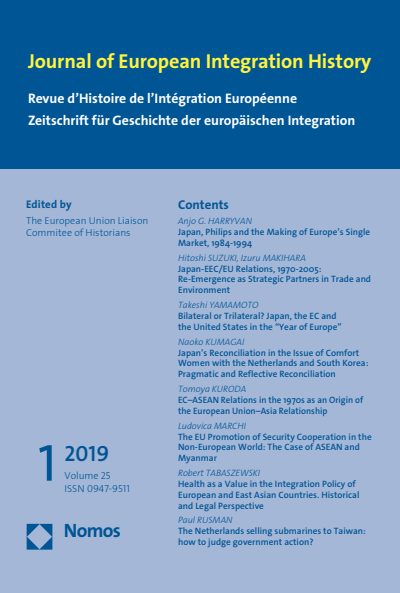
Japanese competition has been a prime factor in overcoming European economic fragmentation. In the course of the 1980s Japanese technology - especially in consumer electronics - as well as Japanese business practices were key incentives for the...
Negotiations on a Japan-EEC trade agreement faced a deadlock only three years after the launch of the common foreign trade policy in 1970. The European Commission adopted a step-by-step approach to change the climate. European business people were...
It is perhaps a little known fact that Henry Kissinger mentioned Japan several times in his [in]famous “Year of Europe” speech of 1973. He intended to include Japan in the “New Atlantic Charter”, making it a US-EC-Japan triangular framework...
Reconciliation among states tends to be pragmatic, based on cost/benefit national interest calculation. But it can be reflective, involving the perpetrator’s responsibility and remorse and the victims’ forgiveness, thus enhancing their mutual...
Today, the relationship between EU and Asian countries is at a turning point. During the Cold War, there was quite a large gap in status between the EC and ASEAN. The EC was highly institutionalised and the most advanced regional organisation, while...
This article explores the EU’s attempts at the ASEAN Regional Forum (ARF) to encourage Myanmar directly, or indirectly via the Association of Southeast Asian Nations (ASEAN), to connect with security cooperation. It argues that both ASEAN’s...
The article concerns cooperation on individual and public health between EU and ASEAN countries. A specific approach of European countries towards the protection, improvement and control of health was analysed and the involvement of governments from...
The Dutch sale of major weapons to Taiwan in 1980 ran counter to the Netherlands’ recent recognition of the People’s Republic of China as the sole representative of China. This led to a rupture of diplomatic relations, an outcome seemingly...