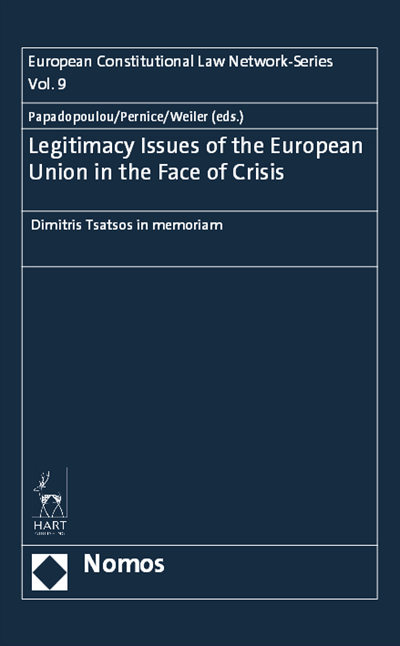
Legitimacy Issues of the European Union in the Face of Crisis
Dimitris Tsatsos in memoriam- Editors:
- | |
- Series:
- European Constitutional Law Network-Series, Volume 9
- Publisher:
- 2018
Summary
Angesichts der Krisen, die die Europäische Union seit einigen Jahren erschüttern, von der Finanzkrise bis hin zur Flüchtlingskrise und zum Brexit-Votum verstärken sich Skepsis und Ablehnung; eine drohende Legitimationskrise zwingt zur Analyse nicht nur der Ursachen sondern auch der Potentiale einer Stärkung der Legitimation. Dieser Band beruht auf den Beiträgen und Diskussionen zweier Konferenzen des European Constitutional Law Network (ECLN) über demokratietheoretische Grundlagen, eine Analyse der Ursachen der Finanzkrise und der Rolle der Gerichte bei ihrer Bewältigung, den Schutz der Grundrechte der Unionsbürger und die Stärkung von Bürgernähe und Partizipation durch Digitalisierung bis hin zu konkreten Reformvorschlägen. Ein dialogischer Epilog von Joseph Weiler und einigen der Autoren gibt Anregungen zur weiteren Diskussion und Reflektion, auf die es in den kommenden Jahren ankommt, wenn die EU als demokratische Union der Bürger aus den Krisen hervorgehen und sich weiter entwickeln soll.
Mit Beiträgen von
Giacinto della Cananea, Tom Eijsbouts, Federico Fabbrini, George Gerapetritis, Anna-Maria Konsta, George Karavokyris, Mattias Kumm, Jean-Victor Louis, Miguel Poiares Maduro, Antonis Manitakis, Ana Maria Guerra Martins, Lina Papadopoulou, Ingolf Pernice, Joseph H. H. Weiler und Jiri Zemánek
Keywords
Search publication
Bibliographic data
- Edition
- 2/2018
- Copyright Year
- 2018
- ISBN-Print
- 978-3-8487-5564-6
- ISBN-Online
- 978-3-8452-9741-5
- Publisher
- Nomos, Baden-Baden
- Series
- European Constitutional Law Network-Series
- Volume
- 9
- Language
- English
- Pages
- 432
- Product Type
- Edited Book
Table of contents
- Titelei/Inhaltsverzeichnis No access Pages 1 - 8
- Introduction: Legitimacy Issues of the European Union No access Pages 9 - 22
- Authors:
- Abstract No accessAuthors:
- I. Introduction No accessAuthors:
- II. Definition of ‘deliberative democracy’ No accessAuthors:
- III. Purpose of deliberative democracy No accessAuthors:
- Authors:
- A. Inclusiveness No accessAuthors:
- B. Endorsement No accessAuthors:
- C. Evidence No accessAuthors:
- D. Interplay and fair play No accessAuthors:
- E. Transparency No accessAuthors:
- V. Deliberativism beyond the state No accessAuthors:
- Authors:
- A. Deliberative modules No accessAuthors:
- B. Deliberative education and financing No accessAuthors:
- VII. Epilogue No accessAuthors:
- Authors:
- Abstract No accessAuthors:
- I. Three Modes of ‘Translation’ No accessAuthors:
- Authors:
- A. Talking about legitimacy No accessAuthors:
- B. Running out of output legitimacy No accessAuthors:
- C. Values-based legitimacy No accessAuthors:
- D. Procedural, democratic legitimacy No accessAuthors:
- Authors:
- Authors:
- 1. States as the single source of legitimacy No accessAuthors:
- 2. The European people as the single source of EU legitimacy No accessAuthors:
- B. The double legitimacy: states and peoples No accessAuthors:
- C. From double to triple legitimacy: adding citizens to states and peoples No accessAuthors:
- Authors:
- Authors:
- 1. The European Council and the Council No accessAuthors:
- 2. The European and the national Parliaments No accessAuthors:
- 3. The European Commission No accessAuthors:
- 4. The procedure to amend the Treaties No accessAuthors:
- Authors:
- 1. Representative democracy No accessAuthors:
- Authors:
- a. Participatory democracy No accessAuthors:
- b. The citizens’ initiative No accessAuthors:
- V. Loyal to the God of Small Steps No accessAuthors:
- Authors:
- Abstract No accessAuthors:
- Introduction: ‘Old’ Democratic Principles Revisited No accessAuthors:
- Authors:
- A. Origins of the Principle No accessAuthors:
- B. A Common Constitutional Tradition No accessAuthors:
- Authors:
- A. A Limited Budget? No accessAuthors:
- B. Ambiguity of the ‘Own Resources’ No accessAuthors:
- C. The European Parliament: A Spending Authority No accessAuthors:
- D. Rights Dissociated from Duties No accessAuthors:
- Authors:
- A. A European Tax No accessAuthors:
- B. Who Should Pay? No accessAuthors:
- C. A Pro-Investment Tax No accessAuthors:
- Conclusions No accessAuthors:
- Authors:
- Abstract No accessAuthors:
- Introduction No accessAuthors:
- I. Method No accessAuthors:
- II. Traditional and Constitutional Peoples; Original and Electoral Ones No accessAuthors:
- Authors:
- IV. Debunking the 'No-Demos Thesis' No accessAuthors:
- V. Debunking the Ein Volk No accessAuthors:
- Conclusion: an Answer to Giacinto No accessAuthors:
- Authors:
- Abstract No accessAuthors:
- Introduction No accessAuthors:
- Authors:
- A. A Eurocrisis as a result of faulty constitutional architecture? No accessAuthors:
- B. A sovereign debt crisis as a result of profligate spending of some states? No accessAuthors:
- Authors:
- 1. States as lenders of last resort for banks No accessAuthors:
- 2. Banks as lenders of last resort for states No accessAuthors:
- Authors:
- a. What a Banking Union must seek to achieve No accessAuthors:
- b. The ECB (in cooperation with the ESM) as a lender of last resort No accessAuthors:
- Authors:
- Authors:
- 1. On legacy loss allocation No accessAuthors:
- 2. From interstate transfers to the EU´s own resources No accessAuthors:
- B. Why the elections to the European Parliament should be turned into a genuine competition for a European government No accessAuthors:
- Conclusion No accessAuthors:
- Authors:
- Abstract No accessAuthors:
- Introduction No accessAuthors:
- I. Beyond the Limits of Interpretation No accessAuthors:
- II. Judicial Self-Restraint during the Financial Crisis: Legal Techniques and Pragmatological Constraints No accessAuthors:
- III. Authority and Competence No accessAuthors:
- IV. Conclusion: Crisis, Normality and Legitimacy No accessAuthors:
- Authors:
- I. Introduction No accessAuthors:
- II. The ECB and the Court of Justice No accessAuthors:
- III. The Limits of Judicial Control on Monetary Policy, the Policy of Communication and the OMT Decision No accessAuthors:
- IV. The OMT and the Order by the BVerfG for a Preliminary Ruling of the Court of Justice No accessAuthors:
- V. The Conclusions of the Advocate General No accessAuthors:
- VI. The Court’s Decision No accessAuthors:
- VII. Conclusions No accessAuthors:
- Authors:
- Abstract No accessAuthors:
- I. A Matter of Equivalence No accessAuthors:
- II. National and European Perspectives of the Common Constitutional Values No accessAuthors:
- III. Breakdown of National Democracies in the Assertion of their Autonomies No accessAuthors:
- IV. More European Democracy No accessAuthors:
- V. The Notion of a ‘Common Constitutional Core’ No accessAuthors:
- VI. Does Sovereignty Matter? No accessAuthors:
- VII. Conclusion No accessAuthors:
- Authors:
- Abstract: No accessAuthors:
- I. The paradox: a resilient constitutional regime in spite of a collapsing political system. No accessAuthors:
- Authors:
- A. Resilience through adaptation: compliance with the country’s international obligations; constitutional changes through informal amendments to the Constitution. No accessAuthors:
- . Resilience through an informal change in the Constitution via jurisprudence: the privileged judicial techniques of resorting to the vague concept of ‘the public interest’ and the criterion of ‘propo... No accessAuthors:
- III. Towards a malleable or flexible constitutional normality. The ‘crisis’ as a momentary yet decisive ‘discontinuity’ in a long constitutional continuity. No accessAuthors:
- IV. Conclusion No accessAuthors:
- Authors:
- Abstract No accessAuthors:
- Authors:
- A. The background of Opinion 2/13 No accessAuthors:
- B. Scholars’ Reactions No accessAuthors:
- C. Purpose of the Present Study No accessAuthors:
- Authors:
- A. Multilevel Protection of Fundamental Rights and EU Accession to the ECHR No accessAuthors:
- B. Multilevel Constitutionalism No accessAuthors:
- Authors:
- A. Violation of the integrity and autonomy of EU Law No accessAuthors:
- B. Institutional Innovations No accessAuthors:
- C. CJEU Jurisdiction over Common Foreign and Security Policy No accessAuthors:
- Authors:
- Authors:
- Authors:
- a) Coordination between Article 53 of the Charter and Article 53 ECHR No accessAuthors:
- b) Area of Freedom, Security and Justice No accessAuthors:
- c) Jurisdiction over Common Foreign and Security Policy No accessAuthors:
- 2. Principle of Common Values between the EU Member States, the EU, the Council of Europe and its Member States No accessAuthors:
- 3. Principle of Cooperative Judicial Dialogue No accessAuthors:
- 4. Principle of Sincere Cooperation and Mutual Trust No accessAuthors:
- V. Concluding Remarks No accessAuthors:
- Authors:
- Abstract No accessAuthors:
- I. The Legislative Framework No accessAuthors:
- II. Extension of Citizenship Rights No accessAuthors:
- III. Limitation of Citizenship Rights No accessAuthors:
- IV. Concluding Remarks on the Right to Care No accessAuthors:
- Authors:
- Abstract No accessAuthors:
- Introduction No accessAuthors:
- Authors:
- A. EU-strategies for e-government No accessAuthors:
- B. E-government by legislation: The Services-Directive No accessAuthors:
- C. Encouragement: Taking the citizen Seriously No accessAuthors:
- Authors:
- A. Questioning input-legitimacy in the EU No accessAuthors:
- Authors:
- 1. Transparency No accessAuthors:
- 2. An Evolving European Public Sphere No accessAuthors:
- 3. E-voting, Political Dialogue and Accountability No accessAuthors:
- 4. Participation: ‘Speaking with Your Government’ No accessAuthors:
- C. An open constitutional process: The example of the Constitutional Convention No accessAuthors:
- Authors:
- A. Transparency of decision-making processes No accessAuthors:
- B. Networks for parliamentary, administrative and judicial cooperation No accessAuthors:
- C. Public discourse on subsidiarity as a case of throughput legitimacy No accessAuthors:
- Conclusions No accessAuthors:
- Authors:
- Abstract No accessAuthors:
- Introduction No accessAuthors:
- I. The Council and its shortcomings in EU legislation No accessAuthors:
- II. The European Council and its potential in EU legislation No accessAuthors:
- III. Conclusion No accessAuthors:
- Authors:
- Introduction No accessAuthors:
- I. Two Narratives and Democracy No accessAuthors:
- II. EU Failings in Addressing the Crisis and Democracy No accessAuthors:
- Authors:
- A. Union of Rules No accessAuthors:
- B. Union of National democracies No accessAuthors:
- Authors:
- 1. A Budget and Resources for Stability and Democracy No accessAuthors:
- 2. New and Reformed EU Policies No accessAuthors:
- 3. A European political space No accessAuthors:
- Authors:
- I No accessAuthors:
- II No accessAuthors:
- III No accessAuthors:
- IV No accessAuthors:
- On Chapter 1: George Gerapetritis No access
- Reply of George Gerapetritis No access
- On Chapter 2: Lina Papadopoulou No access
- Reply of Lina Papadopoulou No access
- On Chapter 3: Giacinto della Cananea No access
- Reply of Giacinto della Cananea No access
- On Chapter 4: Tom Eisbouts No access
- Reply of Tom Eijsbouts No access
- On Chapter 6: Karavokyris No access
- Reply of George Karavokyris No access
- On Chapter 7: Jean Victor Louis No access
- Reply of Jean-Victor Louis No access
- On Chapter 9: Antonis Manitakis No access
- Reply of Antonis Manitakis No access
- On Chapter 10: Anna Maria Guerra Martins No access
- Reply of Ana Maria Guerra Martins No access
- On Chapter 12: Ingolf Pernice No access
- Reply of Ingolf Pernice No access
- List of Authors No access Pages 427 - 432