, to see if you have full access to this publication.
Monograph No access
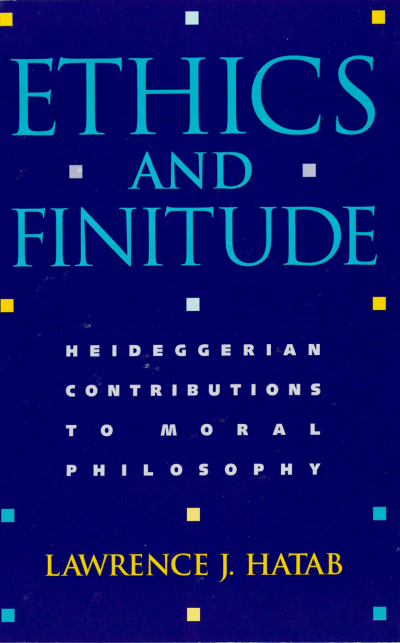
Ethics and Finitude
Heideggerian Contributions to Moral Philosophy
Authors:
Publisher:
2000
Summary
This book explores what anyone interested in ethics can draw from Heidegger's thinking. Heidegger argues for the radical finitude of being. But finitude is not only an ontological matter; it is also located in ethical life. Moral matters are responses to finite limit-conditions, and ethics itself is finite in its modes of disclosure, appropriation, and performance. With Heidegger's help, Lawrence Hatab argues that ethics should be understood as the contingent engagement of basic practical questions, such as how should human beings live?
Search publication
Bibliographic data
Edition
1/2000
Copyright Year
2000
ISBN-Print
978-0-8476-9683-3
ISBN-Online
978-0-7425-7879-1
Publisher
Rowman & Littlefield, Lanham
Language
English
Pages
2
Product Type
Monograph
Table of contents
ChapterPages
Contents No access
Preface No access
Abbreviations No access
Introduction No access Pages 1 - 8
1 An Overview of Heidegger's Thought No access Pages 9 - 32
2 Language, Pluralism, and Truth No access Pages 33 - 50
3 Being-Ethical-in-the-World No access Pages 51 - 98
4 Heidegger and Aristotle No access Pages 99 - 116
5 Virtue No access Pages 117 - 136
6 The Role of Empathy in Ethics No access Pages 137 - 168
7 Selfhood, Freedom, and Community No access Pages 169 - 194
8 Ethical Existence and Limits No access Pages 195 - 200
Epilogue: Heidegger and National Socialism No access Pages 201 - 208