, to see if you have full access to this publication.
Monograph No access
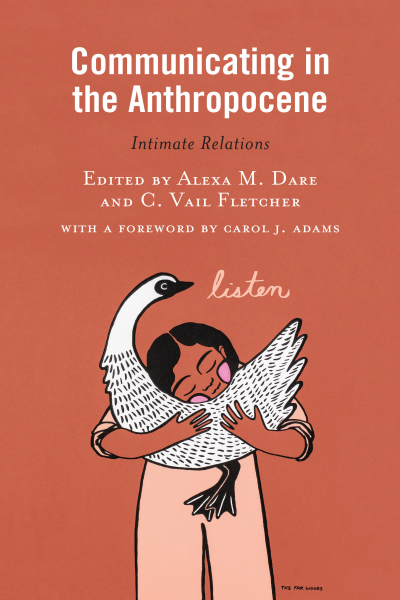
Communicating in the Anthropocene
Intimate Relations
Authors:
|
Publisher:
2021
Summary
The purpose of Communicating in the Anthropocene: Intimate Relations is to tell a different story about the world. Humans, especially those raised in Western traditions, have long told stories about themselves as individual protagonists who act with varying degrees of free will against a background of mute supporting characters and inert landscapes. Humans can be either saviors or destroyers, but our actions are explained and judged again and again as emanating from the individual. And yet, as the coronavirus pandemic has made clear, humans are unavoidably interconnected not only with other humans, but with nonhuman and more-than-human others with whom we share space and time. Why do so many of us humans avoid, deny, or resist a view of the world where our lives are made possible, maybe even made richer, through connection? In this volume, we suggest a view of communication as intimacy. We use this concept as a provocation for thinking about how we humans are in an always-already state of being-in-relation with other humans, nonhumans, and the land.
Keywords
Search publication
Bibliographic data
Edition
1/2021
Copyright Year
2021
ISBN-Print
978-1-7936-2928-9
ISBN-Online
978-1-7936-2929-6
Publisher
Lexington, Lanham
Language
English
Pages
416
Product Type
Monograph
Table of contents
ChapterPages
Contents No access
Foreword No access
Acknowledgments No access
Chapter 1 Introduction No access Pages 1 - 10
Chapter 2 Vigilant Mourning and the Future of Earthly Coexistence No access
Chapter 3 Presence and Absence in the Watershed No access
Chapter 4 The Trouble with Resilience No access
Chapter 5 Solastalgia and Art Therapy in Climate Change No access
Chapter 6 Living (in) Spider Webs No access
Chapter 7 The Permeable Heart No access
Chapter 8 Intimacy on the Half-Shell No access
Chapter 9 i am naiad No access
Chapter 10 Ada Clapham Govan and “Birds I Know” No access
Chapter 11 Dialogic Elephant and Human Relations in Sri Lanka as Social Practices of Cohabitation No access
Chapter 12 ocean medicine, mother medicine, sky medicine No access
Chapter 13 Weirding Wellness No access
Chapter 14 Multispecies Motherhood No access
Chapter 15 Plant Persons, More-than-Human Power, and Institutional Practices in Indigenous Higher Education No access
Chapter 16 OAK No access
Chapter 17 Objects/Ecologies No access
Chapter 18 If the Ocean Were a Person No access
Chapter 19 Personal Affairs No access
Chapter 20 Tahlequah’s Internatural Activism No access
Chapter 21 Never the Same River Twice No access
Chapter 22 The Titans at the Heart of the Anthropocene No access
Chapter 23 Listen to the Lake No access
Chapter 24 The Geo-Doc No access
Chapter 25 Intimate Dwelling and Mourning Loss in the (m)Anthropocene No access
Chapter 26 The Climate Gaze and Koalas in Extremis No access
Chapter 27 From Fatbergs to Microplastics No access
Chapter 28 Doğa İçin Çal (Play for Nature) No access
Chapter 29 Subversive Art No access
Index No access Pages 397 - 404
About the Editors, ContributingAuthors, and Artists No access Pages 405 - 416