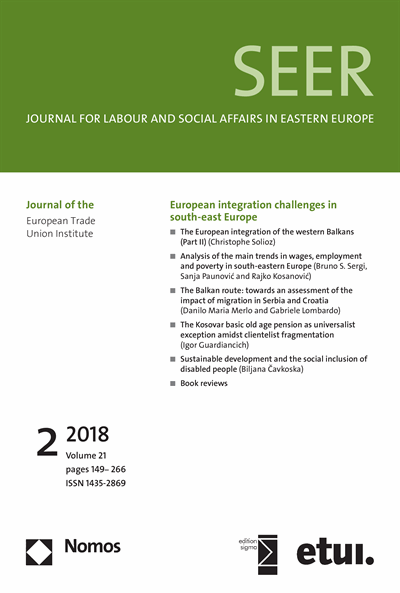
SEER tries to stimulate the exchange of information among researchers, trade unionists and people who have a special interest in the political, social and economic development of the region of south-east Europe. The journal tries to draw attention to new research results and the latest analyses about the ongoing process of political and social changes in the south-east of Europe. It tries to create more understanding for the importance of the elaboration of democratic structures in industrial relations. The SEER combines contributions from different disciplines and »political schools« into an information package of interest for policy makers, researchers, academics and trade unionists from various backgrounds.Website: www.seer.nomos.de
This final part of the author’s keynote on the occasion of our 20th anniversary symposium, held earlier in 2018, draws the recent history of central and eastern Europe up to date. It then goes on to explore the deep-seated changes that the author...
This article reviews the recent performance of south-east European, and eastern European, economies on the issue of wages. This is a revised version of an article which we carried previously (Vol. 20 No. 2) but which has now been updated to take...
This article describes the flow of migrants towards the EU and seeks to provide a preliminary assessment of the impact of such flows on the economies of Croatia and Serbia, two countries on the route but not necessarily destination countries in...
Kosovo’s universal non-means-tested basic old age pension provides an income floor for all resident citizens aged 65 and over who do not qualify for other budget-financed schemes. It is regarded as administratively simple and cost-efficient....
The seventeen Sustainable Development Goals of the 2030 UN Agenda for Sustainable Development were adopted by world leaders at an historic UN Summit in 2015 and officially came into force in 2016. The goals are not legally binding, but it is for...