, to see if you have full access to this publication.
Monograph No access
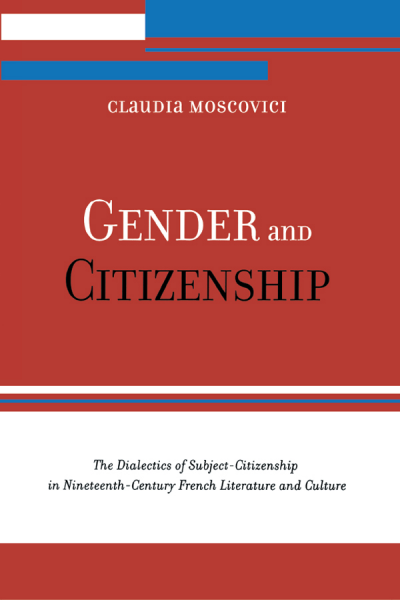
Gender and Citizenship
The Dialectics of Subject-Citizenship in Nineteenth Century French Literature and Culture
Authors:
Publisher:
2000
Summary
Moscovici proposes a new understanding of how gender relations were reformulated by both male and female writers in nineteenth-century France. She analyzes the different versions of gendered citizenship elaborated by Friedrich Hegel, George Sand, Honore de Balzac, Auguste Comte and Herculine Barbin revealing a shift from a single dialectical (or male-centered) definition of citizenship to a double dialectical (or bi-gendered) one in which each sex plays an important role in subject-citizenship and is defined as the negation of the other sex. Moscovici further argues that a double dialectical pattern of androgyny endows women with a (relational) cultural identity that secures their paradoxical roles as both representatives and outsiders to subject-citizenship in nineteenth-century French society and culture.
Search publication
Bibliographic data
Edition
1/2000
Copyright Year
2000
ISBN-Print
978-0-8476-9694-9
ISBN-Online
978-0-7425-8129-6
Publisher
Rowman & Littlefield, Lanham
Language
English
Pages
131
Product Type
Monograph
Table of contents
ChapterPages
Table of Contents No access
Acknowledgments No access
Introduction. The Dialectics of Subject-Citizenship No access
Chapter 1. Theoretical Foundations: Doubling the Dialectic No access Pages 1 - 12
Chapter 2. The Social Model of Citizenship: Comte's A General View of Positivism No access Pages 13 - 36
Chapter 3. Gendered Spheres in Balzac's La Cousine Bette No access Pages 37 - 64
Chapter 4. Exemplary Androgyny in Sand's Indiana No access Pages 65 - 88
Chapter 5. Gender Trouble in the Diary of Herculine Barbin: Unreading Foucault No access Pages 89 - 110
Conclusion. Androgyny and the Chiasmic Economy of Sexual Difference No access Pages 111 - 118