, to see if you have full access to this publication.
Edited Book No access
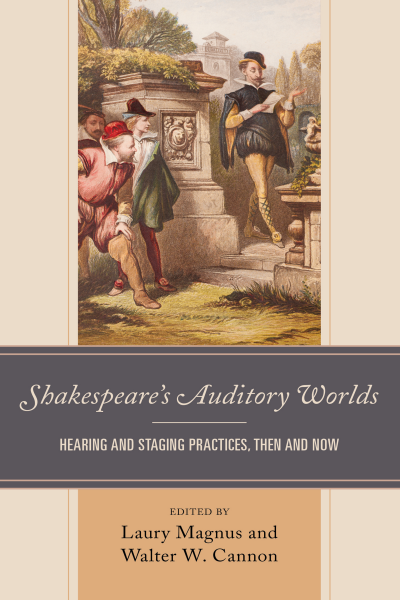
Shakespeare's Auditory Worlds
Hearing and Staging Practices, Then and Now
Editors:
|
Publisher:
2020
Summary
Inspired by the verbal exuberance and richness of all that can be heard by audiences both on and off Shakespeare’s stages, Shakespeare’s Auditory Worlds examines such special listening situations as overhearing, eavesdropping, and asides. It breaks new ground by exploring the complex relationships between sound and sight, dialogue and blocking, dialects and other languages, re-voicings, and, finally, nonverbal or metaverbal relationships inherent in noise, sounds, and music, staging interstices that have been largely overlooked in the critical literature on aurality in Shakespeare. Its contributors include David Bevington, Ralph Alan Cohen, Steve Urkowitz, and Leslie Dunn, and, in a concluding “Virtual Roundtable” section, six seasoned repertory actors of the American Shakespeare Center as well, who discuss their nuanced hearing experiences on stage. Their “hearing” invites us to understand the multiple dimensions of Shakespeare’s auditory world from the vantage point of actors who are listening “in the round” to what they hear from their onstage interlocutors, from offstage and backstage cues, from the musicians’ galleries, and often most interestingly, from their audiences.
Keywords
Search publication
Bibliographic data
Edition
1/2020
Copyright Year
2020
ISBN-Print
978-1-68393-200-0
ISBN-Online
978-1-68393-201-7
Publisher
Lexington, Lanham
Language
English
Pages
293
Product Type
Edited Book
Table of contents
ChapterPages
Contents No access
Acknowledgments No access
Introduction Listening to Shakespeare's Worlds of Sound No access Pages 1 - 14
Chapter 1 "Report me and my cause aright": Hearing the Language of Exhortation in Hamlet and King Lear No access
Chapter 2 Sound and Sight, Sound vs. Sight in Hamlet No access
Chapter 3 Hearing and Interfering: Solving Puzzles in Theater Productions of Measure for Measure No access
Chapter 4 Silence, Mishearing, and Indirection in Much Ado No access
Chapter 5 Writing Letters, Hearing Voices: Epistolary Error in Twelfth Night No access
Chapter 6 Staging "Skimble-skamble Stuff": 1 Henry IV and the Welsh Voice No access
Chapter 7 Soundscape for an Offstage Beheading: Shakespeare's Revision of 2 Henry VI 4.1 No access
Chapter 8 "Fearful and confused cries": Birdsong, Sympathy, and the Fear of Sound in Titus Andronicus No access
Chapter 9 "They say it will penetrate": Music as Aural Violation in The Two Gentlemen of Verona and Cymbeline No access
Chapter 10 Hearing Cues in Shakespeare: Instrumental Music and Sound Effects in the Later Plays No access
Chapter 11 Reconstructing Audience at Shakespeare's Globe No access
Voices from the Blackfriars Stage: A Virtual Roundtable Discussion from Actors at the American Shakespeare Center No access
Hearing on the Blackfriars Stage: A Coda No access
Index No access Pages 275 - 288
About the Editors and Contributors No access Pages 289 - 293
Similar publications
from the topics "Medienwissenschaft, Kommunikationsforschung"