KNOWLEDGE ORGANIZATION is a forum for all those interested in the organization of knowledge on a universal or a domain-specific scale, using concept-analytical or concept-synthetical approaches, as well as quantitative and qualitative methodologies. KNOWLEDGE ORGANIZATION also addresses the intellectual and automatic compilation and use of classification systems and thesauri in all fields of knowledge, with special attention being given to the problems of terminology.KNOWLEDGE ORGANIZATION publishes original articles, reports on conferences and similar communications, as well as book reviews, letters to the editor, and an extensive annotated bibliography of recent classification and indexing literature.KNOWLEDGE ORGANIZATION should therefore be available at every university and research library of every country, at every information center, at colleges and schools of library and information science, in the hands of everybody interested in the fields mentioned above and thus also at every office for updating information on any topic related to the problems of order in our information-flooded times.
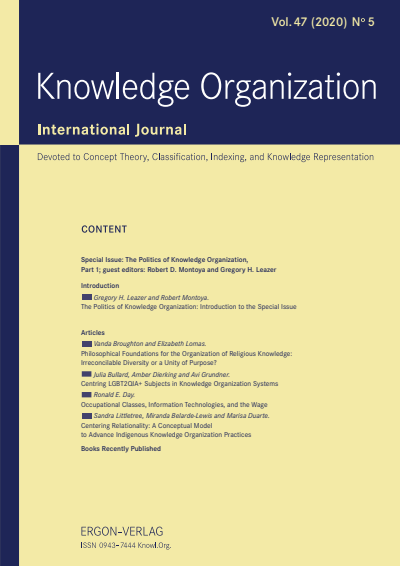
Politics is about the distribution of goods and risks. We can describe the distribution of goods, and we can also characterize those distributions as a kind of inequality. As a baseline definition of “politics of information” we mean the...
: We examine the way in which religion is managed in the major library classification schemes and in archival practice and how and why bias and misrepresentation occur. Broad definitions of what is meant by diversity and religious pluralism and why...
This paper contains a report of two interdependent knowledge organization (KO) projects for an LGBT2QIA+ library. The authors, in the context of volunteer library work for an independent library, redesigned the classification system and subject...
Occupational classifications mix epistemic and social notions of class in interesting ways that show not only the descriptive but also the prescriptive uses of documentality. In this paper, I would like to discuss how occupational classes have...
Scholars and practitioners have exposed the limitations of traditional Euro-American approaches to knowledge organization (KO) when it comes to Indigenous topics. To develop more effective KO practices, there is a need for KO practitioners to...