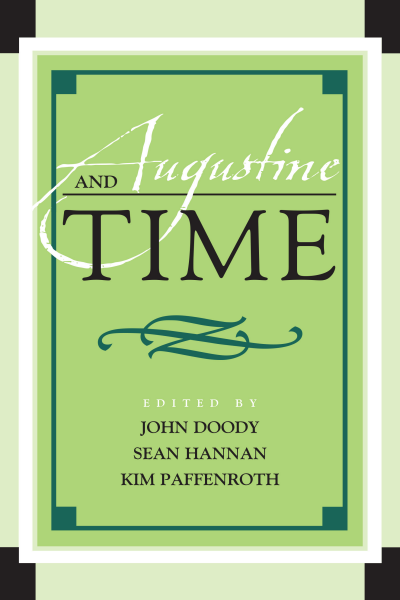
Augustine and Time
- Editors:
- | |
- Publisher:
- 2021
Summary
This collection examines the topic of time in the life and works of Augustine of Hippo. Adopting a global perspective on time as a philosophical and theological problem, the volume includes reflections on the meaning of history, the mortality of human bodies, and the relationship between temporal experience and linguistic expression. As Augustine himself once observed, time is both familiar and surprisingly strange. Everyone’s days are structured by temporal rhythms and routines, from watching the clock to whiling away the hours at work. Few of us, however, take the time to sit down and figure out whether time is real or not, or how it is we are able to hold our past, present, and future thoughts together in a straight line so that we can recite a prayer or sing a song.
Divided into five sections, the essays collected here highlight the ongoing relevance of Augustine’s work even in settings quite distinct from his own era and context. The first three sections, organized around the themes of interpretation, language, and gendered embodiment, engage directly with Augustine’s own writings, from the Confessions to the City of God and beyond. The final two sections, meanwhile, explore the afterlife of the Augustinian approach in conversation with medieval Islamic and Christian thinkers (like Avicenna and Aquinas), as well as a broad range of Buddhist figures (like Dharmakīrti and Vasubandhu).
What binds all of these diverse chapters together is the underlying sense that, regardless of the century or the tradition in which we find ourselves, there is something about the puzzle of temporality that refuses to go away. Time, as Augustine knew, demands our attention. This was true for him in late ancient North Africa. It was also true for Buddhist thinkers in South and East Asia. And it remains just as true for humankind in the twenty-first century, as people around the globe continue to grapple with the reality of time and the challenges of living in a world that always seems to be to be speeding up rather than slowing down.
Search publication
Bibliographic data
- Edition
- 1/2021
- Copyright Year
- 2021
- ISBN-Print
- 978-1-7936-3775-8
- ISBN-Online
- 978-1-7936-3776-5
- Publisher
- Lexington, Lanham
- Language
- English
- Pages
- 342
- Product Type
- Edited Book
Table of contents
- Contents No access
- Notes No access
- Plotinus and Manichaeism on Time, Eternity, and History No access
- Time, Eternity, and History in Augustine’s Italian Writings No access
- Time, Eternity, and History in Augustine’s Thagaste Writings No access
- Conclusion No access
- Notes No access
- Augustine on Time No access
- Critical Responses to Augustine on Time No access
- Notes No access
- I No access
- II No access
- III No access
- IV No access
- V No access
- Notes No access
- Listening to the Voice of Mutable Things No access
- Our Voice to Sing No access
- Living as Singing No access
- Conclusion No access
- Notes No access
- Some Premises No access
- The Internal Reality of Time No access
- Distentio Animi and Joshua’s Sun No access
- Deus Creator Omnium No access
- Final Remarks No access
- Notes No access
- Gadamer’s Theory of Language No access
- Christian Logos Theology No access
- The Augustinian Inner Word No access
- The Reconciliation of Time and Eternity No access
- Conclusion No access
- Notes No access
- Conceptual Distinctions and Augustine’s Physical Account of Time No access
- Resurrected Bodies in the Sermons of Early 411 No access
- Conclusion No access
- Notes No access
- Crisis Theology: Contextualizing Augustine’s City of God No access
- The Desexualization of Gender in the World That Is to Come No access
- Gendered Heavenly Bodies No access
- Conclusion No access
- Notes No access
- New Feminist Materialism No access
- Augustine, Gender, and the Self in Time No access
- Augustine and the New Feminist Materialists in Dialogue No access
- Conclusion No access
- Notes No access
- Avicenna’s Theory of Time No access
- Avicenna and the Puzzle of Too Many Times No access
- Avicenna’s Solution to the Two Puzzles No access
- Avicenna and Augustine on the Eternity of Time No access
- Notes No access
- The Hermeneutics of the Timing of Creation in the De potentia No access
- The Timing of Creation in the Summa theologiae No access
- Conclusion No access
- Notes No access
- Augustine’s Dilemma: Temporal Passage and the Eternity of Divine Knowledge No access
- Aquinas: Sharpening the Horns of Augustine’s Dilemma No access
- Scotus’s Exposure of Augustine’s Dilemma No access
- Suarez’s Augustinian Presentism No access
- Wyclif’s Augustinian Eternalism No access
- Conclusion No access
- Notes No access
- Who Is Thomas Bradwardine? No access
- Bradwardine and Augustinian Approaches to Time No access
- What Is an “Augustinian” View of Time? No access
- Temporality in William Ockham No access
- Bradwardine’s Rejection of Ockham No access
- Conclusion: Bradwardine’s Legacy No access
- Notes No access
- Situating Time and God in Gregory No access
- Situating Gregory in Time No access
- Conclusion No access
- Notes No access
- Ontological Presentism No access
- Practical Presentism No access
- Buddhist Practical Presentism No access
- In Search of Time Past No access
- Varieties of Buddhist Four-Dimensionalism No access
- Reality, Eternality, and the Ontological Distinction No access
- Conclusion No access
- Notes No access
- Proving the Instantaneous Passing Away of All Phenomena No access
- Consciousness in a Fleeting World No access
- Seeing the Instantaneous Passing Away of All Phenomena No access
- Consciousness and the Eternal Present No access
- Notes No access
- Notes No access
- Bibliography No access Pages 309 - 338
- About the Editors and Contributors No access Pages 339 - 342