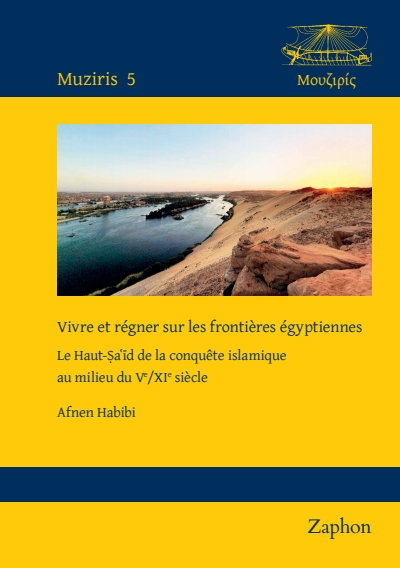
Vivre et régner sur les frontières égyptiennes
Le Haut-Ṣaʽīd de la conquête islamique au milieu du Ve/XIe siècle- Authors:
- Publisher:
- 2026
Summary
The objective of this study is to undertake a regional analysis of Upper Ṣaʽīd – situated in the far south of Egypt – during a time of profound political, social, and cultural transformation – from the Islamic conquest to the mid-5th/11th century. The establishment of the new Islamic authority in Egypt marks a significant turning point in the broader history of the Mediterranean. This analysis draws on a diverse corpus of sources, including papyrological documents (Greek and Coptic for the 7th–8th centuries, Arabic from the 8th century onward), funerary stelae, archaeological findings, and literary texts. The investigation begins in the 1st/7th century, a time when Egypt was administratively divided into two geographic entities : Upper and Lower Egypt. The importance of papyri and ostraca is highlighted in the second part of this research, as they constitute the most valuable source for studying the administrative organisation of the territory in question. Using these Greek and Coptic documents from the 1st/7th–2nd/8th centuries and Arabic documents from the 2nd/8th century onwards, I examine the evolution of the administrative hierarchy between the Byzantine legacy, and the new structure adopted by the new power. Papyrological documents and ostraca are also utilized in the third part of this study to analyze the role played by Upper Ṣaʽīd as a hub monopolizing commercial networks. The evidence reveals that, alongside the interactions between state officials, monasteries and merchants, the network was notably open, attracting pilgrims and merchants from diverse regions. These actors were interconnected through sales transactions and services rendered, reflecting a sustained level of economic activity until the 5th/11th century. These routes were controlled by these entities, with caravans and riverboats facilitating the efficient operation of commerce. Thanks to its strategic geographical position, Upper Ṣaʽīd emerged as a commercial centre and an attractive market, guaranteeing its significance for the Muslim authorities based in the capital.
Reihe
Muziris - 5
Search publication
Bibliographic data
- Edition
- 1/2026
- Copyright Year
- 2026
- ISBN-Print
- 978-3-96327-348-3
- ISBN-Online
- 978-3-96327-349-0
- Publisher
- Zaphon, Münster
- Series
- Muziris / Historische Papyrologie, Epigraphik und verwandte Gebiete der antiken Kulturen / Historical papyrology, epigraphy and neighbouring fields in ancient cultures
- Volume
- 5
- Language
- French
- Pages
- 294
- Product Type
- Monograph
Table of contents
- Remerciements No access
- Table des matières No access
- Translittération en arabe littéral No access
- Liste des abréviations No access
- La première catégorie No access
- La deuxième catégorie No access
- La troisième catégorie No access
- English abstract of the Introduction No access
- A. Les documents grecs No access
- B. Les papyrus arabes No access
- C. Les papyrus et ostraca coptes No access
- A. Les inscriptions funéraires No access
- B. L’apport archéologique No access
- A. L’historiographie égyptienne No access
- B. L’historiographie chrétienne No access
- C. Les géographes No access
- English abstract of the chapter: The contribution of sourcesto the history of Upper Ṣaʽīd following the Islamic conquest No access
- A. Iḫmīm No access
- B. Isnā No access
- C. Udfū No access
- D. Uswān No access
- A. Les Buǧǧa No access
- B. al-Wāḥāt No access
- C. ʽīḏāb No access
- D. Les territoires des mines No access
- A. al-Ǧanādil (Les cataractes) No access
- B. Bilāq No access
- C. al-Qaṣr No access
- D. Le territoire nubien No access
- English abstract of the chapter: The geographical area of Upper Ṣaʽīdand its borders with Nubian territory No access
- 1. La conquête de l’Égypte et l’expédition du Haut-Ṣaʽīd par les musulmans No access
- 2. La conquête musulmane de la Nubie et le traité de Baqṭ No access
- 3. La relation entre le pouvoir musulman et les Buǧǧa No access
- English abstract of the chapter: The Muslim conquest of Upper Ṣaʽīdin the 1st/7th century No access
- Conclusion de la première partie No access
- 1. L’organisation territoriale et l’origine des institutions administratives No access
- A. Les ducs No access
- B. Les topotérètes No access
- C. Les pagarques No access
- D. Les notaires No access
- E. Les scribes et les messagers No access
- 3. Le pouvoir judiciaire et l’apparition des Cadis No access
- English abstract of the chapter: The administrative organisationof Upper Ṣaʽīd following the Muslim settlement No access
- 1. Le système fiscal No access
- 2. Le système de la perception des taxes No access
- 3. Le problème des fugitifs et l’émission des saufs-conduits No access
- English abstract of the chapter: The financial organisation No access
- 1. L’organisation militaire du Haut-Ṣaʽīd No access
- 2. Le rôle diplomatique du Haut-Ṣaʽīd No access
- English abstract of the chapter: The military organisationand diplomatic role played by the Upper Ṣa’īd No access
- Conclusion de la deuxième partie No access
- A. Des échanges entre fonctionnaires No access
- B. Des échanges entre fonctionnaires et églises No access
- C. Des échanges entre commerçants No access
- A. Les routes de circulation No access
- B. Au rythme des caravanes No access
- C. Les flux maritimes No access
- A. Des marchandises alimentaires No access
- B. Des matériaux de construction No access
- C. Des produits textiles et de la poterie No access
- D. Des mines No access
- E. Des esclaves No access
- English abstract of the chapter: The Upper Ṣaʽīd: a monopoly of trade networks No access
- A. Les artisans No access
- B. Les marins No access
- C. Les commerçants No access
- D. Les ouvriers du textile et les travailleurs des mines No access
- 2. Les professions dans les stèles funéraires No access
- 3. Le niveau intellectuel d’après les Kutub al-Tarāǧim No access
- English abstract of the chapter: Who are the inhabitants ?Professions and knowledge in question No access
- 1. Datation et provenance confirmés No access
- A. L’apport des stèles funéraires No access
- B. L’apport de Kutub al-Tarāǧim No access
- A. al-Mawālī No access
- B. Le statut de « Um Walad », « al-ǧāria » ou « al-fatā » No access
- English abstract of the chapter: Sociological portrait of the societyof Upper Ṣa’īd No access
- Conclusion de la troisième partie No access
- General conclusion No access
- Bibliographie No access Pages 251 - 270
- Aliments No access
- Lieux No access
- Mesures No access
- Personnages No access
- Substances No access