, to see if you have full access to this publication.
Monograph No access
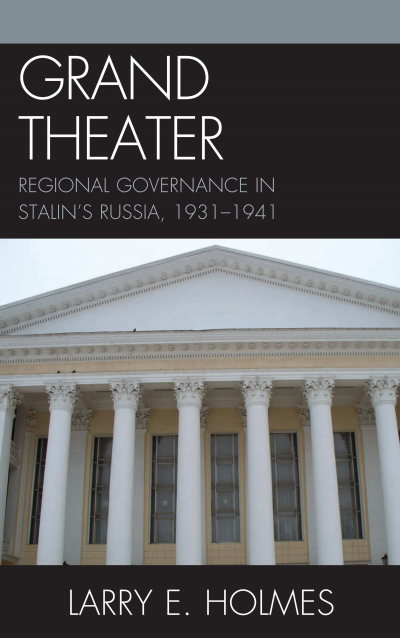
Grand Theater
Regional Governance in Stalin's Russia, 1931-1941
Authors:
Publisher:
2009
Summary
Grand Theater examines bureaucracy not as a readily identifiable structure but rather as a process of day-to-day operation. Thus it is concerned with how agencies of both the communist party and the state apparatus not only implemented directives from above but also responded to perceived successes and failures, chose to produce, share, and conceal information, and reacted when common citizens injected themselves into governance by making demands and complaints. It concentrates on the 1930s as a seminal period when Stalin's regime established a hypercentralized system that dominated the Soviet Union until its collapse and the Russian Federation since then. It also focuses on the administration of schools as the primary window through which to examine governance because of the importance of education to Soviet authorities, most notably Stalin himself, and the accessibility of archival documents in this field, one not classified as particularly sensitive. Grand Theater provides novel insights into the functioning of Stalinist bureaucracy, brings to the forefront a new understanding of center-periphery relations, and reveals the important role of individuals in what has heretofore been largely regarded, when beyond the Kremlin's inner circle, as a highly impersonal system. It also examines in unprecedented ways the reciprocal relationship between ideology and policy formation, on the one hand, and actual administrative practices, on the other, a relationship that more often than not had negative and dysfunctional consequences for both the governed and governing. Holmes argues that the Soviet administrative system during the 1930s was much like grand theater. The documents produced for and by that system were the script for a discursive theatrical reality that inspired neither a careful appraisal of problems nor a dispassionate search for workable solutions.
Search publication
Bibliographic data
Edition
1/2009
Copyright Year
2009
ISBN-Print
978-0-7391-3591-4
ISBN-Online
978-0-7391-3593-8
Publisher
Lexington, Lanham
Language
English
Pages
258
Product Type
Monograph
Table of contents
ChapterPages
Contents No access
Acknowledgments No access
Note on Transliteration and Abbreviations No access
Districts in the Kirov Region, 1935 No access
Preface: The Wealth of Regional History No access
Introduction No access Pages 1 - 24
Chapter 01: A Script of Perfection, Failure, Blame No access Pages 25 - 38
Chapter 02: Ascent into Darkness: Escalating Negativity, 1931–1941 No access Pages 39 - 62
Chapter 03: A Symbiosis of Errors: The Personal ,Professional, and Political, 1931–1938 No access Pages 63 - 90
Chapter 04: The Art of Complaint, 1931–1938 No access Pages 91 - 106
Chapter 05: Power to the People and to the State: Great Performances by V. P. Bulygina and E. T. Chernykh No access Pages 107 - B
Chapter 06: “My Friend, I’ve Hit Rock Bottom”: Politics and Friendship No access Pages 129 - 150
Chapter 07: A Tragedy: The Terror No access Pages 151 - 176
Chapter 08: Degeneration of the Symbiosis of Errors, 1938–1941 No access Pages 177 - 190
Chapter 09: “Stop This Petty Tyranny”: Letters and The Administration of Schools in Falenki, 1940–1941 No access Pages 191 - 204
Chapter 10: Proprietary Professionalism: Mine by Right, 1938–1941 No access Pages 205 - 228