, to see if you have full access to this publication.
Monograph No access
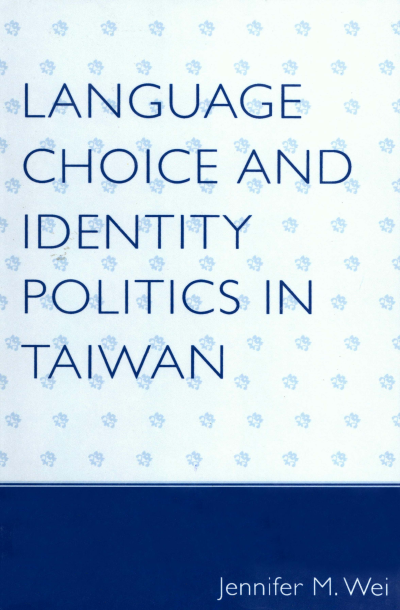
Language Choice and Identity Politics in Taiwan
Authors:
Publisher:
2008
Summary
Jennifer M. Wei argues that construction and perceptions of language and identity parallel sociopolitical transformations, and language and identity crises arise during power transitions. Under these premises, language and identity are never well-defined or well-bounded. Instead, they are best viewed as political symbols subject to manipulation and exploitation during socio-historical upheavals. A choice of language—from phonological shibboleth, Mandarin, or Taiwanese, to choice of official language—cuts to the heart of contested cultural notions of self and other, with profound implications for nationalism, national unity and ethno-linguistic purism. Wei further argues that because of the Chinese Diaspora and Taiwan's connections to China and the United States, arguments and sentiments over language choice and identity have consequences for Taiwan's international and transnational status. They are symbolic acts of imagining Taiwan's past as she looks forward to the future.
Search publication
Bibliographic data
Edition
1/2008
Copyright Year
2008
ISBN-Print
978-0-7391-2352-2
ISBN-Online
978-1-4616-3372-3
Publisher
Lexington, Lanham
Language
English
Pages
136
Product Type
Monograph
Table of contents
ChapterPages
Contents No access
Preface No access
Introduction No access
Chapter 1 To –Er Is to Err: Acts of Identity in Chinese No access Pages 1 - 18
Chapter 2 Language Choice in Mandarin and Tai-yu No access Pages 19 - 32
Chapter 3 Chen Shui-bian's Language Choices No access Pages 33 - 54
Chapter 4 Language Choice and Politics No access Pages 55 - 80
Chapter 5 From Nationalism to Multiculturalism: Making Choices in Language Policy No access Pages 81 - 102
Chapter 6 A Hybrid Chinese for the Twenty-first Century No access Pages 103 - 120