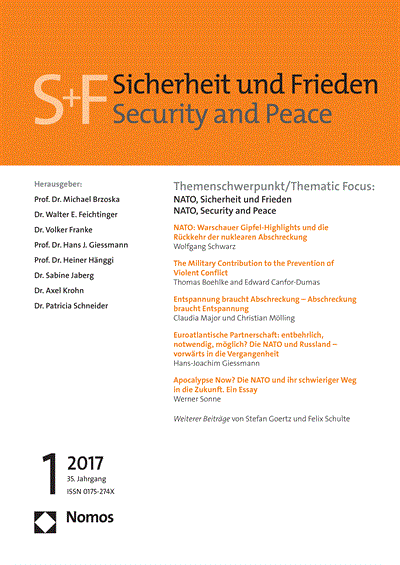
Despite its conventional superiority over Russia, NATO is strengthening its military presence on its Eastern flank. After the enhancement of the NATO Response Force this is now being done by a forward deployment of combat forces. All of this is done...
The Understand to Prevent (U2P) process arises from the changing nature of armed conflict, which is prompting NATO forces to adapt to new challenges. U2P argues that military effort must shift away from crisis response and towards persistent,...
Deterrence and Détente have again come to the forefront of NATO’s agenda. As a response to Russia’s forced annexation of Crimea and destabilization of the Ukraine, NATO decided already at its 2014 Summit in Wales to rebalance its tasks, giving...
With the emergence and spreading of a new conflict along familiar East-West fault lines, we are now facing a reality that has until recently been considered impossible. A new global arms race has already been set in motion. While Russia seems...
In a world of turmoil, the strongest military alliance faces an uncertain future, too. After the elections in the US, former German foreign minister Joschka Fischer even predicts a disintegration of the West. One should have no illusions - without...
The antagonists of the asymmetric conflict between Western democratic states - mostly members of the NATO - and the so called Islamic State (IS) differ in their legal status; their organizational structure and their strategic and tactical aims are...
Ethnic conflicts continue to be the most common form of intrastate conflict. The international community makes efforts to transform war-torn societies into peaceful democracies, often overlooking that building peace can conflict with building...