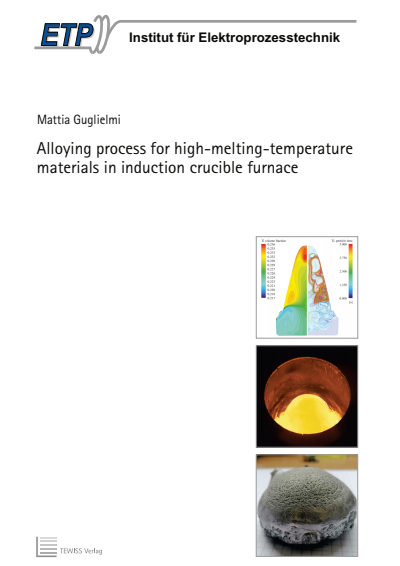
Nb-MASC (niobium–metal and silicide composites) alloys are promising candidates for manufacturing innovative turbine components but present major manufacturing challenges due to melt reactivity and chemical inhomogeneities. This work proposes induction melting and alloying of Nb-MASCs in a cold-wall crucible furnace to overcome these limitations. Electromagnetic forces generated during induction melting enhance mixing, promote homogeneous distribution of alloying elements, and consequently mechanical reinforcement of the manufactured cast. This study integrates numerical simulations and experiments: Eulerian mixture models and Lagrangian discrete phase models are used to predict elemental transport within the melt. Experimental investigations identify optimal melting and alloying conditions to enable an efficient and reproducible melting route.
Search publication
Bibliographic data
Edition
1/2026
Copyright Year
2026
ISBN-Print
978-3-690-30175-6
ISBN-Online
978-3-69030-180-0
Publisher
TEWISS, Garbsen
Series
Berichte aus dem ETP
Volume
01/2026
Language
English
Pages
172
Product Type
Monograph
Table of contents
ChapterPages
Preface No access Pages i - xii
1.1 State of the art No access
1.2 Problem description and aim of the work No access
2.1 Basics of electromagnetism No access
2.2 Basics of thermodynamics No access
2.3 Magnetohydrodynamics No access
2.4 Theory of multicomponent alloys No access
3.1 Mathematical models for the induction melting of alloysin ICCF No access
3.2 Settings of the investigation setup No access
3.3 Numerical model No access
3.4 First numerical results No access
4.1 Induction melting of the Nb-18Si alloy No access
4.2 Induction melting of the Nb-MASC compound No access
5.1 Nanoparticles No access
5.2 Microparticles No access
Chapter 6 Conclusions and outlook No access Pages 135 - 138