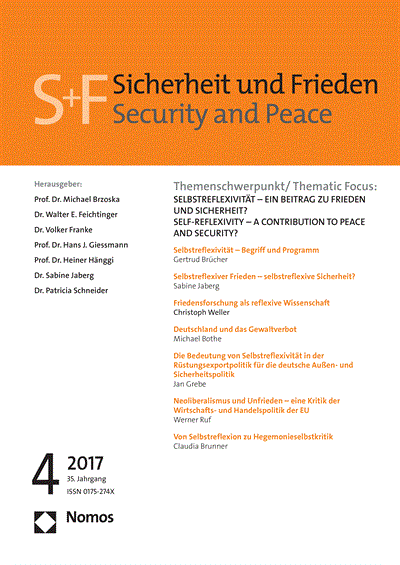
The tautological doubling of a self-relation and the paradoxical interlocking of a figure based on the subject (self) and the object (reflexivity) is currently program: relations (such as social structures, institutions, organizations) shall be...
Peace and security are more or less synonyms. This opinion is often heard, but not true. Firstly, the history of concepts differs. Secondly, their immanent grammar or logic works contrarily: Peace is a social and inclusive idea that implies...
The obvious demand for more self-reflection in security policy raises the issue of reflexivity of and in peace research itself. This article recalls the reflexive potential of critical peace research, but aims to expand it to a reflexive peace...
Since the Second World War, the German position relating to the use of military force is on the one hand characterized by a strong adherence to the principle of non-use of force (“never again”). Yet there has also been the recognition of...
The article looks at Germany’s arms export policy over the recent years and questions the ability for self-reflection. From the assumption that there is a certain degree of self-reflection, yet lacking transparency on the justification of arms...
Neo-liberalism has become the principle for restructuring the world’s economy and societies. Upholding the principle of freedom, in reality it serves the immediate interests of dominant economic actors. The concentration of capital produces power...
While self-reflexivity certainly is useful when aiming to reconsider our thinking about and acting in international politics, it can also function as a hegemonic practice of containing radical critique. The author introduces approaches from critical...