, to see if you have full access to this publication.
Monograph No access
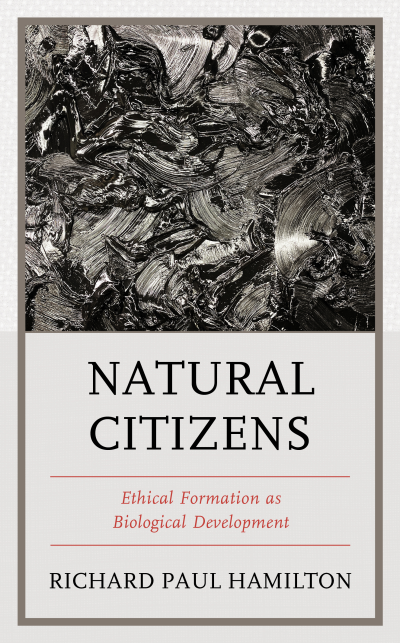
Natural Citizens
Ethical Formation as Biological Development
Authors:
Publisher:
2023
Summary
Natural Citizens: Ethical Formation as Biological Development presents a novel view, "naturalist humanism," that applies recent scientific work challenging dichotomous views of biological development. Rather than being a passive victim of its evolutionary fate, the developing organism is an active participant, partly constructing its own ecological niche from internal and external resources. The human developmental environment, our ecological niche, has a distinctive socio-cultural character. Richard Paul Hamilton proposes that we understand the development of moral character as an integral part of biological development with the virtues construed as refinements of mundane social intelligence.
Drawing on work in 4E Cognition, Hamilton revisits the traditional idea of ethical understanding as quasi-perceptual but argues that this can only be made intelligible by taking a non-representationalist view of perception. The virtuous person has learned how to focus her attention on what enables her to live a fully human life, individually and communally. Given that not all societies are equally conducive to fully human lives, the concluding sections explore how contemporary capitalist society distorts our attention and what obstacles it places in the way of virtue. Natural Citizens highlights the unsustainable state of current social and economic relations and the urgent need for radical alternatives.
Keywords
Search publication
Bibliographic data
Edition
1/2023
Copyright Year
2023
ISBN-Print
978-1-7936-3351-4
ISBN-Online
978-1-7936-3352-1
Publisher
Lexington, Lanham
Language
English
Pages
254
Product Type
Monograph
Table of contents
ChapterPages
Contents No access
Preface No access
Introduction: Naturalist Humanism No access Pages 1 - 12
1. Why Should We Be Naturalists? No access Pages 13 - 34
2. Standard Naturalism, The Placement Problem, and Companion in Guilt Arguments No access Pages 35 - 46
3. Is the Natural Goodness Approach of Philippa Foot and Michael Thompson a Suitable Candidate for LiberalNaturalism? No access Pages 47 - 68
4. The Possibility of a Transcendental Naturalism No access Pages 69 - 88
5. The Myth of the Biological Given and the Developmentalist Turn No access Pages 89 - 102
6. Virtues as Powers and Perfections No access Pages 103 - 124
7. Culture as Our Ecological Niche No access Pages 125 - 148
8. Virtue as Skilled Perception No access Pages 149 - 168
9. The Burdens of Attentiveness No access Pages 169 - 200
10. Can There Be Bourgeois Virtues? No access Pages 201 - 228
Conclusion: Radical Hope and Revolutionary Virtue No access Pages 229 - 230