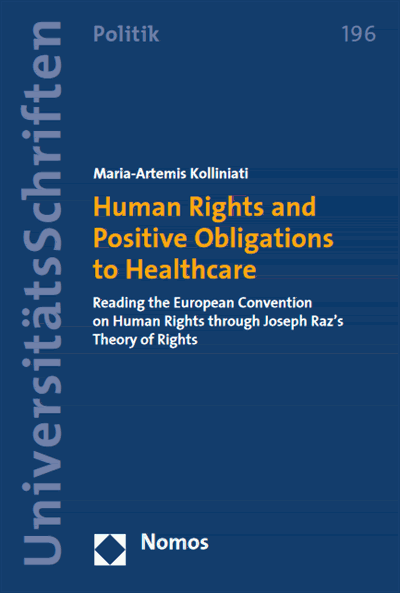
Human Rights and Positive Obligations to Healthcare
Reading the European Convention on Human Rights through Joseph Raz's Theory of Rights- Authors:
- Series:
- Nomos Universitätsschriften - Politik, Volume 196
- Publisher:
- 2019
Summary
Dieses Buch richtet sich an Wissenschaftler, die zur Europäischen Menschenrechtskonvention forschen, und an jene, die an Rechtsphilosophie interessiert sind. Es richtet sich auch an Richter und Anwälte, die mit der EMRK und insbesondere der Rechtsprechung zum Schutz der Gesundheit befasst sind. Studierenden bietet das Buch die Möglichkeit, ihre rechtsphilosophischen Kenntnisse der Menschenrechte und der EMRK zu vertiefen.
Das Buch verfolgt drei Ziele: Erstens soll Joseph Raz´ „Doppeldimension der Menschenrechte“ als Theorie eines mittleren Wegs erörtert werden, die Richtern helfen kann, soziale Aspekte von Menschenrechten zu prüfen. Zweitens wird argumentiert, dass Joseph Raz´ Rechtsphilosophie als Ansatz der „Doppeldimension der Menschenrechte“ und nicht als Interessentheorie verstanden werden sollte. Drittens soll dieses Buch sich nicht nur mit Menschenrechtstheorie befassen, sondern untersuchen, wie die Rechte der EMRK in der Rechtsprechung angewandt und interpretiert werden.
Keywords
Search publication
Bibliographic data
- Edition
- 1/2019
- Copyright Year
- 2019
- ISBN-Print
- 978-3-8487-5852-4
- ISBN-Online
- 978-3-8452-9985-3
- Publisher
- Nomos, Baden-Baden
- Series
- Nomos Universitätsschriften - Politik
- Volume
- 196
- Language
- English
- Pages
- 267
- Product Type
- Monograph
Table of contents
- Titelei/Inhaltsverzeichnis No access Pages 1 - 14
- 1.1 Summary of the main arguments No access
- 1.2 Structure No access
- 1.3 Scope No access
- 1.4 Methodology No access
- 1.5.1 State of the art in international law and in political science No access
- 1.5.2 State of the art and positive obligations to health care No access
- 1.6 Why Joseph Raz’s theory of rights? No access
- 2.1.1 Legal formalism No access
- 2.1.2 American legal realism No access
- 2.2.1 Natural law theory No access
- Jeremy Bentham and the ruling theory of law No access
- H.L.A. Hart and open-textured language of the law No access
- The hermeneutic approach No access
- Non-positivism: Ronald Dworkin and law as a practice of interpretation No access
- 2.3.1 Natural theories of rights No access
- 2.3.2 Ronald Dworkin’s natural theory of rights No access
- 2.3.3 Deontological, rights-based theories and consequentialist accounts of human rights No access
- 2.3.4 Contingent/constructed/relative rights and objective rights No access
- 2.3.5 Charles Taylor’s communitarian account of human rights No access
- 3.1.1 Taking the formal characteristics of the Convention seriously No access
- 3.1.2 Positive obligations and ECtHR case law No access
- 3.2 Theoretical disputes No access
- 3.3 The two-stage analysis of human rights: a bifurcated approach No access
- 4.1 Joseph Raz and legal positivism No access
- 4.2 The notion of human rights in Joseph Raz’s approach No access
- Values and rights No access
- Overreaching and traditional theories No access
- “Universality” as the enemy of human rights No access
- 4.3.2 Anti-universality: Political conception, social relativism and anti-moral relativism No access
- 4.4 The “why-dimension” of rights No access
- 4.5 Rights and interests No access
- 4.6.1 Contingent goods, inherent public goods or collective goods No access
- 4.6.2 The common good: Finnis’s approach and its relationship with Razian collective goods No access
- 4.6.3 Practical reason for Finnis and Raz No access
- 4.6.4 Common good, solidarity and utilitarianism No access
- 4.6.5 Traditional liberal rights and the common good No access
- 4.7.1 The criticism of liberalism by communitarians No access
- 4.7.2 Rights: Autonomy, options and collective goods No access
- 4.8.1 Rights and duties No access
- 4.8.2 Creating new duties: the dynamic aspect of rights No access
- 4.9.1 Raz’s rights and Taylor’s communitarian rights No access
- 5.1 Introduction No access
- 5.2 Expulsion, detention and healthcare: Positive obligations and Article 3 of the ECHR (an overview) No access
- 5.3 Article 3 of the ECHR: its general characteristics and its relationship to healthcare No access
- 5.4.1 Expulsion and intentional acts or omissions No access
- 5.4.2 Expulsion and “minimum level of severity” No access
- 5.4.3 Expulsion and the “threefold condition for exceptional circumstances/humanitarian reasons” No access
- 5.4.4 Expulsion, Article 3 of the ECHR and implied restrictions No access
- 5.4.5 Expulsion and the social aspects of the ECHR No access
- 5.5.1 Detention, Article 3 and the “minimum level of severity” No access
- 5.5.2 Detention and “intentional acts or omissions” No access
- 5.6 Overview of the ECtHR case law relating to Article 3 of the ECHR No access
- 5.7 General characteristics of Article 8 of the ECHR and its relationship with healthcare and positive obligations No access
- 5.8 Interference by public authorities and Article 8 of the ECHR No access
- 5.9 Article 8 of the ECHR and the minimum threshold of severity No access
- 5.10.1 Medical care treatment No access
- 5.10.2 Expulsion No access
- 5.10.3 Environmental protection No access
- 5.11 Overview of the ECtHR case law relating to Article 8 of the ECHR No access
- 6.1 Introduction No access
- 6.2.1 The absence of healthcare and inhuman treatment No access
- 6.2.2 Positive obligation to healthcare, physical well-being and Razian autonomy-based freedom No access
- 6.2.3 Right-holders: Physically present and members of the same moral community No access
- 6.2.4 Balancing interests and financial restrictions No access
- 6.2.5 Democracy as a collective good No access
- 6.2.6 “Human rights inflation”? No access
- 6.3 Overview of chapter six No access
- 7.1 Raz’s theory of rights: A synopsis No access
- 7.2 Critique of Joseph Raz’s account of rights and “research desiderata” for further research No access
- 7.3 Findings of the study and concluding remarks No access
- Bibliography No access Pages 255 - 264
- European Court of Human Rights (and former European Commission of Human Rights) Case Law No access Pages 265 - 267
Bibliography (180 entries)
No match found. Try another term.
- Agamben, Giorgio. Homo sacer: Κυρίαρχη εξουσία και γυμνή ζωή. (μτφρ. Παναγιώτης Τσιαμούρας). Αθήνα: Scripta, 2005. Open Google Scholar DOI: 10.5771/9783845299853
- Akandji-Kombe, Jean-François. “Positive obligations under the European Convention: A guide to the implementation of the European Convention on Human Rights.” Human rights handbooks, no. 7, Strasbourg: Council of Europe, 2007. Open Google Scholar DOI: 10.5771/9783845299853
- Alexy, Robert. A theory of Constitutional Rights, trans. Julian Rivers. Oxford: Oxford University Press, 2002. Open Google Scholar DOI: 10.5771/9783845299853
- Alexy, Robert. A theory of Constitutional Rights “On the concept and the nature of law.” Ratio Juris 21, no.3 (2008): 281-299. Open Google Scholar DOI: 10.5771/9783845299853
- Αριστοτέλης [Aristotle]. Ηθικά Νικομάχεια [Nicomachean Ethics]. (μτφρ. Φιλολογική ομάδα Κάκτου). Αθήνα: Κάκτος, 1993. Open Google Scholar DOI: 10.5771/9783845299853
- Atria, Fernando. “Social Rights, Social Contract, Socialism.” Social & Legal Studies 24, no. 4 (2015): 598–613. Open Google Scholar DOI: 10.5771/9783845299853
- Bader, Ralf M. Robert Nozick. Major conservative and libertarian thinkers v. 11. New York: Continuum, 2010. Open Google Scholar DOI: 10.5771/9783845299853
- Batnitzky, Leora. “A Seamless Web? John Finnis and Joseph Raz on Practical Reason and the Obligation to Obey the Law.” Oxford Journal of Legal Studies 15, no. 2 (1995): 153-175. Open Google Scholar DOI: 10.5771/9783845299853
- Belliotti, Raymohnd A. Justifying Law: The Debate over Foundations, Goals, and Methods. Philadelphia: Temple University Press, 1992. Open Google Scholar DOI: 10.5771/9783845299853
- Bentham, Jeremy. “Anarchical Fallacies; being an examination of the Declaration of Rights issued during the French Revolution.” In Nonsense upon stilts: Bentham, Burke and Marx on the Rights of Man. Edited by Jeremy Waldron, 46-76. London and New York: Methuen, 1987. Open Google Scholar DOI: 10.5771/9783845299853
- Bentham, Jeremy. “Anarchical Fallacies; being an examination of the Declaration of Rights issued during the French Revolution.” In Nonsense upon stilts: Bentham An Introduction to the Principles of Morals and Legislation. [first ed. 1781]. Kitchener: Batoche Books, 2000. Open Google Scholar DOI: 10.5771/9783845299853
- Berlin, Isaiah. Four essays on Liberty. New York: Oxford University Press, 1969. Open Google Scholar DOI: 10.5771/9783845299853
- Bix, Brian. “On the dividing line between natural law theory and legal positivism.” Notre Dame Law Review 75, no. 5 (1999): 1613–1624. Open Google Scholar DOI: 10.5771/9783845299853
- Bix, Brian. “On the dividing line between natural law theory and legal positivism.” Notre Dame Law Review 75 “Natural Law: The Modern Tradition.” In The Oxford handbook of jurisprudence and philosophy of law. Edited by Jules L. Coleman, Scott Shapiro and Kenneth E. Himma, 64–66. Oxford, New York: Oxford University Press, 2004. Open Google Scholar DOI: 10.5771/9783845299853
- Brems, Eva. “Human Rights: Minimum and Maximum Perspectives,” Human Rights Law Review 9(3) (2009): 349-372. Open Google Scholar DOI: 10.5771/9783845299853
- Brownlee, Kimberley. “A Human Right against social deprivation.” The Philosophical Quarterly 63, no. 251 (2013): 199-222. Open Google Scholar DOI: 10.5771/9783845299853
- Bryson, Phillip J. Socialism: Origins, Expansion, Decline, and the Attempted Revival in the United States. Bloomington, Indiana: Xlibris, 2015. Open Google Scholar DOI: 10.5771/9783845299853
- Carens, Joseph H. “Rights and Duties in an Egalitarian Society.” Political Theory 14 (1986): 31-49. Open Google Scholar DOI: 10.5771/9783845299853
- Christodoulidis, Emilios. “Social Rights and Markets.” Social & Legal Studies 24, no. 4 (2015): 595–597. Open Google Scholar DOI: 10.5771/9783845299853
- Coleman, Jules L. “Beyond Inclusive Legal Positivism.” Ratio Juris 22, no. 3 (2009): 359–394. Open Google Scholar DOI: 10.5771/9783845299853
- Colm O´Cinneide. “The triumph of Human Rights: dream or nightmare?” UCL lectures, 2012. Online access: http://www.ucl.ac.uk/lhl/Spring2012/04_26012012 (last accessed: May 17, 2017). Open Google Scholar DOI: 10.5771/9783845299853
- Conant, Lisa. “Individuals, Courts, and the Development of European Social Rights.” Comparative Political Studies 39 (2006): 76-100. Open Google Scholar DOI: 10.5771/9783845299853
- Connell, Andrew. “Civil Rights and Social Welfare: Some Thoughts on the Contemporary Relevance of T. H. Marshall.” The Political Quarterly 83, no. 3 (2012): 551–559. Open Google Scholar DOI: 10.5771/9783845299853
- Council of Europe, European Convention for the Protection of Human Rights and Fundamental Freedoms, as amended by Protocols Nos. 11 and 14, supplemented by Protocols Nos. 1, 4, 6, 7, 12 and 13, 4 November 1950. Open Google Scholar DOI: 10.5771/9783845299853
- Council of Europe, European Social Charter (Revised), 3 May 1996, ETS 163. Open Google Scholar DOI: 10.5771/9783845299853
- Council of Europe. “Manual on Human Rights and the Environment.” 2nd ed. Strasbourg: Council of Europe Publishing, 2012. Open Google Scholar DOI: 10.5771/9783845299853
- Council of Europe. “Practical Guide on Admissibility Criteria.” Strasbourg: Council of Europe/European Court of Human Rights, 2014. Open Google Scholar DOI: 10.5771/9783845299853
- Cruft, Rowan. “Rights: Beyond Interest Theory and Will Theory?” Law and Philosophy 23, no. 4 (2004): 347–397. Open Google Scholar DOI: 10.5771/9783845299853
- Curran, Eleanor. “Hobbes’s Theory of Rights – A Modern Interest Theory.” The Journal of Ethics 6, no. 1 (2002): 63–86. Open Google Scholar DOI: 10.5771/9783845299853
- Daniels, Norman. “Democratic Equality: Rawls’s Complex Egalitarianism.” In The Cambridge companion to Rawls. Edited by Samuel Freeman, 241–276. Cambridge companions to philosophy. Cambridge: Cambridge University Press, 2008. Open Google Scholar DOI: 10.5771/9783845299853
- Donnelly, Jack. “The Relative Universality of Human Rights.” Human Rights Quarterly 29, no. 2 (2007): 281–306. Open Google Scholar DOI: 10.5771/9783845299853
- Donnelly, Jack. “The Relative Universality of Human Rights.” Human Rights Quarterly 29 Universal Human Rights in Theory and Practice. 3rd ed. Ithaca and London: Cornell University Press, 2013. Open Google Scholar DOI: 10.5771/9783845299853
- Dworkin, Ronald. “The Model of Rules.” The University of Chicago Law Review 35, no. 14 (1967): 14-46. Open Google Scholar DOI: 10.5771/9783845299853
- Dworkin, Ronald. “The Model of Rules.” The University of Chicago Law Review 35 Taking Rights Seriously. 2nd ed. Cambridge, Massachusetts: Harvard University Press, 1978. Open Google Scholar DOI: 10.5771/9783845299853
- Dworkin, Ronald. “The Model of Rules.” The University of Chicago Law Review 35 “What Is Equality? Part 1: Equality of Welfare.” Philosophy & Public Affairs 10, no. 3 (1981): 185–246. Open Google Scholar DOI: 10.5771/9783845299853
- Dworkin, Ronald. “The Model of Rules.” The University of Chicago Law Review 35 “Law as interpretation.” Texas Law Review 60 (1982): 527-550. Open Google Scholar DOI: 10.5771/9783845299853
- Dworkin, Ronald. “The Model of Rules.” The University of Chicago Law Review 35 “Rights as trumps.” In Theories of Rights. Edited by Jeremy Waldron. 1rst ed. 153-167. Oxford: Oxford University Press, 1984. Open Google Scholar DOI: 10.5771/9783845299853
- Dworkin, Ronald. “The Model of Rules.” The University of Chicago Law Review 35 Law´s Empire. Cambridge, Massachusetts: The Belknap press of Harvard University Press, 1986. Open Google Scholar DOI: 10.5771/9783845299853
- Dworkin, Ronald. “The Model of Rules.” The University of Chicago Law Review 35 Justice for Hedgehogs. Cambridge, Massachusetts: The Belknap press of Harvard University Press, 2011. Open Google Scholar DOI: 10.5771/9783845299853
- Eskridge Jr., William N. “The New Textualism.” UCLA Law Review 37, no. 621 (1990): 621-691. Open Google Scholar DOI: 10.5771/9783845299853
- European Court of Human Rights, “Research Report on health-related issues in the case-law of the European Court of Human Rights.” Council of Europe, June 2015. Open Google Scholar DOI: 10.5771/9783845299853
- European Union, Charter of Fundamental Rights of the European Union, 26 October 2012, 2012/C 326/02. [Published in the Official Journal of the European Communities, 18 December 2000 (2000/C 364/01)]. Open Google Scholar DOI: 10.5771/9783845299853
- Finnis, John. Natural Law and Natural Rights. 5th ed. New York: Oxford University Press, 1988. Open Google Scholar DOI: 10.5771/9783845299853
- Fredman, Sandra. Human Rights Transformed: Positive Rights and Positive Duties. 1rst ed. Oxford: Oxford University Press, 2008. Open Google Scholar DOI: 10.5771/9783845299853
- Freeman, Michael. “The Philosophical Foundations of Human Rights.” Human Rights Quarterly 16 (1994): 491-514. Open Google Scholar DOI: 10.5771/9783845299853
- Freeman, Michael. “The Philosophical Foundations of Human Rights.” Human Rights Quarterly 16 (1994) Human Rights: An interdisciplinary approach, Cambridge: Polity Press, 2004. Open Google Scholar DOI: 10.5771/9783845299853
- Gadamer, Hans-Georg. Truth and method. translation revised by: Marshall, Donald G; Weinsheimer, Joel. Continuum impacts 2nd, rev. ed. London, New York: Continuum, 2004. Open Google Scholar DOI: 10.5771/9783845299853
- George, Robert P., Lloyd L. Weinreb, and Russell Hittinger. “Recent Criticism of Natural Law Theory.” The University of Chicago Law Review 55, no. 4 (1988): 1371-1429. Open Google Scholar DOI: 10.5771/9783845299853
- George, Robert P. “The Unorthodox Liberalism of Joseph Raz.” The Review of Politics 53, no. 4 (1991): 652–671. Open Google Scholar DOI: 10.5771/9783845299853
- Gerards, Janneke. “The European Court of Human Rights.” In Comparative Constitutional Reasoning. Edited by András Jakab, 237–276. Cambridge: Cambridge University Press, 2017. Open Google Scholar DOI: 10.5771/9783845299853
- Green, Michael Steven. “Legal realism as theory of law.” William & Mary Law Review 46, no. 6 (2004): 1915–2000. Open Google Scholar DOI: 10.5771/9783845299853
- Green, Leslie. “Three Themes from Raz.” Oxford Journal of Legal Studies 25, no. 3 (2005): 503–523. Open Google Scholar DOI: 10.5771/9783845299853
- Green, Leslie, and Brian Leiter. Oxford studies in philosophy of law. Oxford: Oxford University Press, 2013. Open Google Scholar DOI: 10.5771/9783845299853
- Greer, Steven C. The exceptions to Articles 8 to 11 of the European Convention on Human Rights. Human rights files 15. Strasbourg: Council of Europe Publishing, 1997. Open Google Scholar DOI: 10.5771/9783845299853
- Greer, Steven C. The exceptions to Articles 8 to 11 of the European Convention on Human Rights. Human rights files 15. Strasbourg: Council of Europe Publishing “"Balancing" and the European Court of Human Rights: A Contribution to the Habermas-Alexy Debate.” Cambridge Law Journal 63, no. 2 (1999): 412–434. Open Google Scholar DOI: 10.5771/9783845299853
- Greer, Steven C. The exceptions to Articles 8 to 11 of the European Convention on Human Rights. Human rights files 15. Strasbourg: Council of Europe Publishing The European Convention on Human Rights: Achievements, problems and prospects. Cambridge studies in European law and policy. Cambridge: Cambridge University Press, 2006. Open Google Scholar DOI: 10.5771/9783845299853
- Grotius, Hugo. The Rights of War and Peace, including the Law of Nature and of Nations: translated from the Original Latin of Grotius, with Notes and Illustrations from Political and Legal Writers, by A.C. Campbell, A.M. with an Introduction by David J. Hill. New York: M. Walter Dunne, 1901 ed. [1625]. Available online: http://oll.libertyfund.org/titles/grotius-the-rights-of-war-and-peace-1901-ed (last update 12-10-2015). Open Google Scholar DOI: 10.5771/9783845299853
- Hare, Richard M. Freedom and reason. Oxford: Clarendon Press, 1963. Open Google Scholar DOI: 10.5771/9783845299853
- Harris, David John, Michael O'Boyle, Colin Warbrick, Ed Bates, and Carla Buckley. Law of the European Convention on Human Rights. With the assistance of Paul Harvey. 3rd ed. Oxford: Oxford University Press, 2014. Open Google Scholar DOI: 10.5771/9783845299853
- Hart, Herbert L. A. “Are There Any Natural Rights?” The Philosophical Review 64, no. 2 (1955): 175–91. Open Google Scholar DOI: 10.5771/9783845299853
- Hart, Herbert L. A. “Are There Any Natural Rights?” The Philosophical Review 64 The Concept of Law. Oxford: Oxford University Press, 1961. Open Google Scholar DOI: 10.5771/9783845299853
- Hittinger, Russell. A critique of the new natural law theory. Notre Dame, Ind: University of Notre Dame Press, 1987. Open Google Scholar DOI: 10.5771/9783845299853
- Hobbes, Thomas. Leviathan. (ed. A. P. Martinich and Brian Battiste). Toronto: Broadview Editions, 2011. Open Google Scholar DOI: 10.5771/9783845299853
- Holmes, Oliver Wendell. “The Path of the Law.” Harvard Law Review 457, no. 10 (1897). Open Google Scholar DOI: 10.5771/9783845299853
- Horty, John F. “Rules and reasons in the theory of precedent.” Legal Theory 17 (2011): 1-33. Open Google Scholar DOI: 10.5771/9783845299853
- Kao, Grace Y. Grounding Human Rights in a Pluralist World. Washington, DC: Georgetown University Press, 2011. Open Google Scholar DOI: 10.5771/9783845299853
- Kar, Robin B. “Hart's Response to Exclusive Legal Positivism.” Georgetown law Journal 95 (2006): 393–461. Open Google Scholar DOI: 10.5771/9783845299853
- Kelsen, Hans. Pure theory of law. Translation from the second German edition: Max Knight. Berkeley and Los Angeles: University of California Press, 1967. Open Google Scholar DOI: 10.5771/9783845299853
- Kenny, Jo. “European Convention on Human Rights and Social Welfare.” European Human Rights Law Review, no. 5 (2010): 495–503. Open Google Scholar DOI: 10.5771/9783845299853
- Kilkelly, Ursula. “The right to respect for private and family life: A guide to the implementation of Article 8 of the European Convention on Human Rights.” Human rights handbooks 1, 2003. http://www.echr.coe.int/LibraryDocs/HR%20handbooks/handbook01_en.pdf. Open Google Scholar DOI: 10.5771/9783845299853
- Klatt, Matthias. “Positive Obligations under the European Convention on Human Rights.” Heidelberg Journal of International Law (HJIL) 71 (2011): 691–718. Open Google Scholar DOI: 10.5771/9783845299853
- Koch, Ida Elisabeth. “Economic, Social and Cultural Rights as Components in Civil and Political Rights: A Hermeneutic Perspective.” The International Journal of Human Rights 10 (2006): 405-430. Open Google Scholar DOI: 10.5771/9783845299853
- Korsgaard, Christine M., G. A. Cohen, Raymond Geuss, Thomas Nagel, and Bernard Williams. The Sources of Normativity. 14th Ed. Cambridge: Cambridge University Press, 2010. Open Google Scholar DOI: 10.5771/9783845299853
- Kramer, Matthew H. “Refining the Interest Theory of Rights.” The American Journal of Jurisprudence 55, no. 1 (2010): 31–39. Open Google Scholar DOI: 10.5771/9783845299853
- Kramer, Matthew H. “Refining the Interest Theory of Rights.” The American Journal of Jurisprudence 55 “Some Doubts about Alternatives to the Interest Theory of Rights.” Ethics 123, no. 2 (2013): 245–63. Open Google Scholar DOI: 10.5771/9783845299853
- Kronman, Anthony T. “Talent Pooling.” Nomos 23 (1981): 58–79. Open Google Scholar DOI: 10.5771/9783845299853
- Kumm, Mattias. “Political Liberalism and the Structure of Rights: On the Place and Limits of the Proportionality Requirement.” In Law, rights and discourse: The legal philosophy of Robert Alexy. Edited by George Pavlakos, 131–66. Legal Theory Today, No. 11. Oxford, Portland, Or.: Hart Publishing, 2007. Open Google Scholar DOI: 10.5771/9783845299853
- Kymlicka, Will. “Liberal Individualism and Liberal Neutrality.” Ethics 99, no. 4 (1989): 883–905. Open Google Scholar DOI: 10.5771/9783845299853
- Kymlicka, Will. “Liberal Individualism and Liberal Neutrality.” Ethics 99 Contemporary political philosophy: An introduction. 2nd ed. New York: Oxford University Press, 2002. Open Google Scholar DOI: 10.5771/9783845299853
- La Torre, Massimo. “On Two Distinct and Opposing Versions of Natural Law: "Exclusive" versus "Inclusive".” Ratio Juris 19, no. 2 (2006): 197–216. Open Google Scholar DOI: 10.5771/9783845299853
- Lambert, Hélène. The position of aliens in relation to the European Convention on Human Rights. 3rd ed. Migration Collection. Strasbourg: Council of Europe Publishing, 2006. Open Google Scholar DOI: 10.5771/9783845299853
- Lamond, Grant. “Do precedents create rules?.” Legal Theory 11 (2005): 1-26. Open Google Scholar DOI: 10.5771/9783845299853
- Langlois, Anthony J. “Human Rights and Modern Liberalism: A Critique.” Political Studies 51, no. 3 (2016): 509–523. Open Google Scholar DOI: 10.5771/9783845299853
- Lavrysen, Laurens. “The scope of rights and the scope of obligations: Positive obligations.” In Shaping rights in the ECHR: The Role of the European Court of Human rights in Determining the scope of Human Rights. Edited by Eva Brems and Janneke Gerrards. 162-182. Cambridge: Cambridge University Press, 2014. Open Google Scholar DOI: 10.5771/9783845299853
- Lavrysen, Laurens. “The scope of rights and the scope of obligations: Positive obligations.” In Shaping rights in the ECHR: The Role of the European Court of Human rights in Determining the scope of Human Rights. Edited by Eva Brems and Janneke Gerrards. 162-182. Cambridge: Cambridge University Press Human Rights in a positive state: Rethinking the relationship between positive and negative obligations under the European Convention on Human Rights. Doctoral thesis. University of Ghent, 2016. Open Google Scholar DOI: 10.5771/9783845299853
- Leijten, Ingrit. “Defining the scope of economic and social guarantees in the case law of the ECtHR.” In Shaping rights in the ECHR: The Role of the European Court of Human rights in Determining the scope of Human Rights. Edited by Eva Brems and Janneke Gerrards. 109–136. Cambridge: Cambridge University Press, 2014. Open Google Scholar DOI: 10.5771/9783845299853
- Leiter, Brian. “Positivism, Formalism, Realism: Reviewed Work: Legal Positivism in American Jurisprudence by Anthony Sebok.” Columbia Law Review 99, no. 4 (1999): 1138–1164. Open Google Scholar DOI: 10.5771/9783845299853
- Leiter, Brian. “Legal Formalism and Legal Realism: What is the Issue?” Legal Theory 16, no. 02 (2010): 111–133. Open Google Scholar DOI: 10.5771/9783845299853
- Letsas, George. “The Truth in Autonomous Concepts: How To Interpret the ECHR.” European Journal of International Law 15, no. 2 (2004): 279–305. Open Google Scholar DOI: 10.5771/9783845299853
- Letsas, George. A theory of interpretation of the European Convention on Human Rights. Oxford: Oxford University Press, 2007. Open Google Scholar DOI: 10.5771/9783845299853
- Letsas, George. “Strasbourg's Interpretive Ethic: Lessons for the International Lawyer.” European Journal of International Law 21, no. 3 (2010): 509–541. Open Google Scholar DOI: 10.5771/9783845299853
- Locke, John. Second Treatise of Government. (ed. C. B. Macpherson). Indianapolis, Indiana: Hackett Publishing Company, 1980. Open Google Scholar DOI: 10.5771/9783845299853
- Lomasky, Loren E. “But is it liberalism?” Critical Review 4, 1-2 (1990): 86–105. Open Google Scholar DOI: 10.5771/9783845299853
- Loughlin, Martin. Sword and scales: An examination of the relationship between law and politics. Oxford, Portland, Or.: Hart Publishing, 2000. Open Google Scholar DOI: 10.5771/9783845299853
- Luling Haughton, Rosemary. “Transcendence and Being Modern.” In A Catholic modernity? Charles Taylor's Marianist Award lecture, with responses by William M. Shea, Rosemary Luling Haughton, George Marsden, Jean Bethke Elshtain. Edited by Charles Taylor, and James Heft. 65-81. New York: Oxford University Press, 1999. Open Google Scholar DOI: 10.5771/9783845299853
- MacIntyre, Alasdair C. After Virtue: A Study in Moral Theory. 3rd ed. Notre Dame, Indiana: University of Notre Dame Press, 2007. Open Google Scholar DOI: 10.5771/9783845299853
- Mackie, John L. Ethics: Inventing Right and Wrong. New York: Penguin, 1977. Open Google Scholar DOI: 10.5771/9783845299853
- Macklem, Patrick. The Sovereignty of Human Rights. New York: Oxford University Press, 2015. Open Google Scholar DOI: 10.5771/9783845299853
- Magnussen, Anne-Mette, and Even Nilssen. “Juridification and the Construction of Social Citizenship.” Journal of Law and Society 40, no. 2 (2013): 228–248. Open Google Scholar DOI: 10.5771/9783845299853
- Mantouvalou, Virginia. “N v UK: No Duty to Rescue the Nearby Needy?” The Modern Law Review Limited 72 (2009): 815-843. Open Google Scholar DOI: 10.5771/9783845299853
- Mantouvalou, Virginia. “N v UK: No Duty to Rescue the Nearby Needy?” The Modern Law Review Limited 72 (2009) “Labour Rights in the European Convention on Human Rights: An Intellectual Justification for an Integrated Approach to Interpretation.” Human Rights Law Review 13:3 (2013): 529-555. Open Google Scholar DOI: 10.5771/9783845299853
- McCabe, David. “Joseph Raz and the Contextual Argument for Liberal Perfectionism.” Ethics 111, no. 3 (2001): 493–522. Open Google Scholar DOI: 10.5771/9783845299853
- Mccrudden, Christopher. “Legal Research and the Social Sciences.” Law Quarterly Review 122 (2006): 632-650. Open Google Scholar DOI: 10.5771/9783845299853
- Mill, John Stuart. Utilitarianism. Cambridge: Cambridge University Press, 2014. Open Google Scholar DOI: 10.5771/9783845299853
- Moore, Margaret. “Liberalism and the Ideal of the Good Life.” The Review of Politics 53, no. 4 (1991): 672–690. Open Google Scholar DOI: 10.5771/9783845299853
- Morawetz, Thomas. “The Authority of Law. Joseph Raz.” Ethics 91, no. 3 (1981): 516–519. Open Google Scholar DOI: 10.5771/9783845299853
- Moskop, J. C. “Rawlsian justice and a human right to health care.” The Journal of medicine and philosophy 8, no. 4 (1983): 329–338. Open Google Scholar DOI: 10.5771/9783845299853
- Mowbray, Alistair R. The development of positive obligations under the European Convention on Human Rights by the European Court of Human Rights. Human rights law in perspective v. 2. Oxford: Hart Publishing, 2004. Open Google Scholar DOI: 10.5771/9783845299853
- Nathan, Andrew J. “Universalism: A Particularistic Account.” In Negotiating culture and human rights. Edited by Lynda S. Bell, Andrew J. Nathan and Ilan Peleg, 349–68. New York: Columbia University Press, 2001. Open Google Scholar DOI: 10.5771/9783845299853
- Nickel, James W. “Poverty and Rights.” Philosophical Quarterly 55, no. 220 (2005): 385–402. Open Google Scholar DOI: 10.5771/9783845299853
- Norman, Wayne J. “The Autonomy-Based Liberalism of Joseph Raz.” Canadian Journal of Law and Jurisprudence 2, no. 2 (1989): 151–162. Open Google Scholar DOI: 10.5771/9783845299853
- Nozick, Robert. Anarchy, State, and Utopia. Oxford: Blackwell Publishers, 1999. Open Google Scholar DOI: 10.5771/9783845299853
- Nussbaum, Martha, and Sen, Amartya. The Quality of Life. Chicago: University of Chicago Press 1993. The online version available at: http://www.oxfordscholarship.com/view/10.1093/0198287976.001.0001/acprof-9780198287971. Open Google Scholar DOI: 10.5771/9783845299853
- Olson, Mancur. The Logic of collective action: Public goods and the theory of groups. 2nd edition. Cambridge, Mass.: Harvard University Press, 1971. Open Google Scholar DOI: 10.5771/9783845299853
- Osiatyński, Wiktor. Human rights and their limits. Cambridge: Cambridge University Press, 2009. Open Google Scholar DOI: 10.5771/9783845299853
- Ostrom, Elinor. Governing the commons: The evolution of institutions for collective action. Cambridge: Cambridge University Press, 1990. Open Google Scholar DOI: 10.5771/9783845299853
- Paul, Ellen Frankel, Fred D. Miller, and Jeffrey Paul, eds. Natural rights liberalism from Locke to Nozick. Cambridge: Cambridge University Press, 2005. Open Google Scholar DOI: 10.5771/9783845299853
- Pavlakos, George. “Non-Individualism, Rights, and Practical Reason.” Ratio Juris 21, no. 1 (2008): 66–93. Open Google Scholar DOI: 10.5771/9783845299853
- Pavlakos, George, Niko Kolodny, Ulrike Heuer, and Douglas Lavin. “Three comments on Joseph Raz’s Conception on Normativity.” Jurisprudence 2, no. 2 (2011): 329-378. Open Google Scholar DOI: 10.5771/9783845299853
- Pettit, Philip. A theory of freedom: From the psychology to the politics of agency. Oxford: Oxford University Press, 2001. Open Google Scholar DOI: 10.5771/9783845299853
- Πολίτης, Γιώργος Ν. (2010). Ελευθερία και Εξουσία: Καταστατικές αρχές κοινωνικής φιλοσοφίας. Αθήνα: Γιώργος Ν. Πολίτης. Open Google Scholar DOI: 10.5771/9783845299853
- Posner, Richard A. “Legal formalism, legal realism, and the interpretation of statutes and the constitution.” Case Western Reserve Law Review 37, no. 2 (1986): 179–217. Open Google Scholar DOI: 10.5771/9783845299853
- Pound, Roscoe. “Mechanical Jurisprudence.” Columbia Law Review 8, no. 8 (1908): 605. Open Google Scholar DOI: 10.5771/9783845299853
- Rawls, John. A Theory of Justice. Cambridge, Massachusetts: The Belknap Press of Harvard University Press, 1999. Open Google Scholar DOI: 10.5771/9783845299853
- Rawls, John. A Theory of Justice. Cambridge The Law of Peoples. 2nd ed. Cambridge, Massachusetts: Harvard University Press, 2000. Open Google Scholar DOI: 10.5771/9783845299853
- Raz, Joseph. “Legal Principles and the Limits of Law.” The Yale Law Journal 81, no. 5 (1972): 823-854. Open Google Scholar DOI: 10.5771/9783845299853
- Raz, Joseph. “Legal Principles and the Limits of Law.” The Yale Law Journal 81 The Authority of Law: Essays on Law and Morality. New York: Oxford University Press, 1979. Open Google Scholar DOI: 10.5771/9783845299853
- Raz, Joseph. “Legal Principles and the Limits of Law.” The Yale Law Journal 81 “Professor Dworkin´s theory of rights.” Review of Taking Rights Seriously, by Ronald Dworkin. Political Studies XXVI, no. 1 (1983): 123-137. Open Google Scholar DOI: 10.5771/9783845299853
- Raz, Joseph. “Legal Principles and the Limits of Law.” The Yale Law Journal 81 “On the Nature of Rights.” Mind 93, no. 370 (1984): 194-214. Open Google Scholar DOI: 10.5771/9783845299853
- Raz, Joseph. “Legal Principles and the Limits of Law.” The Yale Law Journal 81 The Morality of Freedom. New York: Oxford University Press, 1988. Open Google Scholar DOI: 10.5771/9783845299853
- Raz, Joseph. “Legal Principles and the Limits of Law.” The Yale Law Journal 81 “Liberating duties.” Law and Philosophy 8, no. 1 (1989): 3-21. Open Google Scholar DOI: 10.5771/9783845299853
- Raz, Joseph. “Legal Principles and the Limits of Law.” The Yale Law Journal 81 “Morality as Interpretation.” Review of Interpretation and Social Criticism, by Michael Walzer. Ethics 101, no. 2 (1991): 392-405. Open Google Scholar DOI: 10.5771/9783845299853
- Raz, Joseph. “Legal Principles and the Limits of Law.” The Yale Law Journal 81 “Rights and Individual Well-being.” Ratio Juris 5, no. 2 (1992): 127-142. Open Google Scholar DOI: 10.5771/9783845299853
- Raz, Joseph. “Legal Principles and the Limits of Law.” The Yale Law Journal 81 “On the Autonomy of Legal Reasoning.” Ratio Juris 6, no. 1 (1993): 1-15. Open Google Scholar DOI: 10.5771/9783845299853
- Raz, Joseph. “Legal Principles and the Limits of Law.” The Yale Law Journal 81 26 March 1993, in the second out of four lectures titled ´The Practice of Value´ at Princeton University. Open Google Scholar DOI: 10.5771/9783845299853
- Raz, Joseph. “Legal Principles and the Limits of Law.” The Yale Law Journal 81 “Rights and Politics.” Indiana Law Journal 71, no. 27 (1995): 27-44. Open Google Scholar DOI: 10.5771/9783845299853
- Raz, Joseph. “Legal Principles and the Limits of Law.” The Yale Law Journal 81 Ethics in the public domain: Essays in the Morality of Law and Politics. New York: Oxford University Press, 1996. Open Google Scholar DOI: 10.5771/9783845299853
- Raz, Joseph. “Legal Principles and the Limits of Law.” The Yale Law Journal 81 Practical Reason and Norms. New York: Oxford University Press, 1999. Open Google Scholar DOI: 10.5771/9783845299853
- Raz, Joseph. “Legal Principles and the Limits of Law.” The Yale Law Journal 81 “The Myth of Instrumental Rationality.” Journal of Ethics and Social Philosophy 1, no. 1 (2005): 2-28. Open Google Scholar DOI: 10.5771/9783845299853
- Raz, Joseph. “Legal Principles and the Limits of Law.” The Yale Law Journal 81 “Human Rights Without Foundations.” Legal Studies Research Paper Series, no. 14/2007, University of Oxford Faculty of Law, 2007. Open Google Scholar DOI: 10.5771/9783845299853
- Raz, Joseph. “Legal Principles and the Limits of Law.” The Yale Law Journal 81 “Being in the world.” Ratio 23, no. 4 (2010): 433-452. Open Google Scholar DOI: 10.5771/9783845299853
- Raz, Joseph. “Legal Principles and the Limits of Law.” The Yale Law Journal 81 “Human Rights in the Emerging World Order.” Transnational Legal Theory 1, no. 1 (2010): 31-47. Open Google Scholar DOI: 10.5771/9783845299853
- Raz, Joseph. “Legal Principles and the Limits of Law.” The Yale Law Journal 81 “Is there a reason to keep a promise?” Legal Studies Research Paper Series, no. 2014-5, King’s College London Dickson Poon School of Law, 2012. Open Google Scholar DOI: 10.5771/9783845299853
- Raz, Joseph. “Legal Principles and the Limits of Law.” The Yale Law Journal 81 Email correspondence with author. February 9, 2017. Open Google Scholar DOI: 10.5771/9783845299853
- Raz, Joseph. “Legal Principles and the Limits of Law.” The Yale Law Journal 81 Email correspondence with author. February 14, 2017. Open Google Scholar DOI: 10.5771/9783845299853
- Reidy, Aisling. “The prohibition of torture: A guide to the implementation of Article 3 of the European Convention on Human Rights.” Human rights handbooks, no. 6, Strasbourg: Council of Europe, 2003. Open Google Scholar DOI: 10.5771/9783845299853
- Ruger, Jennifer Prah. “Toward a Theory of a Right to Health: Capability and Incompletely Theorized Agreements.” Yale Journal of Law & the Humanities 18 (2006): 273-326. Open Google Scholar DOI: 10.5771/9783845299853
- Sandel, Michael J., ed. Liberalism and its critics. Readings in social and political theory. New York: New York University Press, 1984. Open Google Scholar DOI: 10.5771/9783845299853
- Sandel, Michael J. Liberalism and the limits of justice. 2nd edition. Cambridge: Cambridge University Press, 1998. Open Google Scholar DOI: 10.5771/9783845299853
- Sathanapally, Aruna. “Justifying procedural rights review.” paper presentation at the Expert seminar on procedural review and the European Court of Human Rights, Ghent, 21-22 May 2015. Open Google Scholar DOI: 10.5771/9783845299853
- Scanlon, Thomas M. “Rights and Interests.” In Arguments for a better world: Essays in honor of Amartya Sen. Edited by Kaushik Basu and Amartya Sen, 68–79. Oxford: Oxford University Press, 2009. Open Google Scholar DOI: 10.5771/9783845299853
- Sebok, Anthony James. Legal positivism in American jurisprudence. Cambridge studies in philosophy and law. Cambridge: Cambridge University Press, 1998. Open Google Scholar DOI: 10.5771/9783845299853
- Sen, Amartya. Inequality Reexamined. Cambridge: Harvard University Press, 1992. Open Google Scholar DOI: 10.5771/9783845299853
- Sen, Amartya. Inequality Reexamined. Cambridge: Harvard University Press Development as Freedom. Oxford: Oxford University Press, 1999. Open Google Scholar DOI: 10.5771/9783845299853
- Shapiro, Danny. “Does Ronald Dworkin Take Rights Seriously?” Canadian Journal of Philosophy 12, no. 3 (2013): 417–434. Open Google Scholar DOI: 10.5771/9783845299853
- Shea, William M. “A Vote of Thanks to Voltaire.” In A Catholic modernity? Charles Taylor's Marianist Award lecture, with responses by William M. Shea, Rosemary Luling Haughton, George Marsden, Jean Bethke Elshtain. Edited by Charles Taylor and James Heft, 39–64. New York: Oxford University Press, 1999. Open Google Scholar DOI: 10.5771/9783845299853
- Shelton, Dina (ed.). The Oxford handbook of International Human Rights Law, Oxford: Oxford University Press, 2013. Open Google Scholar DOI: 10.5771/9783845299853
- Shue, Henry. Basic Rights: Subsistence, Affluence, and U.S. Foreign Policy. Princeton, New Jersey: Princeton University Press, 1980. Open Google Scholar DOI: 10.5771/9783845299853
- Simmonds, Nigel E. Central issues in jurisprudence: Justice, law and rights. 3rd ed. London: Sweet & Maxwell, 2008. Open Google Scholar DOI: 10.5771/9783845299853
- Simpson, A. W. Brian. “The Ratio Decidendi of a Case and the Doctrine of Binding Precedent.” In Oxford Essays in Jurisprudence 1st series. Edited by A. G. Guest, 148–175. London: Oxford University Press, 1961. Open Google Scholar DOI: 10.5771/9783845299853
- Skinner, Quentin. “The idea of negative liberty: Philosophical and historical perspectives.” In Philosophy in History: Essays in the Historiography of Philosophy. Edited by Richard Rorty, Jerome Schneewind, and Quentin Skinner. Cambridge: Cambridge University Press, 1984. Open Google Scholar DOI: 10.5771/9783845299853
- Smet, Stijn. “The ‘absolute’ prohibition of torture and inhuman or degrading treatment in Article 3 ECHR.” In Shaping rights in the ECHR: The role of the European Court of Human Rights in determining the scope of human rights. Edited by Eva Brems and Janneke H. Gerards, 273–93. Cambridge: Cambridge University Press, 2014. Open Google Scholar DOI: 10.5771/9783845299853
- Stone Sweet, Alec. “On the Constitutionalisation of the Convention: The European Court of Human Rights as a Constitutional Court.” Faculty Scholarship Series 1-1, Yale Law School, 2009. Open Google Scholar DOI: 10.5771/9783845299853
- Sumner, Leonard W. The moral foundation of rights. Oxford: Oxford University Press, 1987. Open Google Scholar DOI: 10.5771/9783845299853
- Tamanaha, Brian Z. Beyond the Formalist-Realist Divide: The Role of Politics in Judging. Princeton, N.J.: Princeton University Press, 2009. Open Google Scholar DOI: 10.5771/9783845299853
- Tasioulas, John. “Human Rights, Legitimacy, and International Law.” The American Journal of Jurisprudence 58, no. 1 (2013): 1-25. Open Google Scholar DOI: 10.5771/9783845299853
- Taylor, Charles. Human Agency and Language: Philosophical Papers 1. New York: Cambridge University Press, 1985. Open Google Scholar DOI: 10.5771/9783845299853
- Taylor, Charles. Human Agency and Language: Philosophical Papers 1. New York: Cambridge University Press “A Catholic Modernity?” In A Catholic Modernity? Charles Taylor´s Marianist Award Lecture, with responses by William M. Shea, Rosemary Luling Haughton, George Marsden, Jean Bethke Elshtain. Edited by Charles Taylor, and James Heft, 13-37. New York: Oxford University Press, 1999. Open Google Scholar DOI: 10.5771/9783845299853
- Taylor, Charles. Human Agency and Language: Philosophical Papers 1. New York: Cambridge University Press Sources of the Self: The Making of the Modern Identity. 10th ed. Cambridge, Massachusetts: Harvard University Press, 2001. Open Google Scholar DOI: 10.5771/9783845299853
- Taylor, Charles. Human Agency and Language: Philosophical Papers 1. New York: Cambridge University Press “Gadamer on the Human Sciences.” In The Cambridge Companion to Gadamer. Edited by Robert J. Dostal. 126-142. Cambridge: Cambridge University Press, 2002. Open Google Scholar DOI: 10.5771/9783845299853
- Van der Schyff, Gerhard. Limitation of Rights: As study of the European Convention and the South African Bill of Rights. Nijmegen: Wolf Legal Publishers, 2005. Open Google Scholar DOI: 10.5771/9783845299853
- van Duffel, Siegfried. “Moral Philosophy.” In The Oxford handbook of International Human Rights Law. Edited by Dinah Shelton. 32–53. Oxford: Oxford University Press, 2013. Open Google Scholar DOI: 10.5771/9783845299853
- Van Hoecke, Mark, ed. Methodologies of Legal Research: Which kind of method for what kind of disciple? Oxford and Portland, Oregon: Hart Publishing, 2011. Open Google Scholar DOI: 10.5771/9783845299853
- Veitch, Scott, Emilios A. Christodoulidis, and Lindsay Farmer. Jurisprudence: Themes and concepts. 2nd ed. London: Routledge, 2012. Open Google Scholar DOI: 10.5771/9783845299853
- Waldron, Jeremy. Nonsense upon stilts: Bentham, Burke and Marx on the Rights of Man. London and New York: Methuen, 1987. Open Google Scholar DOI: 10.5771/9783845299853
- Waldron, Jeremy. Nonsense upon stilts: Bentham “A Right-Based Critique of Constitutional Rights.” Oxford Journal of Legal Studies 13, no. 1 (1993): 18-51. Open Google Scholar DOI: 10.5771/9783845299853
- Walzer, Michael. “The Communitarian Critique of Liberalism.” Political Theory 18, no. 1 (1990): 6-23. Open Google Scholar DOI: 10.5771/9783845299853
- Weinreb, Lloyd. Natural Law and Justice. Cambridge: Harvard University Press, 1987. Open Google Scholar DOI: 10.5771/9783845299853
- Wellman, Carl. The moral dimensions of human rights. New York: Oxford University Press, 2010. Open Google Scholar DOI: 10.5771/9783845299853
- Williams, Bernard. “A critique of utilitarianism.” In Utilitarianism For and Against. Edited by J. J. C. Smart and Bernard Williams. 77-150. New York: Cambridge University Press, 1998. Open Google Scholar DOI: 10.5771/9783845299853