, to see if you have full access to this publication.
Monograph No access
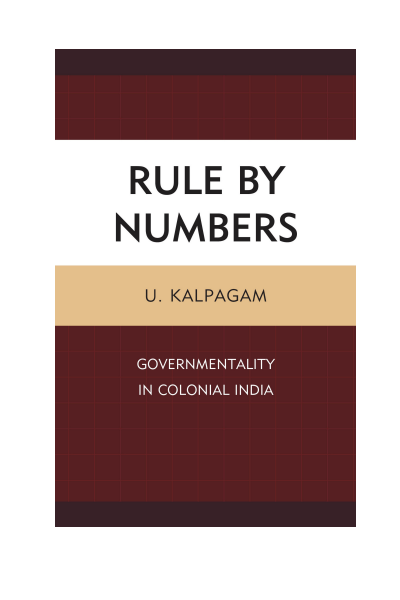
Rule by Numbers
Governmentality in Colonial India
Authors:
Publisher:
2014
Summary
This book examines aspects of the production of statistical knowledge as part of colonial governance in India using Foucault’s ideas of “governmentality.” The modern state is distinctive for its bureaucratic organization, official procedures, and accountability that in the colonial context of governing at a distance instituted a vast system of recordation bearing semblance to and yet differing markedly from the Victorian administrative state. The colonial rule of difference that shaped liberal governmentality introduced new categories of rule that were nested in the procedures and records and could be unraveled from the archive of colonial governance. Such an exercise is attempted here for certain key epistemic categories such as space, time, measurement, classification and causality that have enabled the constitution of modern knowledge and the social scientific discourses of “economy,” “society,” and “history.” The different chapters engage with how enumerative technologies of rule led to proliferating measurements and classifications as fields and objects came within the purview of modern governance rendering both statistical knowledge and also new ways of acting on objects and new discourses of governance and the nation. The postcolonial implications of colonial governmentality are examined with respect to both planning techniques for attainment of justice and the role of information in the constitution of neoliberal subjects.
Keywords
Search publication
Bibliographic data
Edition
1/2014
Copyright Year
2014
ISBN-Print
978-0-7391-8935-1
ISBN-Online
978-0-7391-8936-8
Publisher
Lexington, Lanham
Language
English
Pages
363
Product Type
Monograph
Table of contents
ChapterPages
Contents No access
Preface and Acknowledgments No access
Introduction No access Pages 1 - 26
Chapter One: Sovereignty and Governmentality No access Pages 27 - 82
Chapter Two: The Production of Space No access Pages 83 - 110
Chapter Three: Temporalities, Routines of Rule, and History No access Pages 111 - 136
Chapter Four: Colonial Governmentality and the “Economy” No access Pages 137 - 174
Chapter Five: Classification and Society No access Pages 175 - 222
Chapter Six: Bio-power and Statistical Causality No access Pages 223 - 260
Chapter Seven: Colonial Governmentality and the Public Sphere No access Pages 261 - 288
Conclusion No access Pages 289 - 310
Bibliography No access Pages 311 - 332
Name Index No access Pages 333 - 338
Subject Index No access Pages 339 - 362
About the Author No access Pages 363 - 363
Similar publications
from the topics "Soziologie allgemein"
Edited Book Full access
Karen Kastenhofer, Marius Albiez, Pauline Riousset, Constanze Scherz, Michael Decker