, to see if you have full access to this publication.
Monograph No access
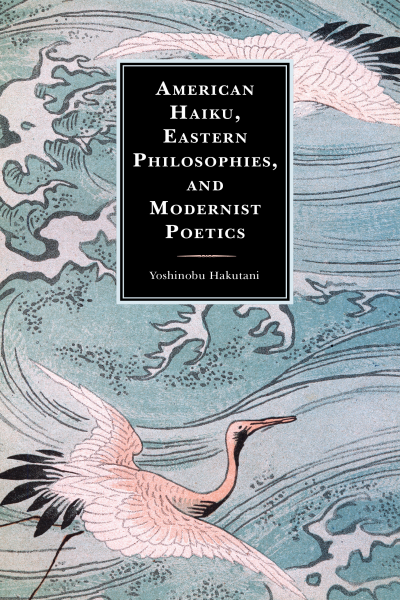
American Haiku, Eastern Philosophies, and Modernist Poetics
Authors:
Publisher:
2020
Summary
American Haiku, Eastern Philosophies, and Modernist Poetics traces the genesis and development of haiku in Japan as it transformed over the years and eventually made its way to the Western world. Yoshinobu Hakutani analyzes the prominent Eastern philosophies expressed through haiku, such as Confucianism and Zen, and the aesthetic principles of yugen, sabi, and wabi. Hakutani discusses several reinventions of haiku, from Matsuo Basho’s transformation of the classic haiku, to Masaoka Shiki’s modernist perspectives expressing subjective thoughts and feelings, and eventually to Yone Noguchi’s introduction of haiku to the Western world through W. B. Yeats and Ezra Pound. Hakutani argues that the adoption and transformation of haiku is one of the most popular East-West artistic, cultural, and literary exchanges to have taken place in modern and postmodern times.
Keywords
Search publication
Bibliographic data
Edition
1/2020
Copyright Year
2020
ISBN-Print
978-1-7936-3450-4
ISBN-Online
978-1-7936-3451-1
Publisher
Lexington, Lanham
Language
English
Pages
228
Product Type
Monograph
Table of contents
ChapterPages
Contents No access
Acknowledgments No access
Introduction No access Pages 1 - 16
Chapter 1 No access Pages 17 - 26
Chapter 2 No access Pages 27 - 44
Chapter 3 No access Pages 45 - 60
Chapter 4 No access Pages 61 - 82
Chapter 5 No access Pages 83 - 96
Chapter 6 No access Pages 97 - 110
Chapter 7 No access Pages 111 - 126
Chapter 8 No access Pages 127 - 138
Chapter 9 No access Pages 139 - 160
Chapter 10 No access Pages 161 - 180
Chapter 11 No access Pages 181 - 204
Bibliography No access Pages 205 - 210
Subject Index No access Pages 211 - 220
Index of Haiku and Poems No access Pages 221 - 226